
A seashell or sea shell, also known simply as a shell, is a hard, protective outer layer usually created by an animal or organism that lives in the sea. Most seashells are made by mollusks, such as snails, clams, and oysters to protect their soft insides. Empty seashells are often found washed up on beaches by beachcombers. The shells are empty because the animal has died and the soft parts have decomposed or been eaten by another organism.

Hermit crabs are anomuran decapod crustaceans of the superfamily Paguroidea that have adapted to occupy empty scavenged mollusc shells to protect their fragile exoskeletons. There are over 800 species of hermit crab, most of which possess an asymmetric abdomen concealed by a snug-fitting shell. Hermit crabs' soft (non-calcified) abdominal exoskeleton means they must occupy shelter produced by other organisms or risk being defenseless.
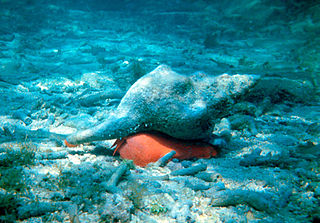
Triplofusus giganteus, commonly known as the Florida horse conch, or the giant horse conch, is a species of extremely large predatory subtropical and tropical sea snail, a marine gastropod mollusc in the family Fasciolariidae, the spindle snails, tulip snails and their allies. On average, it weighs over 11 pounds (5.0 kg).
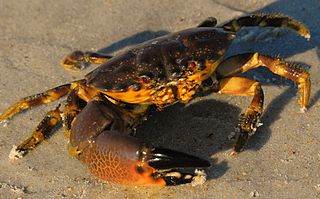
The Florida stone crab is a crab found in the western North Atlantic, from Connecticut to Colombia, including Texas, the Gulf of Mexico, Belize, Mexico, Jamaica, Cuba, The Bahamas, and the East Coast of the United States. The crab can also be found in and around the salt marshes of South Carolina and Georgia. It is widely caught for food. The closely related species Menippe adina is sometimes considered a subspecies – they can interbreed, forming hybrids – and they are treated as one species for commercial fishing, with their ranges partly overlapping. The two species are believed to have diverged approximately 3 million years ago.

Aliger gigas, originally known as Strombus gigas or more recently as Lobatus gigas, commonly known as the queen conch, is a species of large sea snail, a marine gastropod mollusc in the family of true conches, the Strombidae. This species is one of the largest molluscs native to the Caribbean Sea, and tropical northwestern Atlantic, from Bermuda to Brazil, reaching up to 35.2 centimetres (13.9 in) in shell length. A. gigas is closely related to the goliath conch, Lobatus goliath, a species endemic to Brazil, as well as the rooster conch, Aliger gallus.

Paguristes cadenati, the red reef hermit crab or scarlet hermit crab, is a small species of hermit crab with a bright red body and yellow eyestalks that lives in the Caribbean Sea. The specific name honours the French ichthyologist Jean Cadenat (1908-1992), who collected the type specimen and sent it to the French carcinologist Jacques Forest, who described it as a new species.
A molluscivore is a carnivorous animal that specialises in feeding on molluscs such as gastropods, bivalves, brachiopods and cephalopods. Known molluscivores include numerous predatory molluscs,, arthropods such as crabs and firefly larvae, and, vertebrates such as fish, birds and mammals. Molluscivory is performed in a variety ways with some animals highly adapted to this method of feeding behaviour. A similar behaviour, durophagy, describes the feeding of animals that consume hard-shelled or exoskeleton bearing organisms, such as corals, shelled molluscs, or crabs.
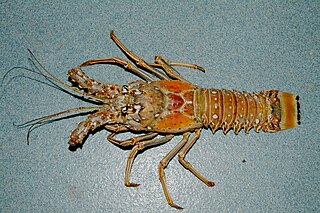
Panulirus argus, the Caribbean spiny lobster, is a species of spiny lobster that lives on reefs and in mangrove swamps in the western Atlantic Ocean.

Pagurus novizealandiae, or the New Zealand hermit crab is a hermit crab of the family Paguridae, endemic to New Zealand. Its body is up to 16 millimetres (0.63 in) wide.

Octopus cyanea, also known as the big blue octopus or day octopus, is an octopus in the family Octopodidae. It occurs in both the Pacific and Indian Oceans, from Hawaii to the eastern coast of Africa. O. cyanea grows to 16 cm in mantle length with arms to at least 80 cm. This octopus was described initially by the British zoologist John Edward Gray in 1849; the type specimen was collected off Australia and is at the Natural History Museum in London.

Melongena corona, common name the Florida crown conch, is a species of sea snail, a marine gastropod mollusk in the family Melongenidae, the crown conches and their allies.

Cerithium litteratum is a species of sea snail, a marine gastropod mollusk in the family Cerithiidae.

Macrostrombus costatus, formerly known as Strombus costatus and Lobatus costatus, or commonly known as the milk conch, is a species of large sea snail, a marine gastropod mollusk in the family Strombidae, the true conchs. They are an edible species and important food source for the inhabitants of where they are found. Conchs are most notable for their medium to large-sized ornamental shells. Milk conchs are dispersed among the tropical waters of the Atlantic Ocean, along the coasts and islands of North, Central, and South America.
Pseudospongosorites is a genus of sea sponges belonging to the family Suberitidae. Currently, the genus is considered as monotypic, consisting of a single species Pseudospongosorites suberitoides. It is found in the Caribbean Sea, the Gulf of Mexico and on the Atlantic coast of the United States as far north as North Carolina. This species is known by the common name Florida hermit crab sponge, so named because hermit crabs often use it as shelter.

Dardanus venosus, the starry-eyed crab or stareye crab, is a species of hermit crab in the family Diogenidae. It occurs in shallow water on the eastern coasts of America from Florida southward to Brazil. It is sometimes kept in reef aquaria.

Calliactis tricolor, the tricolor anemone or hitchhiking anemone, is a species of sea anemone in the family Hormathiidae. It occurs in the Caribbean Sea and the Gulf of Mexico. It can be found attached to rocks but is often attached to a living crab or mollusc or an empty shell occupied by a hermit crab.

The thinstripe hermit crab, Clibanarius vittatus, is a species of hermit crab in the family Diogenidae. It is found in the Caribbean Sea, the Gulf of Mexico and the western Atlantic Ocean.
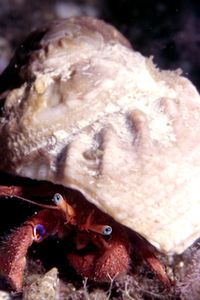
Paguristes eremita, the eye spot hermit crab, is a species of hermit crab in the family Diogenidae. It is found in the Mediterranean Sea.
Octopus maya, known colloquially as the Mexican four-eyed octopus, is a shallow water octopus that can be found in the tropical Western Atlantic Ocean. It is common to sea grass prairies and coral formations. The species was initially discovered in an octopus fishery in Campeche Mexico, where its close external resemblance to Octopus vulgaris led to its mistaken grouping with the other species. O. maya makes up 80% of octopus catch in the Yucatán Peninsula, while O. vulgaris makes up the remaining 20%.

Octopus tehuelchus, commonly known as the Patagonian octopus, is a species of octopus, a marine cephalopod mollusc of the order Octopoda. It is native to shallow waters in the subtropical southwestern Atlantic Ocean. It was first described in 1834 by the French naturalist Alcide d'Orbigny.


