
Bhaichung Bhutia, also spelled as Baichung Bhutia, is a former Indian professional footballer who played as a striker. Bhutia is considered the torchbearer of Indian football in the international arena. He is often nicknamed the Sikkimese Sniper because of his shooting skills in football. Three-time Indian Player of the Year I. M. Vijayan described Bhutia as "God's gift to Indian football". Bhaichung Bhutia has an older brother named Chewang Bhutia. Chewang and Bhaichung both went to boarding school. Bhutia has had four spells at I-League football team East Bengal Club, the club where he started his career. When he joined English club Bury in 1999, he became the first Indian footballer to sign a contract with a European club and only the second to play professionally in Europe, after Mohammed Salim. Afterwards he had a short loan spell at the Malaysian football club Perak FA. As well as this he has played for JCT Mills, which won the league once during his tenure; and Mohun Bagan, which failed to win the league once during his two spells, in his native India. His international footballing honours include winning the Nehru Cup, LG Cup, SAFF Championship three times and the AFC Challenge Cup. He is also India's second most capped player, with 82 international caps to his name. He is also India's second youngest international goal scorer after Jerry Zirsanga when he scored his first goal against Uzbekistan in 1995 Nehru cup at the age of 18 years 90 days.
The India national football team represents India in international football and is controlled by the All India Football Federation. Under the global jurisdiction of FIFA and governed in Asia by the AFC, the team is also part of the South Asian Football Federation. The team, which was once considered one of the best teams in Asia, had its golden era during the 1950s and early 1960s. During this period, under the coaching of Syed Abdul Rahim, India won gold during the 1951 and 1962 Asian Games, while finishing fourth at the 1956 Summer Olympics.

Dola Banerjee is an Indian sportswoman who competes in archery.

Hon. Captain Subedar Major Vijay Kumar Sharma AVSM, SM is a sport shooter from India. He won the silver medal in the individual 25 metre rapid fire pistol event at the 2012 Summer Olympics. Kumar hails from Barsar village of Hamirpur district of Himachal Pradesh and is a retired Subedar Major in the Dogra Regiment Indian Army. Vijay Kumar is supported by the Olympic Gold Quest initiative. He has been posted at Indian Army Marksmanship Unit (AMU) Mhow since 2003 where he is being coached by the Russian Pavel Smirnov.
Subimal Goswami, commonly known by his nickname Chuni Goswami, is a former Indian international footballer and first class cricketer. He was born in Kishoreganj District of undivided Bengal. As a striker, he played 50 international matches representing India. As a first class cricketer, he played Ranji Trophy for Bengal.
Magan Singh Rajvi is a former Indian football player. He hails from Indian state of Rajasthan. He was part of the Indian football team which won bronze medal at the 1970 Asian Games. He was also captained the Indian team in 1973 and 1974. He is one of the few and 6th hat trick scorer of India which he scored against Thailand on 23 July 1974 at 1974 Merdeka Cup.
Mullera Poovayya Ganesh is a former Indian professional field hockey player. He was also captain and coach of the Indian team. He was awarded the Arjuna Award in 1973.
Krishanu Dey was an Indian footballer from Kolkata, India. He was an attacking midfielder and was known as the "Indian Maradona" among his fans due to his footballing skills and playing style.1
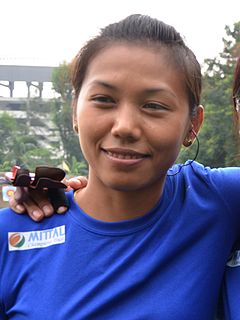
Bombayla Devi Laishram is an Indian archer. A member of the national recurve team representing India at the international events since 2007, she has won a silver medal at the World Archery Championships, and four gold, five silver, and four bronze medals at various editions of the Archery World Cup. Laishram peaked at no. 14 in the world rankings in March 2009.

Sushil Kumar Solanki is an Indian freestyle wrestler. He was competing in the 66 kg weight division when he won the 2010 world title, a silver medal at the 2012 London Olympics and a bronze medal at the 2008 Beijing Olympics, which made him the only Indian to win two individual Olympic medals. He carried the Indian flag at the opening ceremony of 2012 London Olympics.His08 Olympic medal was second for India in wrestling, and the first since Khashaba Dadasaheb Jadhav's bronze medal at the 1952 Summer Olympics. In July 2009, he received the Rajiv Gandhi Khel Ratna – India's highest honour for sportspersons. On 3 October 2010, Kumar handed the Queen's Baton to Prince Charles in the Queen's Baton Relay for the 2010 Commonwealth Games Opening Ceremony. Sushil won the gold medal in the 74 kg division at the 2014 Commonwealth Games.

Mangte Chungneijang Mary Kom is an Indian Olympic boxer and incumbent Member of Parliament, Rajya Sabha. She is the only woman to become World Amateur Boxing champion for a record six times, the only woman boxer to have won a medal in each one of the first seven World Championships, and the only boxer to win eight World Championship medals. Nicknamed Magnificent Mary, she is the only Indian woman boxer to have qualified for the 2012 Summer Olympics, competing in the flyweight (51 kg) category and winning the bronze medal. She had also been ranked as No. 1 AIBA World Women's Ranking Light Flyweight category. She became the first Indian woman boxer to get a Gold Medal in the Asian Games in 2014 at Incheon, South Korea and is the first Indian woman boxer to win gold at the 2018 Commonwealth Games. She is also the only boxer to become Asian Amateur Boxing Champion for record five times.
Peter Thangaraj was an Indian football player. Thangaraj played for the Indian national side at the 1956 Melbourne and 1960 Rome Olympics. He was voted Asia’s best goalkeeper in 1958. Thangaraj was a recipient of Arjuna Award for the year 1967.

Rahul Banerjee is an Indian Olympic archer.
Hockey India is now the governing body with exclusive mandate to direct and conduct all activities for both men and women's hockey in India. It is recognized by the Ministry of Youth Affairs & Sports, Govt. of India as the sole body responsible towards promoting Hockey in India. It was formed after Indian Hockey Federation was dismissed in 2008 by IOA.
The history of the India national football team dates back to the 1920s. They have never played in the World Cup although they qualified in 1950. They have had no entries in the tournament from 1950 onwards. India have never won the final of the Asian Championship but managed their best ever finish by making it to the final in the 1964 AFC Asian Cup. They have only made three appearances since then
Shabbir Ali, is an Indian association football manager and former player.
The national Indian governing body of archery as a sport in India is the Archery Association of India.

Prasun Banerjee is a retired international footballer and an Arjuna Award Winner (1979) from Kolkata, India. Younger brother of the Pradip Kumar Banerjee, Prasun had also captained the India national football team in international tournaments.

Football is one of the most popular sports in Kolkata, West Bengal.. Mohun Bagan, East Bengal and Mohammedan is the heart of Kolkata football. Kolkata is known to be the hub of Indian football with the two most supported teams in the country being based within the city – Mohun Bagan and East Bengal. Both teams play against each other in the Kolkata derby. The city is also home to the biggest stadium in India, the Vivekananda Yuba Bharati Krirangan, which as of 2015 has a capacity of 85,000. The record attendance of 131,000 came in a match between the said two teams in the semifinal of the 1997 Federation Cup.


