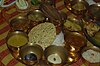
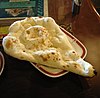
Ethiopian cuisine characteristically consists of vegetable and often very spicy meat dishes. This is usually in the form of wat, a thick stew, served on top of injera, a large sourdough flatbread, which is about 50 centimeters in diameter and made out of fermented teff flour. Ethiopians usually eat with their right hands, using pieces of injera to pick up bites of entrées and side dishes.

Malay cuisine is the traditional food of the ethnic Malays of Southeast Asia, residing in modern-day Malaysia, Indonesia, Singapore, Brunei, Southern Thailand and the Philippines as well as Cocos Islands, Christmas Island, Sri Lanka and South Africa.

Vada pav, alternatively spelt wada pao, is a vegetarian fast food dish native to the Indian state of Maharashtra. The dish consists of a deep fried potato dumpling placed inside a bread bun (pav) sliced almost in half through the middle. It is generally accompanied with one or more chutneys and a green chili pepper. Although it originated as an affordable street food in Mumbai, it is now served in food stalls and restaurants across India. It is also called Bombay burger in keeping with its origins and its resemblance in physical form to a burger.

Raita is a side dish in Indian cuisine made of dahi together with raw or cooked vegetables, more seldom fruit, or in the case of boondi raita, with fried droplets of batter made from besan.

Chaat, or chāt is a family of savoury snacks that originated in India, typically served as an hors d'oeuvre or at roadside tracks from stalls or food carts across South Asia in India, Pakistan, Nepal and Bangladesh. With its origins in Uttar Pradesh, India, chaat has become immensely popular in the rest of South Asia.
Maharashtrian or Marathicuisine is the cuisine of the Marathi people from the Indian state of Maharashtra. It has distinctive attributes, while sharing much with other Indian cuisines. Traditionally, Maharashtrians have considered their food to be more austere than others.
The fast food industry in India has evolved with the changing lifestyles of the young Indian population. The variety of gastronomic preferences across the regions, hereditary or acquired, has brought about different modules across the country.

Chicken feet are cooked and eaten in many countries. After an outer layer of hard skin is removed, most of the edible tissue on the feet consists of skin and tendons, with no muscle. This gives the feet a distinct gelatinous texture different from the rest of the chicken meat.

Peanut sauce, satay sauce, bumbu kacang, sambal kacang, or pecel is an Indonesian sauce made from ground roasted or fried peanuts, widely used in Indonesian cuisine and many other dishes throughout the world.

Tteokbokki (Korean: 떡볶이), or simmered rice cake, is a popular Korean food made from small-sized garae-tteok called tteokmyeon or commonly tteokbokki-tteok. Eomuk, boiled eggs, and scallions are some common ingredients paired with tteokbokki in dishes. It can be seasoned with either spicy gochujang or non-spicy ganjang -based sauce; the former is the most common form, while the latter is less common and sometimes called gungjung-tteokbokki.

Fried plantain is a dish cooked wherever plantains grow, from West Africa to East Africa as well as Central America, the tropical region of northern South America and the Caribbean countries like Haiti to Cuba and in many parts of Southeast Asia and Oceania, where fried snacks are widely popular. In Indonesia it is called gorengan. It is called ojoko in Igbo in South East Nigeria, and dodo in Yoruba in South West Nigeria, otherwise known as simply fried plantain in other parts of Nigeria. Kelewele is a fried spicy plantain or can be fried as a side dish for Red Red and fish stew in Ghana.

Javanese cuisine is the cuisine of Javanese people, a major ethnic group in Indonesia, more precisely the province of Central Java, Yogyakarta and East Java.

Misal, is a very popular spicy dish in the Western Indian state of Maharashtra. The dish is mostly eaten for breakfast or as a midday snack or sometimes as a one-dish meal, often as part of misal pav. It remains a favourite snack since it is easy to make with affordable ingredients and has a good nutritional value. The taste of misal ranges from mildly to extremely spicy. And there are a lot of varieties as well. Misal is also a popular street food. The dish is always served hot.
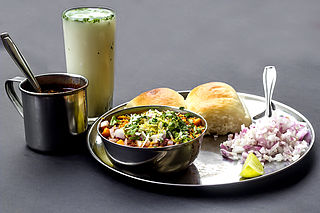
Misal pav is a dish from the Indian state of Maharashtra. It consists of misal and pav. The final dish is topped with farsan or sev, onions, lemon and coriander (cilantro). It is usually served hot with bread or rolls toasted with butter and buttermilk or dahi and papad. It is served as a breakfast dish, as a snack and also as a full meal.

Ivorian cuisine is the traditional cuisine of Côte d'Ivoire, or the Ivory Coast, and is based on tubers, grains, pig, chicken, seafood, fish, fresh fruits, vegetables and spices. It is very similar to that of neighboring countries in West Africa. Common staple foods include grains and tubers. Côte d'Ivoire is one of the largest cocoa producers in the world and also produces palm oil and coffee.

Malaysian Indian cuisine, or the cooking of the ethnic Indian communities in Malaysia, consists of adaptations of authentic dishes from India, as well as original creations inspired by the diverse food culture of Malaysia. Because the vast majority of Malaysia's Indian community are of South Indian descent, and are mostly ethnic Tamils who are descendants of immigrants from a historical region which consists of the modern Indian state of Tamil Nadu and Sri Lanka's Northern Province, much of Malaysian Indian cuisine is predominantly South Indian inspired in character and taste. A typical Malaysian Indian dish is likely to be redolent with curry leaves, whole and powdered spice, and contains fresh coconut in various forms. Ghee is still widely used for cooking, although vegetable oils and refined palm oils are now commonplace in home kitchens. Before a meal it is customary to wash hands as cutlery is often not used while eating, with the exception of a serving spoon for each respective dish.

Street food of Mumbai is the food sold by hawkers from portable market stalls in Mumbai. It is one of the characteristics of the city. The city is known for its distinctive street foods. Although street food is common all over India, street food in Mumbai is noted because people from all economic classes eat on the roadside almost round the clock and it is sometimes felt that the taste of street food is better than restaurants in the city. Many Mumbaikars like a small snack on the road in the evening. People of Mumbai cutting across barriers of class, religion, gender and ethnicity are passionate about street food. Street food vendors are credited by some for developing the city's food culture. Street food in Mumbai is relatively inexpensive as compared to restaurants and vendors tend to be clustered around crowded areas such as colleges and railway stations.

Street food, as in other areas of India, are popular in Chennai, despite the common belief in India that street food is unhealthy. The idly sambhar is a popular dish, which is served as breakfast or dinner. Apart from regular South Indian street food, the city's streets are also filled with several North Indian street food outlets, most of them established by North Indian migrants themselves. Gujarati and Burmese are also available. Street food in Chennai is so popular that a game had developed based on the TV show The Amazing Race where contestants have to follow clues to street-food spots in the city.
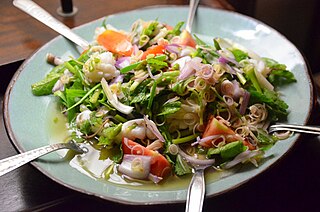
Salads that are internationally known as Thai salads with a few exceptions fall into four main preparation methods. In Thai cuisine these are called yam, tam, lap and phla. A few other dishes can also be regarded as being a salad.

Vada or Vadai is a category of savoury fried snacks native to India. Vadas can be described variously as fritters, cutlets, or dumplings. Alternative names for this food include vadai, vade, and bada. Vadas are sometimes stuffed with vegetables and traditionally served with chutneys and sambar.