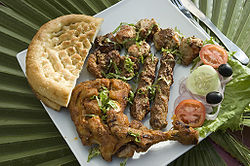
Biryani is a mixed rice dish originating in South Asia, traditionally made with rice, meat (chicken, goat, beef) or seafood (prawns or fish), vegetables, and spices. It was present in Mughal-era India, though the precise date and place of origin are debated.[1] It is thought to derive from a Persian rice dish, either pilau or birinj biryan.[1][2][3] The dish makes use of slow-cooking as in Persian pilau, combined with Persian-style yoghurt-marinated meat and a spicy Indian style of cooking; it was likely developed in the Mughal court kitchens.[1] It is also possible that biryani was brought to South India before the Mughal era, or that pilau was brought to India and biryani was developed from it before being adopted by the Mughals.
Biryani is one of the most popular dishes in South Asia and among the South Asian diaspora. The dish is often associated with the region's Muslim population. Similar dishes are prepared in many other countries, often with local variations, and often brought there by South Asian diaspora populations. Biryani is the most-ordered dish on Indian online food ordering and delivery services, is used in weddings and celebrations throughout the region, and has been described as the most popular dish in India.
A modern Persian pilau, havij polo (Persian: هویج پلو, "carrot rice") with rice grains cooked to remain separate and in different colours. Pilau may be an ancestor of biryani.
Pilau (Persian: پلو 'plo', "rice") is a Persian rice dish, attested by the polymath and physician Avicenna in 10th century Persia.[10]
The Mughal text Ain-i-Akbari (written 1589–1596[11]), from the time of the emperor Akbar, mentions both pilau and biryani, listing ingredients with required quantities for each:[12]
Secondly, [dishes] in which meat and rice, &c., are used ... 2. Duzdbiryán. 10 s[eer] rice, 3½ s. g'hí; 10 s. meat; ½ s. salt: this gives five dishes. 3. Qimah Paláo. Rice and meat as in the preceding; 4 s. g'hí; 1 s. peeled gram; 2 s. onions; ½ s. salt; ¼ s. fresh ginger, and pepper; cuminseed, cardamums and cloves, 1 d[han]. of each: this gives five dishes.[a][12]
The Ain-i-Akbari further names a dish of spiced mutton as a biryani, this time without mentioning rice:
Thirdly, meats with spices... Biryán. For a whole Dashmandi sheep, take 2 s[eer] salt; 1 s[eer] g'hí; 2 m[āshā] saffron, cloves, pepper, cuminseed: it is made in various ways."[a][12]
The Portuguese priest Sebastien Manrique described rice dishes on sale in the tent-city of the next Mughal emperor Shah Jahan as he travelled to Lahore in 1641. Manrique distinguished "Persian" pilau from "Mogol" biryani:
Among these dishes the principal and most substantial were the rich and aromatic Mogol Bringes [biryanis][b] and Persian pilaos of different hues".[14]
The dish is mentioned, too, in letters of the emperor Aurangzeb to his son.[15] For example:
Exalted son, I remember the savour of your 'khichidi' and 'biryani' during the winter. Truly the 'kabuli' cooked by Islam Khan does not surpass them (in point of relish and savour). I wanted to have from you (in my service) Saliman, who cooks 'biryani'; but you did not allow him to serve as my cook. If you happen to find a pupil of his, skilful in the art of cookery, you will send him to me.[17][18]
According to the historian Rana Safvi, the earliest actual recipe is from the later Mughal period, from Bahadur Shah Zafar's time.[16]
The historian of food Lizzie Collingham writes that the modern biryani developed in India (Hindustan) in the royal kitchens of the Mughal Empire, specifically during the rule of the emperor Akbar (1556–1605), and is a mix of the native spicy rice dishes of South Asia, Persian yoghurt-marinated meat, and the Persian pilau style of garnished rice.[1] Collingham writes that "in the kitchens [of the Mughal court]... the delicately flavoured Persian pilau met the pungent and spicy rice dishes of Hindustan to create the classic Mughlai dish, biryani".[1]
The cookery writer Pratibha Karan states that biryani is of Indian origin, derived from pilau which Muslim traders and invaders brought with them. She speculates that pilau was an army dish in medieval India. Armies would prepare a one-pot dish of rice with any available red meat. Over time, the dish became biryani due to different methods of cooking.[9][13]
In the view of the historian of Islamic cuisine Salma Hussein[3] and others, biryani came to South Asia from Persia before the Mughal era,[13] most probably arriving in South India's Deccan region, brought by travelling soldier-statesmen and pilgrims.[3] It has also been suggested that the dish was introduced from Persia by the Mughals.[19] Another variant theory, that biryani came to India with Timur's invasion, appears to be incorrect because there is no record of biryani having existed in his native region of Central Asia during that period.[13]
The historian of food K. T. Achaya states that pilau is "of older usage in India" than biryani, indicating that it could have been a precursor of biryani.[2] Achaya notes that ancient and early medieval Indian texts described rice cooked with meat and spices, suggesting that composite rice dishes were part of the subcontinent’s cuisine long before the Mughal period.[20]He further references early Tamil literature from the Sangam era (circa 300 BCE–300 CE), describing a dish known in these sources as ūn sōru—rice cooked with meat, ghee, and spices—which bears structural similarities to later layered rice preparations.[21]
The translator and cookery author Colleen Taylor Sen argues that layered rice dishes developed in India through a gradual process of culinary refinement, particularly in regional courts and aristocratic households. According to Sen, while Indo-Islamic courts contributed to the dish's elaboration, the adaptation of local rice varieties, indigenous spices, and region-specific cooking methods suggest a strong Indian foundation in its evolution.[22][pageneeded]
Biryani evidently has some connection with Persia, but commentators disagree on what that might be. Pilau is certainly a Persian dish, attested by Avicenna in 10th century Persia; Birinj biryan is a Persian phrase meaning "fried rice". The Mughals had biryani by the reign of Akbar in the 16th century, attested in the Ain-i-Akbari.
Evidence: 1: folk theory 2: Kris Dhillon 3: Salma Hussein 4,5: Pratibha Karan 6: Lizzie Collingham 7: Colleen Sen
Ingredients for biryani vary according to the region and the type of meat and vegetables used. Meat (chicken, goat, beef[23]) is the prime ingredient with rice. Seafood (fish, prawns) and vegetables are sometimes added. Navratan biryani tends to use sweeter, richer ingredients such as cashews, sultanas (kishmish), and fruits such as apple and pineapple.[24]
Biryani may be served with side dishes such as raita (yoghurt with cucumber, tomato, etc), fried or curried aubergine (brinjal), salad, or a curried side such as ande ka salan (with boiled eggs)[27] or mirchi ka salan (with chili peppers).[28]
Dietary variations include adding eggs, potatoes, and substituting meat with paneer or vegetables, especially in Hindu or non-religious vegetarian variants.[29] Kolkata biryani, invented by Wajid Ali Shah in the 1850s, includes potato.[30]
Biryani can be cooked using one of two techniques, pakki ("cooked") and kacchi ("raw").[31] In a pakki biryani, the ingredients are cooked separately (at least in part) and then arranged in layers. The different layers can be individually coloured and flavoured with a brightly-coloured spice such as turmeric or saffron.[31] In a kacchi biryani, layers are arranged in a pot which is then sealed and cooked slowly (Dum cooking) for the food to steam in its own liquid.[31]
The British-era author Abdul Halim Sharar mentions that biryani has a stronger curried taste due to a greater amount of spices.[32][34] According to Delhi-based historian Sohail Hashmi, pilau tends to be plainer than biryani, and consists of meat or vegetables cooked with rice with the bottom layered with potatoes or onions. Biryani contains more gravy, and is often cooked longer, leaving the meat (and vegetables, if present) more tender, and the rice more flavoured. Biryani is cooked with additional dressings and often has a light layer of scorched rice at the bottom.[24]
The cookery author Pratibha Karan states that while the terms are often applied arbitrarily, the main distinction is that a biryani consists of two layers of rice with a layer of meat (and vegetables, if present) in the middle, while the pilau is not layered. Further, in modern usage, biryani is the primary dish in a meal, while pilau is usually a secondary accompaniment to a larger meal; and biryanis have more complex and stronger spices than pilaus.[13]
Hyderabadi egg biryani served with mirchi ka salan, raita and salad
There are many types of biryani in the Indian subcontinent. Biryani is the single most-ordered dish in Indian online food ordering and delivery services, and has been described as the most popular dish in India.[35][36] The names of variants are often based on their region or city of origin. Some have taken the name of the shop that sells it, as in Fakhruddin Biriyani in Dhaka,[37][38] Students biryani in Karachi, Lucky biryani in Bandra, Mumbai and Baghdadi biryani in Colaba, Mumbai.[24]Biryanis are often specific to the Muslim communities where they originate; they are usually the defining dishes of those communities.[39][40]
In 2009, the Deccani Biryani Makers Association submitted 'Hyderabadi Biryani' for a geographical indication, but the attempt failed as they were unable to provide documentary evidence of its historical origin.[41]
Outside the Indian subcontinent
Burmese biryani (danpauk)
Varieties of biryani have arisen in many countries,[42] and was often spread to such places by South Asian diaspora populations.[43] For example in Myanmar, danpauk (ဒံပေါက်) is a mainstay at festive events such as weddings.[44][45] On the Persian Gulf, biryani (Persian: برياني) is usually saffron-based with chicken,[46] while in Indonesia nasi kebuli is an spicy steamed rice dish[47] cooked in goat meat broth, milk and ghee.[48] In Thailand the dish is known as khao mhok (Thai: ข้าวหมก), using chicken, beef or fish, topped with fried garlic and served with a green sour sauce.[49]
In culture
Biryani forms "the centrepiece of countless Indian holidays and weddings".[50] In Bangladesh, kacchi biryani with mutton has been described as "the quintessential wedding dish"[51] of Old Dhaka, largely replacing the murg (chicken) pulao that was favoured in the 20th century[51] for special occasions across the subcontinent.[1] In Delhi, the Muslim festival of Bakr Eid was marked by biryani at dinner, using the mutton from the goats slaughtered in memory of the prophet Abraham, who had shown he was willing even to sacrifice his own son.[50]
Biryani is used across the Indian Subcontinent in celebrations. Annual biryani festivals have been held in cities such as Ambur,[52]Islamabad[53] and Karachi.[54] South Asian diaspora populations have held their own festivals, for example by the North American Indian Muslim Association in North America.[55] Biryani festivals have been held more widely in places such as Singapore[56] and Qatar.[57][58]
12A seer was a measure of weight, varying by region, but around 1 kg; a māshā was around 2 grams; and a dhan was around 50 milligrams (the weight of one wheat berry).
123Ravish Kumar interviews historian Sohali Hashmi (9 September 2016). प्राइम टाइम: क्या-क्या अलग करेंगे बिरयानी से?[Prime Time: What will separate from Biryani?] (Television production) (in Hindi). Old Delhi: NDTV. Retrieved 19 October 2016.
This page is based on this Wikipedia article Text is available under the CC BY-SA 4.0 license; additional terms may apply. Images, videos and audio are available under their respective licenses.