Veeraswamy is an Indian restaurant in London, at 99–101 Regent Street. It was opened in 1926 by Edward Palmer, a retired Anglo-Indian officer in the British Indian Army. By 2006, it had become the oldest surviving Indian restaurant in the United Kingdom. In 2016, Veeraswamy was awarded a Michelin star.
Palmer's first company, E.P. Veeraswamy & Co., was founded in 1896 as a food ingredients business, not a restaurant, selling Indian foods under the trademark 'Nizam'. In 1924, Palmer advised the restaurant in the Indian Government Pavilion at the British Empire Exhibition in Wembley Park, Middlesex. This led to the founding of the restaurant.
Edward Palmer was a retired Anglo-Indian officer in the British Indian Army, the grandson of an English general and an Indian princess,[4][5] Begum Fyze Baksh; a portrait of the family was made by Johann Zoffany.[6] He initially used the name E. P. Veerasawmy (his grandmother's family name) for his food business (selling Indian ingredients) and cookery book; it became Veeraswamy because of a printing error.[7]
Palmer had considerable knowledge of Indian food, and lectured on the subject. He founded his food ingredients business E. P. Veeraswamy & Co. in Hornsey in 1896 to promote Indian foods "so that they could be used under Western conditions and yet produce Eastern results". He sold them under the trademark 'Nizam'.[8] In 1915 Veeraswamy published a recipe book, Indian Cookery for Use in All Countries; it remained in print into the 21st century.[9][10][11]
In 1924 Palmer was engaged to advise the restaurant in the Indian Government Pavilion at the British Empire Exhibition in Wembley Park, Middlesex.[13] Palmer estimated the restaurant was producing around 500 curries a day at that time.[14][15][16] In 1936, Palmer was brought in by the British Army to teach its cooks how to make curries.[17]
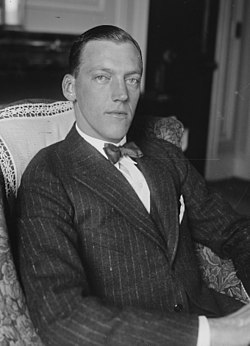
The custom of drinking lager with Indian food may be related to Prince Axel of Denmark's visit to the Veeraswamy-connected Indian restaurant at the British Empire Exhibition on 2 May 1924. He enjoyed his meal and later visited the Regent Street restaurant, apparently bringing a barrel of Carlsberg lager with him. He enjoyed his meal again, and decided to send a barrel of Carlsberg (the Danish royal beer) to the restaurant every year thereafter. The beer proved popular, so the restaurant started importing Carlsberg, and when waiters left to found or work in other Indian restaurants, they served Carlsberg as well.[12][18] The historian of food Lizzie Collingham comments however that the British had noticed how well beer went with curry as early as 1810.[19]
The restaurant was taken over by Sir William Steward in 1934.[24] In 1947, the restaurant's menu described some of its offerings, such as a vegetable curry, tarkari ki salan, as "Indian fare".[2] The food on offer became recognisably more like British Indian restaurant fare in the following years. The menu had acquired dishes such as vindaloo, korma, and poppadums by 1952. Tandoori chicken was on the menu by 1959,[2] once Steward had obtained Britain's first tandoor oven for the restaurant.[24][2] By the end of the 20th century, as customers sought more authentic Indian food, Veeraswamy served a menu of regional Indian cuisine, including dishes from Punjab and Kashmir.[7]
Interior of the restaurant in 2010, back in 1920s style
The restaurant decor was updated repeatedly, with an ultramodern theme in the late 1990s; however, for its 80th anniversary in 2006, it was redecorated in a 1920s motif. Veeraswamy was acquired by the Chutney Mary group in 1997, placing it under the ownership of Ranjit Mathrani and Namitha Panjabi.[4][25]
In 2016 Veeraswamy was awarded a Michelin star.[2] The Michelin Guide said that it "may have opened in 1926, but the kitchen continues to produce wonderfully authentic and satisfying dishes after all these years. You can expect to find cuisine from all parts of India, including cleverly enhanced street snacks and stand-out dishes inspired by royal recipes. Top quality British produce is often used, such as Welsh lamb for the Kashmiri rogan josh. The room is awash with colour and is run with charm and obvious pride".[27]
Threat of closure, 2025
In 2025, the restaurant was facing closure because the Crown Estate, owner of Victory House, the grade 2 listed building housing Veeraswamy, did not intend to extend Veeraswamy's lease as they planned to refurbish and upgrade offices in the building.[28][2] The lease was set to cease at the end of June 2025, but the restaurant owner initiated legal proceedings against the Crown Estate, allowing the company to continue trading.[29] In November 2025, the restaurant's owner, MW Eat, was acquired by Fairfax Financial Holdings.[1]
Reception
In 2001, the London evening newspaper The Standard wrote that Veeraswamy had "the most ambitious dishes, the highest level of culinary excellence, and the most modern décor".[7] The review stated that the restaurant had from its foundation been "wildly successful", with a "celebrity clientele until the 1960s".[7] It found the food authentic and "unusually sophisticated", with dishes such as the "spot on" tandoor-baked swordfish with cumin, turmeric, and lemon, or the "awesomely good" achaar gosht with hot chilli and a rich creamy sauce.[7]
In 2016, Diplomat Magazine called the venison mutta kebab, a dish like a scotch egg made with venison and quail with a tamarind glaze, "a triumph".[30] The Kashmiri rogan josh was "an intensely aromatic curry" and "a firm favourite", while the Kerala prawn curry was "possibly the best curry I have ever tasted".[30]
In 2024, City A.M. tried "all" Veeraswamy's starters, admiring the raj kachori, which combined pomegranate, cream, and "spiced potato innards" and a "gently sweet, moreish chutney". It found the dining room both "cosy" and like "a state room at an Indian Mahal", with extremely friendly staff.[31]
Many early 20th century British Indian restaurants followed Veeraswamy's palatial style of decoration.[32] The San Francisco Indian restaurant India House, founded in 1947 and noted in many guidebooks, was run by a British couple, David and Patricia Brown, who had studied Indian cuisine in England and India; they brought some of Veeraswamy's recipes to America with them.[33]
↑Vijayaraghavacharya, T. (1925). The British Empire Exhibition, 1924. Report by the Commissioner for India for the British Empire Exhibition. Calcutta: Government of India.
This page is based on this Wikipedia article Text is available under the CC BY-SA 4.0 license; additional terms may apply. Images, videos and audio are available under their respective licenses.


 (Michelin Guide 2022) [2]