The Asian crimson-winged finch is a pale-colored thickset finch with a heavy, dull yellowish bill. It is found from Turkey to NE Pakistan. The African crimson-winged finch was formerly considered conspecific and together known as the crimson-winged finch. It has an average length of 13 centimetres (5.1 in) and a wingspan of ca. 32 centimetres (13 in). It is light brown overall, with a whitish mid-belly, a black cap and a pinkish pattern on the wings and tail. The female is slightly duller than the male.
The purple-red earth snake is a species of nonvenomous shield tail snake, endemic to southern India. No subspecies are currently recognized.
The arrowtooth lizardfish is a lizardfish of the family Synodontidae, found in isolate locations across the southwestern Pacific, at depths of between 9 and 200 m. Its length is between 15 and 28 cm.
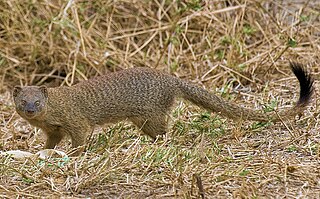
The common slender mongoose, also known as the black-tipped mongoose or the black-tailed mongoose, is a very common mongoose species native to sub-Saharan Africa.
The Namaqua slender mongoose, also known as the Namibian slender mongoose, is a subspecies of the common slender mongoose. It is endemic to Namibia. Originally described as Herpestes cauui swalius and considered separate from H. sanguineus on the basis and color and skull shape, it was provisionally placed in H. sanguineus but considered to possibly be a distinct species. The characters used to distinguish them were later found to be non-diagnostic.

The crimson seedcracker is a common species of estrildid finch found in Africa. It has an estimated global extent of occurrence of 834,000 km2 (322,000 sq mi). It is found in Burkina Faso, Côte d'Ivoire, Gambia, Guinea, Guinea-Bissau, Liberia, Mali, Senegal and Sierra Leone. The International Union for Conservation of Nature has classified the species as being of least concern.

Hemigrapsus sanguineus, the Japanese shore crab or Asian shore crab, is a species of crab from East Asia. It has been introduced to several other regions, and is now an invasive species in North America and Europe. It was introduced to these regions by ships from Asia emptying their ballast tanks in coastal waters.
Pristimantis sanguineus is a species of frog in the family Strabomantidae. It is endemic to Colombia. Its natural habitats are tropical moist lowland forests, moist montane forests, and rivers. It is threatened by habitat loss.

The red satinbird, commonly known as antenna satinbird or crested cnemophilus and formerly known as the sickle-crested bird-of-paradise, is a subspecies of bird in the family Cnemophilidae. It was formerly placed in the bird-of-paradise family Paradisaeidae until genetic work proved it was unrelated to those birds. It is found in the Bird's Tail Peninsula, Papua New Guinea.

The stripe-billed aracari or stripe-billed araçari is a near-passerine bird in the toucan family Ramphastidae. It is found in Colombia, Ecuador, and Panama.

The blood-colored woodpecker is a species of bird in subfamily Picinae of the woodpecker family Picidae. It is found in Guyana and Suriname.

Herpestes is a genus within the mongoose family Herpestidae. Several species in the family are known as slender mongooses. It is the type genus of the family, and comprises 5-6 living species, each with several subspecies. Fossil remains of three prehistoric species were excavated in France, and described in 1853.
Onychodiaptomus is a genus of copepods in the family Diaptomidae, containing the following species:
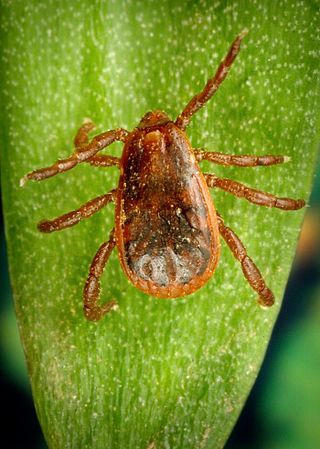
Rhipicephalus sanguineus, commonly called the brown dog tick, kennel tick, or pantropical dog tick, is a species of tick found worldwide, but more commonly in warmer climates. This species is unusual among ticks in that its entire lifecycle can be completed indoors. The brown dog tick is easily recognized by its reddish-brown color, elongated body shape, and hexagonal basis capituli. Adults are 2.28 to 3.18 mm in length and 1.11 to 1.68 mm in width. They do not have ornamentation on their backs.

The African crimson-winged finch is a pale-colored thickset finch with a heavy, dull yellowish bill. It is found in the Atlas Mountains of Morocco and Algeria. It was formerly considered a subspecies of the Asian crimson-winged finch. It has an average length of 13 cm (5.1 in) and a wingspan of ca. 32 cm (13 in). It is light brown overall, with a whitish mid-belly, a black cap and a pinkish pattern on the wings and tail. The female is slightly duller than the male.

Abantennarius sanguineus, the bloody frogfish or sanguine frogfish, is a species of marine ray-finned fish belonging to the family Antennariidae, the frogfishes. The sanguine frogfish is found in the eastern Pacific Ocean.
Cirrhilabrus sanguineus, the red-blotched fairy-wrasse, is a species of wrasse native to the coral reefs of the Mauritius. This species can reach a standard length of 6.7 cm (2.6 in). It occurs at depths from 40 to 60 m. It can be found in the aquarium trade.
Atractus sanguineus, the bloody ground snake, is a species of snake in the family Colubridae. The species can be found in Colombia.

Bodianus sanguineus, the sunrise wrasse, is a species of wrasse found in Hawaii.

Lygistopterus sanguineus is a species of net-winged beetle in the family Lycidae.