The Fox Theatre is a performing arts center located at 2211 Woodward Avenue in Downtown Detroit, Michigan, near the Grand Circus Park Historic District. Opened in 1928 as a flagship movie palace in the Fox Theatres chain, it was at over 5,000 seats the largest theater in the city. Designed by theater architect C. Howard Crane, it was listed on the National Register of Historic Places in 1985.
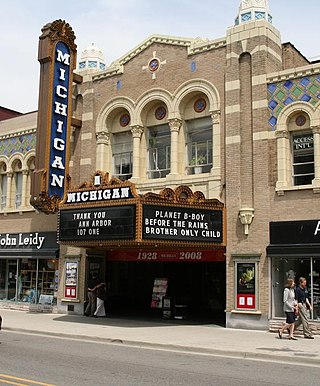
The Michigan Theater is a movie palace in Ann Arbor, Michigan, United States, near the Central Campus of the University of Michigan. It shows independent films and stage productions, and hosts musical concerts.

The Chicago Theatre, originally known as the Balaban and Katz Chicago Theatre, is a landmark theater located on North State Street in the Loop area of Chicago, Illinois. Built in 1921, the Chicago Theatre was the flagship for the Balaban and Katz (B&K) group of theaters run by A. J. Balaban, his brother Barney Balaban and partner Sam Katz. Along with the other B&K theaters, from 1925 to 1945 the Chicago Theatre was a dominant movie theater enterprise. Currently, Madison Square Garden, Inc. owns and operates the Chicago Theatre as a 3600 seat performing arts venue for stage plays, magic shows, comedy, speeches, sporting events and popular music concerts.

The Maryland Theatre is a music and entertainment venue located in the Arts and Entertainment District of downtown Hagerstown, Maryland. It was built in 1915, partially destroyed by fire in 1974, reopened in 1978, and expanded into a full performing arts complex in 2019. The theatre's seating capacity is 1,279 people, and it hosts performances of symphony orchestras, country artists, comedians, children's shows, pop stars, recitals, stage shows, and others. Over 81,000 patrons attended performances at the Maryland Theatre in 2005, making it one of Maryland's premier venues for the performing arts. The Maryland Symphony Orchestra performs there regularly and has been headquartered in the building since 2019. The theater features a fully restored Wurlitzer theatre organ.

Proctor's Theatre is a theatre and former vaudeville house located in Schenectady, New York, United States. Many famous artists have performed there, including Mariah Carey, Britney Spears, Hal Holbrook, Ted Wiles, and George Burns, as well as many others. It has one of the largest movie screens in the Northeast.
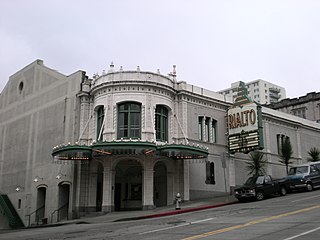
The Rialto Theatre in Tacoma, Washington was built in 1918 to showcase movies. Its design reflects the affluence following World War I. It reflects the character of a palace and is the result of efforts by entrepreneur Henry T. Moore and Tacoma architect Roland E. Borhek. Designed to hold 1500 patrons and retail space. The two-and-a-half-story structure is in the historic downtown of Tacoma. The area has long been associated with theaters and entertainment. The theater is freestanding, with a dramatic view on an incline with a classical façade sheathed of glazed white terra cotta. Both the interior and exterior retain most of the original design of Roland E. Borhek. The theater has an auditorium, proscenium with stage, a relocated projection booth, balcony, lobby, and commercial space. It has been altered with the removal of the storefronts and marquee. On the inside, the lobby's decorative ceiling has been hidden and the concession areas expanded.

The Standard Theatre, now known as the Folly Theater and also known as the Century Theater and Shubert's Missouri, is a former vaudeville hall in downtown Kansas City, Missouri. Built in 1900, it was designed by Kansas City architect Louis S. Curtiss. The theater was associated with the adjoining Edward Hotel, which was also designed by Curtiss; the hotel was demolished in 1965.

The Webster Congregational Church is a historic Congregational church off NH 127 on Long Street in Webster, New Hampshire, United States. The church was built in 1823 by George Pillsbury, a local builder, with interior joinery by William Abbot, another experienced church builder, and is an excellent representation of late Federal styling. The main facade has three entrances, each topped by a semicircular fanlight with reeded soffit. The central doorway has sidelight windows, while the flanking doors do not. On the second level there is a Palladian window above the central door, and smaller round-arch windows nearly above the flanking doors. The gable end of the roof is fully pedimented, with a semi-elliptical window in the tympanum.

The Vista Theater is a theatre located at 218 Iron Street in Negaunee, Michigan. It was listed on the National Register of Historic Places in 2005.

The Mississippi Lofts and Adler Theatre is an apartment building and theater complex located in downtown Davenport, Iowa, United States. It is individually listed on the National Register of Historic Places by its original name, the Hotel Mississippi and RKO Orpheum Theater. The Hotel Mississippi was listed on the Davenport Register of Historic Properties in 2005. In 2020 the complex was included as a contributing property in the Davenport Downtown Commercial Historic District.

The State Theatre is a Moderne style cinema in Red Bluff, California, USA. It was built in 1945-46 to a design by architects Alexander A. and Mackenzie A. Cantin, replacing a theater that had burned two years before. It provided the only public stage in Tehama County until 1991, and was the only cinema until 1993. It is notable as one of the few theaters to be built in the United States during World War II.

The Cascade Theatre is a prominent example of the Art Deco style in Redding, California. The cinema was designed by J. Lloyd Conrich of San Francisco in 1934 for the Naify family, who operated the Golden State Theaters chain of movie theaters in northern California, which later became the United Artists Theaters. The new cinema was built in 1935 by Salih Brothers and opened on August 9 with 1348 seats. It was the first air conditioned public building in Redding. In 1979 the large house was subdivided into four smaller theaters, and in 1997 it closed. The Cascade Theatre reopened in 2004 after it was purchased by Southern Oregon University and the JPR Foundation. The house was restored to its original configuration and it is used as a community auditorium and arts center.

The Grand is a Non-Profit performing arts center on Main Street in Ellsworth, Maine). Built in 1938, it is a significant local example of Art Deco architecture, with a prominent marquee and a stepped steel-and-glass tower. It was listed on the National Register of Historic Places on August 1, 2012.

The Poncan Theatre is a historic theater in Ponca City, Oklahoma. It is individually listed on the National Register of Historic Places, and is a contributing property of the Downtown Ponca City Historic District.

Our Lady of Victories Church is a heritage-listed Roman Catholic war memorial church at 29 Cintra Road, Bowen Hills, City of Brisbane, Queensland, Australia. It was designed by Hall & Prentice and built from 1919 to 1962. It is also known as White Temple of Peace. It was added to the Queensland Heritage Register on 11 November 1996.

The Criterion Theatre is a historic performance space at 35 Cottage Street in downtown Bar Harbor, Maine. Built in 1932 when Bar Harbor's summer scene was at its height, it is one of only two Art Deco theaters in the state of Maine. The theatre has in recent years struggled for financial solvency but was purchased in 2014 by a nonprofit organization. After a major renovation, the theater reopened for business in May 2015. It was listed on the National Register of Historic Places in 1980.

The Pantages Theatre or Jones Building in Tacoma, Washington was designed by the architect B. Marcus Priteca. The unusual structure opened in January 1918. It was designed to be an office building and a vaudeville theatre. The theater's Second Renaissance Revival style is juxtaposed with the Commercial style. The exterior above the ground floor is largely unaltered. The building still houses entertainment and commercial activities

The Strand Theatre is a historic performing arts venue at 345 Main Street in downtown Rockland, Maine. Built in 1923 in the wake of a fire that destroyed part of the downtown, it is a rare example of Egyptian Revival architecture, and the only one of three theaters built in Rockland in that period to survive. Now owned by a non-profit, it continues to present films as well as musical and theatrical productions. It was listed on the National Register of Historic Places in 2004.

The Orpheum Theater, formerly the Sioux Falls Community Playhouse, is a historic theater at 315 North Phillips Avenue in downtown Sioux Falls, South Dakota. It is the oldest theater in Sioux Falls and was listed on the National Register of Historic Places in 1983. Originally, it hosted vaudeville performances, and briefly served as a movie theater before being converted again into a stage theater, which it remains today.

The Ambassador Theater is a historic Streamline Moderne movie theater on Liberty Heights Avenue in the Howard Park section of Baltimore, Maryland. It is listed on the National Register of Historic Places and is a designated Baltimore City Landmark.