
Tradescantia is a genus of 85 species of herbaceous perennial wildflowers in the family Commelinaceae, native to the Americas from southern Canada to northern Argentina, including the West Indies. Members of the genus are known by many common names, including inchplant, wandering jew, spiderwort, dayflower and trad.

Tradescantia pallida is a species of spiderwort native to the Gulf Coast region of eastern Mexico. It is a perennial herbaceous species with a trailing habit. The cultivar T. pallida 'Purpurea', commonly called purple heart or purple queen, is widely grown as a houseplant, outdoor container plant, or a garden groundcover. The species has been proven useful in indicating and removing air and soil pollutants and has also been used in food technology.

Tradescantia zebrina, formerly known as Zebrina pendula, is a species of creeping plant in the Tradescantia genus. Common names include silver inch plant and wandering Jew. The latter name is controversial, and some now use the alternative wandering dude. The plant is popular in cultivation due to its fast growth and attractive foliage. It is used as a groundcover in warm winter climates, and as a houseplant elsewhere.

Tradescantia fluminensis is a species of spiderwort native to South America. It is one of several plants known by the common name wandering Jew. It is also known as small-leaf spiderwort, river spiderwort, inch plant, speedy Henry, wandering willie and wandering trad.

Tradescantia virginiana, the Virginia spiderwort, is a species of flowering plant in the family Commelinaceae. It is the type species of Tradescantia, native to the eastern United States. It is commonly found growing wild along roadsides and railway lines. Most garden plants labelled as T. virginiana actually belong to the Andersoniana cultivar group, which are hybrids involving multiple species.

Tradescantia occidentalis, the prairie spiderwort or western spiderwort, is a plant in the dayflower family, Commelinaceae. It is common and widespread across the western Great Plains of the United States, as well as in Arizona, New Mexico, southern Utah, and Sonora, but is listed as a threatened species in Canada.

Tradescantia ohiensis, commonly known as bluejacket or Ohio spiderwort, is an herbaceous plant species in the genus Tradescantia native to eastern and central North America. It is the most common and widely distributed species of Tradescantia in the United States, where it can be found from Maine in the northeast, west to Minnesota, and south to Texas and Florida. It also has a very small distribution in Canada in extreme southern Ontario near Windsor.

Tradescantia spathacea, also called the oyster plant, boatlily or 'Moses-in-the-cradle', is an herb in the Commelinaceae family which was first described in 1788. It is native to Belize, Guatemala, and southern México and is widely cultivated as an ornamental houseplant; it has become naturalized in parts of coastal Southern California, Florida, Hawaii, Louisiana, Texas, and various Pacific and Indian Ocean islands.
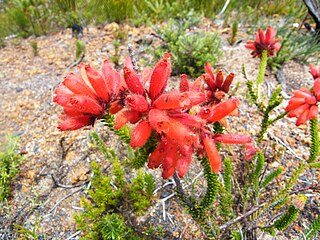
Erica cerinthoides is a species of heath native to South Africa, Lesotho and Eswatini. Common names include fire erica, fire heath, red hairy heath, rooihaartjie or klipheide. Throughout its range the species shows marked variation in habit, flower characteristics and hairiness. A form with white flowers is found in Eswatini and the South African province of Mpumalanga while the variety E. cerinthoides var. barbertona has shorter flowers.

Tradescantia bracteata, the longbract spiderwort, or prairie spiderwort, is a species of Tradescantia. It is native to the northern and central Great Plains and Mississippi Valley regions of the United States, from Arkansas and Oklahoma north to Minnesota and Montana, with a few isolated populations farther east. It is grown for its purple flowers. It blooms from May to July in the US. A protected population of the species is found in the Sugarloaf Mountains-Midland Peak Natural Area.

Tradescantia ozarkana, the Ozark spiderwort, is a species of Tradescantia. It is part of the Commelinaceae family, native to the States of Missouri, Arkansas, and Oklahoma in the south-central United States. It flowers from April to May and can be found in rich, rocky areas, including woods and bluff ledges.

Tradescantia sillamontana is a perennial evergreen herbaceous plant of the genus Tradescantia. This species is one of the most succulent and xerophytic, but at the same time one of the most attractive species of Tradescantia. It is endemic to dry areas of the State of Nuevo León in northeastern Mexico and can also be found in Spain and Italy.

Tradescantia longipes, commonly known as the wild crocus, is a perennial herbaceous plant in the dayflower family. It is found only in the Ozark Mountains of southern Missouri and northern Arkansas in the Midwest United States. A spring blooming species, its flowers can be observed from April to May, typically in its preferred habitat of wooded slopes on rocky hillsides. While most other members of the genus in North America have stems reaching at least a few inches above the soil, the flowering shoots of Tradescantia longipes are borne essentially at ground level. This character is shared with some individuals of Tradescantia hirsuticaulis and Tradescantia virginiana, two closely related species, although both typically have obvious stems. Regardless, Tradescantia longipes can be distinguished from the former with its longer pedicels and bracts without fine hairs, and from the latter by the presence of at least some glandular hairs on the sepals. Furthermore, Tradescantia longipes is a tetraploid, meaning it has four sets of chromosomes, while Tradescantia hirsuticaulis is diploid with only two sets. Tradescantia virginiana occurs in both diploid and tetraploid forms, although it is consistently tetraploid where its range overlaps with Trandescantia longipes.

Prionotes is a genus of flowering plants endemic to Tasmania, with a single species, Prionotes cerinthoides. Commonly known as climbing heath, it is a temperate rainforest climber or a small scrambling shrub in the mountains. It usually lives in very wet, undisturbed places.

Tradescantia hirsuticaulis, commonly called hairystem spiderwort, is a species of plant in the family Commelinaceae that is native to south-central United States.

Tradescantia hirsutiflora, commonly called hairyflower spiderwort, is a species of plant in the spiderwort family that is native to the south-central United States of America.

Tradescantia subaspera, the zigzag spiderwort, is a species of flowering plant in the family Commelinaceae, native to the eastern United States. Its zigzagging stems and wider leaves distinguish it from Tradescantia virginiana. It is recommended for shady naturalistic garden settings. It has three petals which are violet-blue to purple in color. Flowers bloom May to September.
Tradescantia tharpii, the shortstem spiderwort or spider lily, is a species of flowering plant in the family Commelinaceae, native to the central United States. It is small for its genus, reaching only 8–12 in (20–30 cm). It is recommended for shady naturalistic settings.


