
Xanthidae is a family of crabs known as gorilla crabs, mud crabs, pebble crabs or rubble crabs. Xanthid crabs are often brightly coloured and are highly poisonous, containing toxins which are not destroyed by cooking and for which no antidote is known. The toxins are similar to the tetrodotoxin and saxitoxin produced by puffer fish, and may be produced by bacteria in the genus Vibrio living in symbiosis with the crabs, mostly V. alginolyticus and V. parahaemolyticus.

Porcelain crabs are decapod crustaceans in the widespread family Porcellanidae, which superficially resemble true crabs. They have flattened bodies as an adaptation for living in rock crevices. They are delicate, readily losing limbs when attacked, and use their large claws for maintaining territories. They first appeared in the Tithonian age of the Late Jurassic epoch, 145–152 million years ago.

Mictyris is a genus of brightly coloured crabs, placed in its own taxonomical family, the Mictyridae. It inhabits the central Indo-West Pacific region. These crabs congregate on mud flats or beaches in groups of a few thousand, and filter sand or mud for microscopic organisms. They congregate during low tide, and bury themselves in the sand during high tide or whenever they are threatened. This is done in wet sand, and they dig in a corkscrew pattern, leaving many small round pellets of sand behind them.

Libystes is a genus of crabs, containing six species:
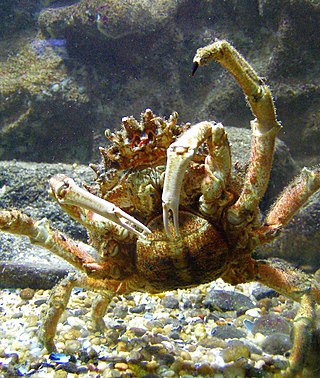
Maja is a genus of majid crabs erected by Jean-Baptiste Lamarck in 1801. It includes the following extant species:
Xanthoidea is a superfamily of crabs, comprising seven families. Formerly, a number of other families were included in Xanthoidea, but many of these have since been removed to other superfamilies. These include Carpilioidea, Eriphioidea, Hexapodoidea, Pilumnoidea and Trapezioidea. Even in this reduced state, Xanthoidea remains one of the most species-rich superfamilies of crabs.
Gecarcinucoidea is a superfamily of freshwater crabs. Its members have been grouped into families in various ways, with some authors recognizing families such as "Deckeniidae", "Sundathelphusidae", and "Parathelphusidae", but now only the family Gecarcinucidae is currently recognized.
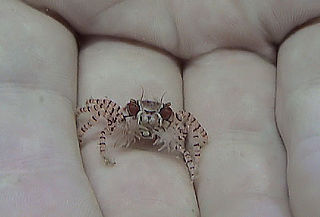
Lybia is a genus of small crabs in the family Xanthidae. Their common names include boxer crabs, boxing crabs and pom-pom crabs. They are notable for their mutualism with sea anemones, which they hold in their claws for defense. In return, the anemones get carried around, which may enable them to capture more food particles with their tentacles. Boxer crabs use at least three species of anemones, including Bundeopsis spp. and Triactis producta. The bonding with the anemone is not needed for survival, however, and boxer crabs have frequently been known to live without them, sometimes substituting other organisms such as sponges and corals for the sea anemones.

Goneplacidae is a family of crabs of the order Decapoda and the superfamily Goneplacoidea. It includes the following genera:
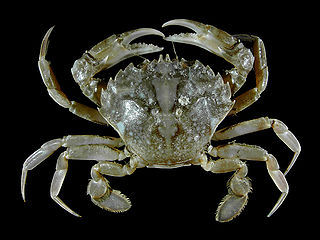
Eubrachyura is a group of decapod crustaceans comprising the more derived crabs. It is divided into two subsections, based on the position of the genital openings in the two sexes. In the Heterotremata, the openings are on the legs in the males, but on the sternum in females, while in the Thoracotremata, the openings are on the sternum in both sexes. This contrasts with the situation in other decapods, in which the genital openings are always on the legs. Heterotremata is the larger of the two groups, containing the species-rich superfamilies Xanthoidea and Pilumnoidea and all the freshwater crabs. The eubrachyura is well known for actively and constantly building its own burrows. The fossil record of the Eubrachyura extends back to the Cretaceous; the supposed Bathonian representative of the group, Hebertides jurassica, ultimately turned out to be Cenozoic in age.

Actumnus is a genus of crabs in the family Pilumnidae. Alongside the 28 extant species, it has a fossil record extending back into the Miocene.

Inachidae is a family of crabs, containing 39 genera:

Pugettia is a genus of kelp crabs in the family Epialtidae. It comprises the following species:

Echinoecus pentagonus, the sea urchin crab, is a species of crab in the family Pilumnidae found from the Red Sea and East Africa to French Polynesia and the Hawaiian Islands. This crab is a parasite that lives in the rectum of a sea urchin. In Hawaii, it chooses only Echinothrix calamaris, leaving few of these urchins unpopulated. Its curved and pointed carapace reaches only 0.5 inches (1.3 cm) in width.
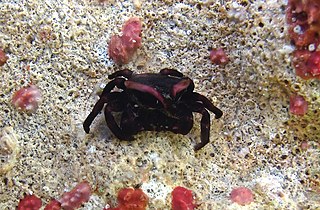
Echinoecus is a genus of crabs that live in association with sea urchins. Formerly considered monotypic, the genus is now thought to contain three species:

Chlorodiella is a genus of crabs in the family Xanthidae, containing the following species:
Vellodius etisoides is a species of crab in the family Xanthidae. It was originally described as Pilodius etisoides, but was transferred to the monotypic genus Vellodius in 1998. It is found around Amami Ōshima in the Ryūkyū Islands, and the Paracel Islands in the South China Sea.
Microcassiope is a genus of crabs in the family Xanthidae, containing the following species:

Trichia dromiaeformis is a crab that lives in the waters of the western Pacific, both the northern and southern hemisphere. It was described as Zalasius dromiaeformis by Mary J. Rathbun in 1897, and this name is still sometimes used. It was first described by De Haan in 1839. It is of the genus Trichia, and family Xanthidae. They are extremely camouflaged and live in sandy, muddy substrate. It grows shaggy hair on its dorsal side and the outside of its legs that resembles algae.


