
Xanthidae is a family of crabs known as gorilla crabs, mud crabs, pebble crabs or rubble crabs. Xanthid crabs are often brightly coloured and are highly poisonous, containing toxins which are not destroyed by cooking and for which no antidote is known. The toxins are similar to the tetrodotoxin and saxitoxin produced by puffer fish, and may be produced by bacteria in the genus Vibrio living in symbiosis with the crabs, mostly V. alginolyticus and V. parahaemolyticus.

Portunidae is a family of crabs which contains the swimming crabs. Its members include many well-known shoreline crabs, such as the blue crab and velvet crab. Two genera in the family are contrastingly named Scylla and Charybdis; the former contains the economically important species black crab and Scylla paramamosain.

Ovalipes is a genus of crabs in the family Ovalipidae.

The Ocypodidae are a family of semiterrestrial crabs that includes the ghost crabs and fiddler crabs. They are found on tropical and temperate shorelines around the world.

Pinnotheridae is a family of tiny soft-bodied crabs that live commensally in the mantles of certain bivalve molluscs and the occasional large gastropod mollusc species in genera such as Strombus and Haliotis. Tunicotheres moseri is commensal with a tunicate. The earliest fossils attributable to the Pinnotheridae date from the Danian.

Palicus is a genus of stilt crabs in the family Palicidae.

Potamonautes is a genus of African freshwater crabs in the family Potamonautidae. It is both the most widespread and most diverse genus of African freshwater crabs, including more than half the species of this continent. They are found in most freshwater habitats of the African mainland and some species are semi-terrestrial.
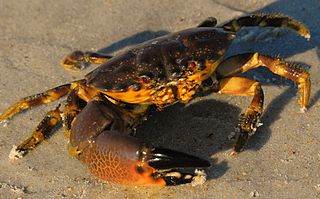
Menippe is a genus of true crabs. One of the best known species is the Florida stone crab. Most of the species of this genus are found in the Atlantic Ocean.
Hexapus is a genus of crabs in the family Hexapodidae. It contains only three extant species found in the Indo-West Pacific. They inhabit the intertidal and subtidal areas of shorelines.

Planes is a genus of crabs in the family Grapsidae that currently comprises three extant species: Planes minutus, Planes marinus Rathbun, 1914, and Planes major (=cyaneus). A further fossil species is known from the Middle Miocene of the Caucasus.

Trapeziidae is a family of crabs, commonly known as coral crabs. All the species in the family are found in a close symbiosis with cnidarians. They are found across the Indo-Pacific, and can best be identified to the species level by the colour patterns they display. Members of the family Tetraliidae were previously included in the Trapeziidae, but the similarities between the taxa is the result of convergent evolution.
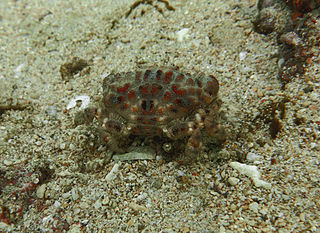
Paractaea is a genus of crabs in the family Xanthidae, containing the following species:
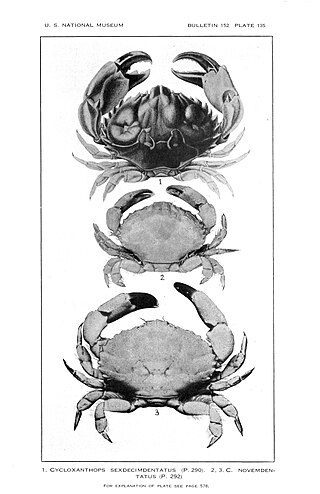
Cycloxanthops is a genus of crabs in the family Xanthidae, containing the following species:

Xanthias is a genus of crabs in the family Xanthidae, containing two exclusively fossil species and the following extant species:

Trichia is a genus of crabs in the family Xanthidae, containing the following species:
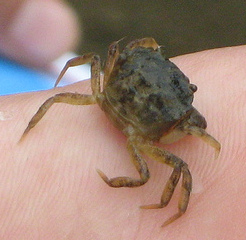
The Panopeidae are a family containing 26 genera of morphologically similar crabs, often known as "mud crabs". Their centers of diversity are the Atlantic Ocean and eastern Pacific Ocean.
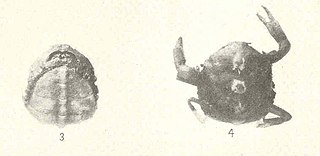
Tunicotheres is a monotypic genus of crabs in the family Pinnotheridae, and Tunicotheres moseri is the only species in the genus. This crab lives commensally in the atrial chamber of a small ascidian. It is found in the tropical western Atlantic Ocean, the Caribbean Sea and the Gulf of Mexico.

Austruca is a genus of Indo-west Pacific fiddler crabs in the family Ocypodidae. There are about 13 described species in this genus.
Atyoida is a genus of freshwater shrimp in the family Atyidae. There are five species in the genus, each endemic to a different Pacific island group. The type species, Atyoida bisulcata, is endemic to Hawaiʻi and described by John Witt Randall in 1840.

Daldorfia is a genus of parthenopid crab, belonging to the subfamily Daldorfiinae.


