
The Hepialidae are a family of insects in the lepidopteran order. Moths of this family are often referred to as swift moths or ghost moths.
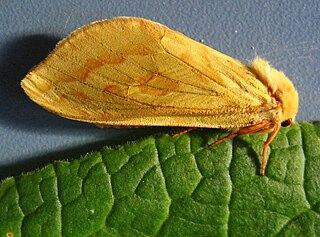
The ghost moth or ghost swift is a moth of the family Hepialidae. It is common throughout Europe, except for in the far south-east.

Abantiades is a genus of moths of the family Hepialidae. There are 14 described species, all found exclusively in Australia. The group includes some large species with a wingspan of up to 160 mm. The larvae feed on the roots of Eucalyptus and other trees.
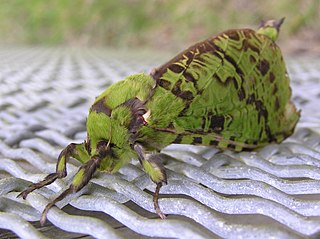
Aenetus is a genus of moths of the family Hepialidae. There are 24 described species found in Indonesia, New Guinea, New Caledonia, Australia and New Zealand. Most species have green or blue forewings and reddish hindwings, but some are predominantly brown or white. The larvae feed in the trunks of living trees, burrowing horizontally into the trunk, then vertically down.
The Hepialoidea are the superfamily of "ghost moths" and "swift moths".
Bordaia is a genus of moths of the family Hepialidae. There are five described species, all endemic to Australia.

Fraus is a genus of moths of the family Hepialidae. There are 25 described species, all endemic to Australia.
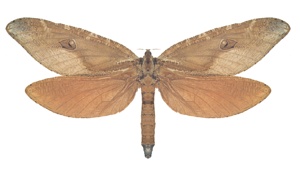
Zelotypia is a monotypic moth genus of the family Hepialidae. The only described species is Z. stacyi, the bentwing ghost moth, which is only found in Queensland and New South Wales, Australia. This is a very large species with a wingspan of up to 250 mm. The larva feeds and pupates in the trunks and branches of Eucalyptus.

Abantiades latipennis, known as the Pindi moth, is a species of moth in the family Hepialidae. It may also be referred to as a swift moth or a ghost moth, as this is a common name associated with Hepialidae. Endemic to Australia and identified in 1932, it is most populous in temperate rainforest where eucalypti are prevalent, as the larvae feed primarily on the roots of these trees. Females lay eggs during flight in a scattering fashion. The larvae live for over eighteen months underground, while adult moths survive for approximately one week, as they have no mouthparts with which to feed. The moths are preyed upon by a number of predators, including bats and owls. Brown in colour overall, males are paler and the identifying silver bars of the male's wings are more prominent than those of the female's, with dark margins. Male adults are generally smaller.
Bordaia furva is a species of moth of the family Hepialidae. It is endemic to Western Australia.
Bordaia karnka is a species of moth of the family Hepialidae. It is endemic to Western Australia.
Bordaia moesta is a species of moth of the family Hepialidae. It is endemic to Western Australia.
Bordaia paradoxa is a species of moth of the family Hepialidae. It is endemic to Western Australia.
Bordaia pica is a species of moth of the family Hepialidae. It is endemic to South Australia, Victoria and Western Australia.

Sthenopis pretiosus, the gold-spotted ghost moth, is a species of moth of the family Hepialidae. It was first described by Gottlieb August Wilhelm Herrich-Schäffer in 1856. It can be found in found Brazil, Venezuela and in the eastern United States and south-eastern Canada.
Trictena barnardi is a species of moth of the family Hepialidae. It was described by Norman Tindale in 1941, and is endemic to Western Australia.

