The yellow-tailed black cockatoo is a large cockatoo native to the south-east of Australia measuring 55–65 cm (22–26 in) in length. It has a short crest on the top of its head. Its plumage is mostly brownish black and it has prominent yellow cheek patches and a yellow tail band. The body feathers are edged with yellow giving a scalloped appearance. The adult male has a black beak and pinkish-red eye-rings, and the female has a bone-coloured beak and grey eye-rings. In flight, yellow-tailed black cockatoos flap deeply and slowly, with a peculiar heavy fluid motion. Their loud, wailing calls carry for long distances. The whiteae is found south of Victoria to the East of South Australia and is smaller in size. The yellow-tailed black cockatoo is found in temperate forests and forested areas across south and central eastern Queensland to southeastern South Australia, including a very small population persisting in the Eyre Peninsula. Two subspecies are recognised, although Tasmanian and southern mainland populations of the southern subspecies xanthanotus may be distinct enough from each other to bring the total to three. Birds of subspecies funereus have longer wings and tails and darker plumage overall, while those of xanthanotus have more prominent scalloping.
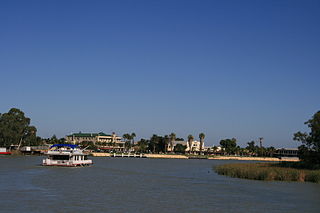
Renmark is a town in South Australia's rural Riverland area, and is located 254 km (157.83 mi) northeast of Adelaide, on the banks of the River Murray. The Sturt Highway between Adelaide and Sydney runs through the town; Renmark is the last major town encountered in South Australia when driving this route. It is 31 m (101.71 ft) above sea level. At the 2016 census, Renmark had a population of 4,634.

The Riverland is a region of South Australia. It covers an area of 9,386 square kilometres (3,624 sq mi) along the River Murray from where it flows into South Australia from New South Wales and Victoria downstream to Blanchetown. The major town centres are Renmark, Berri, Loxton, Waikerie, Barmera and Monash, and many minor townships. The population is approximately 35,000 people.

The Mount Lofty Ranges are a range of mountains in the Australian state of South Australia which for a small part of its length borders the east of Adelaide. The part of the range in the vicinity of Adelaide is called the Adelaide Hills and defines the eastern border of the Adelaide Plains.

Stirling is a town in the Adelaide Hills, South Australia, approximately 15 km from the Adelaide city centre. It is administered by the Adelaide Hills Council. Neighbouring townships are Crafers and Aldgate. Other nearby towns are Heathfield and Bridgewater. Of those five, Stirling has by far the largest commercial strip, with the greatest number and widest variety of shops, and the only banks. Stirling East, a similar sized area towards Aldgate, is home to several schools.

Waikerie is a rural town in the Riverland region of South Australia on the south bank of the Murray River. At the 2016 census, Waikerie had a population of 2,684. The Sturt Highway passes to the south of the town at the top of the cliffs. There is a cable ferry crossing the river to provide vehicle access from the north side of the river. Waikerie is known for citrus growing, along with stone fruit and grapes.

Ceratopogonidae is a family of flies commonly known as no-see-ums, or biting midges, generally 1–3 millimetres in length. The family includes more than 5,000 species, distributed worldwide, apart from the Antarctic and the Arctic.

Cobbler Creek Recreation Park is a 266-hectare (657-acre) protected area located in South Australia about 19 kilometres (12 mi) north of the Adelaide city centre in the suburb of Salisbury East. Originally part of the lands of the Kaurna aboriginal people, it was farmed from European settlement of South Australia until the declaration of the park in 1989.

The South Australian wine industry is responsible for more than half the production of all Australian wine. South Australia has a vast diversity in geography and climate which allows the state to be able to produce a range of grape varieties–from the cool climate Riesling variety in the Clare Valley wine region to the big, full bodied Shiraz wines of the Barossa Valley.

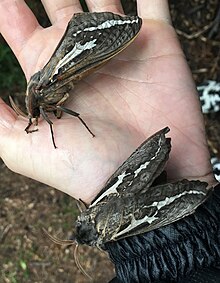
Abantiades latipennis, known as the Pindi moth, is a species of moth in the family Hepialidae. It may also be referred to as a swift moth or a ghost moth, as this is a common name associated with Hepialidae. Endemic to Australia and identified in 1932, it is most populous in temperate rainforest where eucalypti are prevalent, as the larvae feed primarily on the roots of these trees. Females lay eggs during flight in a scattering fashion. The larvae live for over eighteen months underground, while adult moths survive for approximately one week, as they have no mouthparts with which to feed. The moths are preyed upon by a number of predators, including bats and owls. Brown in colour overall, males are paler and the identifying silver bars of the male's wings are more prominent than those of the female's, with dark margins. Male adults are generally smaller.

The Murraylands is a geographical region of the Australian state of South Australia (SA); its name reflects that of the river running through it. Lying due east of South Australia's capital city, Adelaide, it extends from the eastern slopes of the Mount Lofty Ranges to the border with the state of Victoria, a distance of about 180 kilometres. The north-to-south distance is about 130 kilometres. The region's economy is centred on agriculture, and tourism, especially along its 200-kilometre (120-mile) frontage of the River Murray.
Culama alpina is a moth in the family Cossidae. It was described by Kallies and D.J. Hilton in 2012. It is found in Australia, where it has been recorded from Tasmania, Victoria, New South Wales and the Australian Capital Territory. The habitat consists of alpine heath and snow gum woodlands.
Culama glauca is a moth in the family Cossidae. It was described by Kallies and D.J. Hilton in 2012. It is found in Australia, where it has been recorded from Western Australia and New South Wales. The habitat consists of dry woodlands, mallee and heath.
Anaphes nitens is a species of fairyfly, a chalcid wasp in the family Mymaridae. Native to Australia, it is an egg parasitoid of the gum tree snout beetle, a pest of Eucalyptus trees, and has been used in biological pest control of that species.
The Erawirung people, also known as Yirau, Juju and other names, were an Aboriginal Australian people whose traditional territory was located in what is today the Riverland of South Australia. They consisted of sub-groups or clans, including Jeraruk, Rankbirit and Wilu, and have been referred to as Meru people, which was a larger grouping which could also include the Ngawait and Ngaiawang peoples.
The Ngaiawang (Ngayawang) were an Aboriginal Australian people of the western Riverland area of South Australia, with a language considered part of the Lower Murray group. They are now considered extinct. They have sometimes been referred to as part of the Meru people, a larger grouping which could also include the Ngawait and Erawirung peoples. They were called Birta by the Kaurna and Ngadjuri peoples, variations of Murundi by the Jarildekald people, and were also known various other terms and spellings.
Mylor Conservation Park is a protected area located in the Australian state of South Australia in the suburb of Mylor in the Adelaide Hills state government region about 19 kilometres (12 mi) south-east of the state capital of Adelaide and about 1 kilometre (0.62 mi) north-east of the town of Mylor.
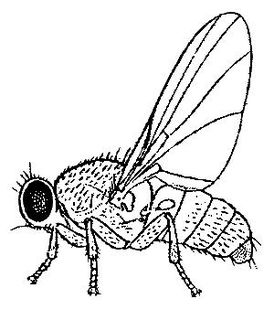
Fergusonina, the sole genus in the family of Fergusoninidae, are gall-forming flies. There are about 40 species in the genus, all of them producing galls on Eucalyptus, Melaleuca, Corymbia, and Metrosideros species in Australia and New Zealand.

The brownspotted wrasse, also known as the blue-spotted parrotfish, brown-spotted parrotfish and orangespotted wrasse, is a species of marine ray-finned fish from the family Labridae, the wrasses. It is found in the Indian Ocean off the western and southern coasts of Australia.