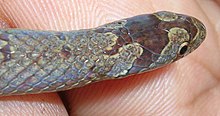
Brown-speckled whipsnake or brown vine snake is a species of tree snake endemic to Sri Lanka. Populations in the Western Ghats of India are now considered a separate species, Ahaetulla sahyadrensis. It is known as හෙනකදයා (henakadaya) in Sinhala; this name provided the name anaconda.
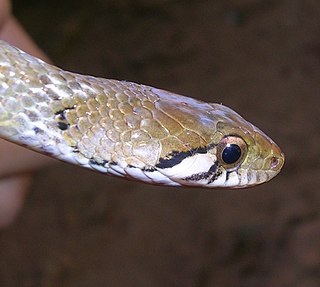
The Nilgiri keelback, also known commonly as Beddome's keelback, is a species of snake found in the Western Ghats in India. The species is named after Richard Henry Beddome, 1830–1911, British army officer and botanist. It was first discovered near the Nilgiris but is now known more widely from the Western Ghats. This snake is terrestrial and feeds on toads.

Hebius monticola is a harmless colubrid snake species endemic to the Western Ghats of India. They are especially well known from the Kodagu and Wayanad regions of the Western Ghats.

Platyceps gracilis, commonly known as the graceful racer or slender racer, is a species of snake endemic to India.

Lycodon aulicus, commonly known as the Indian wolf snake, is a species of nonvenomous snake found in South Asia and Southeast Asia. Early naturalists have suggested its resemblance to the venomous common krait as an instance of Batesian mimicry.

The common kukri snake or banded kukri, Oligodonarnensis, is a species of nonvenomous colubrid found in Sri Lanka, India, Bangladesh, Pakistan, Bhutan and Nepal.

Oligodon cinereus, the ashy kukri snake, ashy kukri snake, black cross-barred kukri snake, golden kukri snake, or Günther's kukri snake, is a species of snake in the family Colubridae.
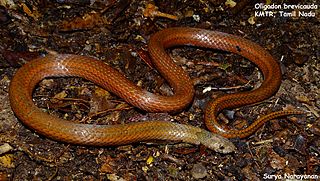
Oligodon brevicauda, the shorthead kukri snake, is a species of snake found in the Western Ghats of India.

The painted keelback is a species of colubrid snake found in Pakistan, Nepal, Bangladesh, and India. This snake is also called the dark-bellied marsh snake.

Sibynophis subpunctatus, commonly known as Duméril's black-headed snake or Jerdon's many-toothed snake, is a species of nonvenomous colubrid snake endemic to Bangladesh, India, Sri Lanka and Nepal

Sibynophis collaris, commonly known as the common many-toothed snake,Betty's many toothed snake or the collared black-headed snake, is a species of colubrid snake endemic to South and East Asia.

Calliophis nigriscens, commonly known as the black coral snake or striped coral snake, is a species of venomous elapid snake endemic to the Western Ghats, India.

Calliophis bibroni, commonly known as Bibron's coral snake, is a species of venomous snake in the family Elapidae. The species is native to India.
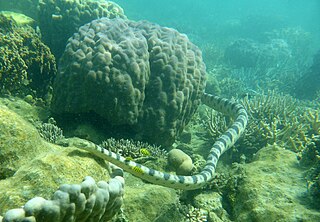
The olive-headed sea snake, also known as the greater sea snake, is a species of venomous sea snake in the family Elapidae.

Snakes, like other reptiles, have skin covered in scales. Snakes are entirely covered with scales or scutes of various shapes and sizes, known as snakeskin as a whole. A scale protects the body of the snake, aids it in locomotion, allows moisture to be retained within, alters the surface characteristics such as roughness to aid in camouflage, and in some cases even aids in prey capture. The simple or complex colouration patterns are a property of the underlying skin, but the folded nature of scaled skin allows bright skin to be concealed between scales then revealed in order to startle predators.

Coelognathus helena monticollaris is subspecies of a nonvenomous constricting snake in the family Colubridae. The subspecies is native to south Central Asia.
The Cameroon racer, Poecilopholis cameronensis, is a species of fangless venomous snake endemic to Africa. Poecilopholis is a monotypic genus created for this species.
Aparallactus lineatus, or the lined centipede-eater, is a species of venomous rear-fanged snake in the family Atractaspididae.
Aparallactus niger is a species of venomous rear-fanged snake in the family Atractaspididae. It is endemic to Western Africa.
Polemon gabonensis, or the Gaboon snake-eater, is a species of venomous rear-fanged snake in the family Atractaspididae. It is endemic to Africa.