60 Cancri

Last updated
60 Cancri
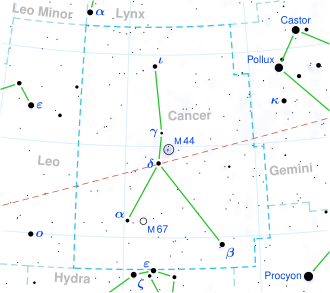
Cancer constellation map.svg
Red circle.svg
Location of 60 Cancri (circled in red)
Observation data
Epoch J2000.0       Equinox J2000.0
Constellation Cancer
Right ascension 08h 55m 55.54693s [1]
Declination +11° 37 33.6990 [1]
Apparent magnitude  (V)+5.44 [2]
Characteristics
Evolutionary stage giant
Spectral type K5 III [3] [2] [4]
B−V color index 1.462±0.004 [2]
Astrometry
Radial velocity (Rv)+25.38±0.16 [1] km/s
Proper motion (μ)RA: −15.443 [1] mas/yr
Dec.: −13.539 [1] mas/yr
Parallax (π)3.8596±0.1340  mas [1]
Distance 850 ± 30  ly
(259 ± 9  pc)
Details
Mass 1.42±0.45 [5]   M
Radius 63 [6]   R
Luminosity 1,023 [6]   L
Surface gravity (log g)1.28±0.11 [5]   cgs
Temperature 4,150±92 [5]   K
Metallicity [Fe/H]−0.01±0.05 [5]   dex
Rotational velocity (v sin i)8.75 [7]  km/s
Age 1.15+0.67
−0.43
[5]   Gyr
Other designations
60 Cnc, NSV 4308, BD+12°1941, GC 12339, HD 76351, HIP 43851, HR 3550, SAO 98235 [4]
Database references
SIMBAD data

60 Cancri is a star in the zodiac constellation Cancer, located about 850 light-years away from the Sun. It is visible to the naked eye as a faint, orange-hued star with an apparent visual magnitude of +5.44. [2] 60 Cancri is situated near the ecliptic, so it is subject to the occasional occultation by the Moon. [8] It is moving away from the Earth with a heliocentric radial velocity of +25 km/s. [1]

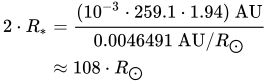
This is an aging giant star with a stellar classification of K5 III, [3] indicating it has exhausted the hydrogen at its core and evolved off the main sequence. It is a suspected variable star of unknown type. [9] The interferometry-measured angular diameter of the primary component, after correcting for limb darkening, is 1.94±0.02  mas , [10] which, at its estimated distance, equates to a physical radius of about 54 times the radius of the Sun. [11] It is around 1.15 billion years old with 1.4 times the mass of the Sun. [5] The star is radiating just over a thousand times the Sun's luminosity [6] from its enlarged photosphere at an effective temperature of 4,150 K. [5]
References

  1. 1 2 3 4 5 6 7 Brown, A. G. A.; et al. (Gaia collaboration) (August 2018). "Gaia Data Release 2: Summary of the contents and survey properties". Astronomy & Astrophysics . 616. A1. arXiv: 1804.09365 . Bibcode: 2018A&A...616A...1G . doi: 10.1051/0004-6361/201833051 . Gaia DR2 record for this source at VizieR.
  2. 1 2 3 4 Anderson, E.; Francis, Ch. (2012), "XHIP: An extended hipparcos compilation", Astronomy Letters, 38 (5): 331, arXiv: 1108.4971 , Bibcode:2012AstL...38..331A, doi:10.1134/S1063773712050015, S2CID   119257644.
  3. 1 2 Adams, Walter S.; et al. (April 1935), "The Spectroscopic Absolute Magnitudes and Parallaxes of 4179 Stars", Astrophysical Journal, 81: 187, Bibcode:1935ApJ....81..187A, doi: 10.1086/143628 .
  4. 1 2 "60 Cnc". SIMBAD . Centre de données astronomiques de Strasbourg . Retrieved 2019-03-09.
  5. 1 2 3 4 5 6 7 Feuillet, Diane K.; et al. (2016), "Determining Ages of APOGEE Giants with Known Distances", The Astrophysical Journal, 817 (1): 40, arXiv: 1511.04088 , Bibcode:2016ApJ...817...40F, doi: 10.3847/0004-637X/817/1/40 , S2CID   118675933.
  6. 1 2 3 Yu, Jie; Khanna, Shourya; Themessl, Nathalie; Hekker, Saskia; Dréau, Guillaume; Gizon, Laurent; Bi, Shaolan (2023). "Revised Extinctions and Radii for 1.5 Million Stars Observed by APOGEE, GALAH, and RAVE". The Astrophysical Journal Supplement Series. 264 (2): 41. arXiv: 2206.00046 . Bibcode:2023ApJS..264...41Y. doi: 10.3847/1538-4365/acabc8 .
  7. Das, Pradosh Barun; Zucker, Daniel B.; De Silva, Gayandhi M.; Borsato, Nicholas W.; Mura-Guzmán, Aldo; Buder, Sven; Ness, Melissa; Nordlander, Thomas; Casey, Andrew R.; Martell, Sarah L.; Bland-Hawthorn, Joss; De Grijs, Richard; Freeman, Ken C.; Kos, Janez; Stello, Dennis; Lewis, Geraint F.; Hayden, Michael R.; Sharma, Sanjib (2025). "The GALAH Survey: Stellar parameters and abundances for 800 000 Gaia RVS spectra using GALAH DR4 and the Cannon". Monthly Notices of the Royal Astronomical Society. 538 (2): 605. arXiv: 2410.12272 . Bibcode:2025MNRAS.538..605D. doi: 10.1093/mnras/staf169 .
  8. White, Nathaniel M.; Feierman, Barry H. (September 1987), "A Catalog of Stellar Angular Diameters Measured by Lunar Occultation", Astronomical Journal, 94: 751, Bibcode:1987AJ.....94..751W, doi:10.1086/114513.
  9. Samus N. N.; et al. (2017), "General Catalogue of Variable Stars", Astronomy Reports, 5.1, 61 (1): 80–88, Bibcode:2017ARep...61...80S, doi:10.1134/S1063772917010085, S2CID   125853869.
  10. Richichi, A.; et al. (February 2005), "CHARM2: An updated Catalog of High Angular Resolution Measurements", Astronomy and Astrophysics, 431 (2): 773–777, Bibcode:2005A&A...431..773R, doi: 10.1051/0004-6361:20042039
  11. Lang, Kenneth R. (2006), Astrophysical formulae, Astronomy and astrophysics library, vol. 1 (3rd ed.), Birkhäuser, ISBN   3-540-29692-1. The radius (R*) is given by: