
Buddleja crispa, the Himalayan butterfly bush, is a deciduous shrub native to Afghanistan, Bhutan, North India, Nepal, Pakistan and China, where it grows on dry river beds, slopes with boulders, exposed cliffs, and in thickets, at elevations of 1400–4300 m. Named by Bentham in 1835, B. crispa was introduced to cultivation in 1850, and came to be considered one of the more attractive species within the genus; it ranked 8th out of 57 species and cultivars in a public poll organized by the Center for Applied Nursery Research (CANR) at the University of Georgia, US. In the UK, B. crispa was accorded the Royal Horticultural Society's Award of Merit in 1961. However, the species is not entirely cold-hardy, and thus its popularity is not as ubiquitous as it might otherwise be.

Buddleja colvilei is endemic to the eastern Himalaya; discovered by Hooker in 1849, he declared it 'the handsomest of all Himalayan shrubs.' In 1896 the species was awarded the RHS First Class Certificate (FCC), given to plants 'of outstanding excellence for exhibition'.
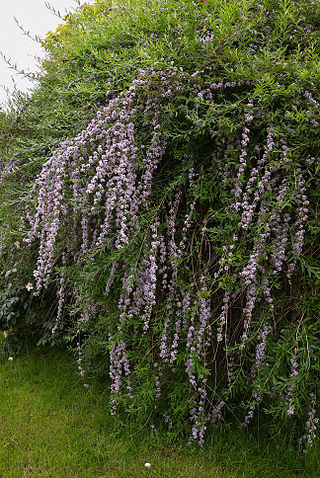
Buddleja alternifolia, known as alternate-leaved butterfly-bush, is a species of flowering plant in the figwort family, which is endemic to Gansu, China. A substantial deciduous shrub growing to 4 metres (13 ft) tall and wide, it bears grey-green leaves and graceful pendent racemes of scented lilac flowers in summer.

Buddleja fallowiana is a species of flowering plant in the figwort family Scrophulariaceae. It is endemic to the Yunnan province of western China, where it grows in open woodland, along forest edges and watercourses. The plant was collected in China by the Scottish botanist George Forrest in 1906, and named in 1917 by Balfour and Smith for George Fallow, a gardener at the Royal Botanic Garden Edinburgh. Fallow had died in Egypt in 1915 from wounds sustained fighting in the Gallipoli Campaign.

Buddleja tibetica was a species sunk as Buddleja crispa by Leeuwenberg in 1979, and treated as such in the subsequent Flora of China; however, the plant remains widely known by its former epithet in horticulture.

Buddleja sterniana was a species sunk as Buddleja crispa by Leeuwenberg in 1979, and treated as such in the subsequent Flora of China. However, the plant remains widely known by its former epithet in horticulture.
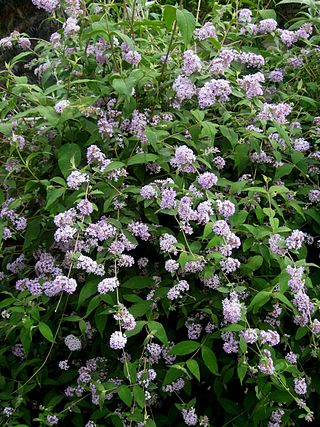
Buddleja delavayi is a Chinese species discovered by Forrest in the Tali Range above Dali, Yunnan, in 1910; it is also found in Xizang (Tibet). The species was named for l'Abbé Delavay, the French missionary and plant collector, by Gagnepain in 1912. The shrub is of interest to the botanist because of its unique resting buds and the different types of inflorescence produced through the year.
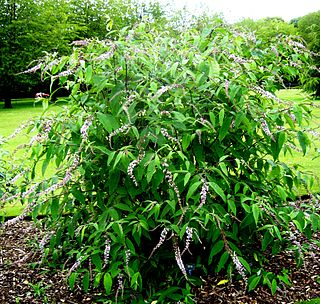
Buddleja albiflora is a deciduous shrub native to the mountains of central China, where it grows on shrub-clad slopes at altitudes of between 1,000 and 2,000 m. Named rather carelessly by Hemsley, the species was discovered by Henry, and introduced to western cultivation by Wilson in 1900.

Buddleja agathosma is a deciduous shrub endemic to western Yunnan, China. Originally identified as B. agathosma by Ludwig Diels, it was sunk as Buddleja crispa by Leeuwenberg in 1979, and treated as such in the subsequent Flora of China published in 1996. However, the shrub remains widely known by its former epithet in horticulture.
Buddleja bhutanica is a species of flowering shrub endemic to Bhutan, where it grows in bush on mountain slopes at elevations around 1,700 m. The shrub was first described and named by Yamazaki in 1971.

Buddleja asiatica is a somewhat tender deciduous shrub native to a vast area of the East Indies, including India, Nepal, Bangladesh, China, Taiwan, Burma, Thailand, Laos, Cambodia, Vietnam, Malaysia, New Guinea, and the Philippines, growing in open woodland at elevations < 2,800 m either as understorey scrub, or as a small tree. First described by Loureiro in 1790, B. asiatica was introduced to the UK in 1874, and accorded the RHS Award of Garden Merit in 1993. It is highly invasive in Hawaii, Guam, and the Northern Mariana Islands.

Buddleja forrestii is a deciduous shrub or small tree widely distributed from India to western China. First described by Diels in 1912, he named the species for plant hunter George Forrest, who discovered the plant in Yunnan in 1904 and introduced it to Western cultivation.

Buddleja japonica is a deciduous shrub native to Honshu and Shikoku, Japan, where it grows on mountain slopes amid scrub. The shrub was named and described by Hemsley in 1889, and introduced to Western cultivation in 1896.
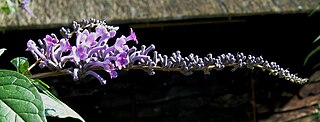
Buddleja lindleyana is a deciduous shrub native to the provinces of Anhui, Hunan, Hubei, Jiangsu, Shanghai, Sichuan, and Yunnan in China, where it grows in rocky scrub alongside streams and tracks at elevations of 200 – 2700 m. The shrub has also naturalized on Okinawa-jima, Japan, and in the south-eastern states of the United States.

Buddleja nivea is a vigorous shrub endemic to western China, evergreen in the wild, but deciduous in cultivation in the UK. The plant was discovered by Wilson in the Yangtze basin at altitudes of 700 – 3,600 m. Introduced to cultivation in 1901, it was named by Duthie in 1905. Several plants similar to the species but originally treated as species and varieties in their own right have now been sunk as B. nivea.
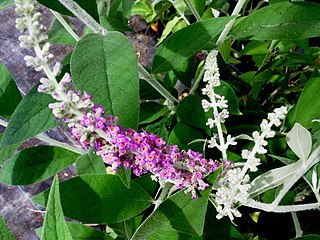
Buddleja stenostachya is a deciduous shrub native to the province of Sichuan, China. The species was discovered and introduced to cultivation by Wilson in 1908, and named by him and Rehder in 1913. There remains some contention over its taxonomy; it was sunk under B. nivea by Leeuwenberg; while another erroneously sank it as a variety of Buddleja crispa.

Buddleja fallowianavar.albaSabourin is a white-flowered variety of B. fallowiana endemic to Yunnan in western China, where it grows in open woodland, along forest edges and watercourses. The shrub was considered superior to the lavender-blue flowered B. fallowiana by Bean, who thought it one of the most attractive of all buddlejas.
Buddleja davidiivar.magnifica is endemic to much of the same area as the type; it was named by Rehder and E. H. Wilson in 1909.
Buddleja davidiivar.veitchiana was collected in Hubei and introduced to cultivation by E. H. Wilson; it was named for the British nurseryman and horticulturist James Veitch by Rehder. The taxonomy of the plant and the other five davidii varieties has been challenged in recent years. Leeuwenberg sank them all as synonyms, considering them to be within the natural variation of a species, a treatment adopted in the Flora of China published in 1996.

Buddleja macrostachya is a large deciduous shrub or small tree with a vast distribution, from Xizang (Tibet) through western China, Bhutan, Sikkim, northern India, Bangladesh, Myanmar (Burma), to Thailand and Vietnam, growing in scrub on mountain slopes to an altitude of 3,200 m, and along rivers in forests. The species was named and described by Wallich ex Bentham in 1835.


