Cambodian general election, 2018

Last updated
Cambodian general election, 2018
Flag of Cambodia.svg
  2013 29 July 20182023 

All 125 seats to the National Assembly
63 seats needed for a majority
Registered8,380,217 Decrease2.svg 13.39%
Turnout6,956,900 (83.02%) Increase2.svg 13.41%
 First party
  Hun Sen (2016) cropped.jpg
Leader Hun Sen
Party CPP
Leader since14 January 1985
Leader's seat Kandal
Last election68 seats, 48.83%
Seats won125
Seat changeIncrease2.svg 57
Popular vote4,889,113
Percentage76.85%
SwingIncrease2.svg 28.02%

Cambodian General Election, 2008.svg

Prime Minister before election

Hun Sen
CPP

Elected Prime Minister

Hun Sen
CPP

Royal arms of Cambodia.svg
This article is part of a series on the
politics and government of
Cambodia
Foreign relations

General elections (Khmer : ការបោះឆ្នោតជ្រើសតាំងតំណាងរាស្ត្រ នីតិកាលទី៦ ឆ្នាំ២០១៨) were held in Cambodia on Sunday, 29 July 2018 to elect members of the sixth National Assembly. Polling precincts opened at 7:00 a.m. and closed at 3:00 p.m. The number of registered voters has decreased for the first time since 1993 and was down 13.39% from the previous general election. Voter turnout was 83.02%. With the absence of a credible opposition, the election was viewed as merely a formality, and dismissed as a "sham election" by the international community. [1] [2] It resulted in a widely expected landslide victory for the ruling Cambodian People's Party, who won all 125 seats in the National Assembly. [3]

Khmer or Cambodian is the language of the Khmer people and the official language of Cambodia. With approximately 16 million speakers, it is the second most widely spoken Austroasiatic language. Khmer has been influenced considerably by Sanskrit and Pali, especially in the royal and religious registers, through Hinduism and Buddhism. The more colloquial registers have influenced, and have been influenced by, Thai, Lao, Vietnamese, and Cham, all of which, due to geographical proximity and long-term cultural contact, form a sprachbund in peninsular Southeast Asia. It is also the earliest recorded and earliest written language of the Mon–Khmer family, predating Mon and by a significant margin Vietnamese, due to Old Khmer being the language of the historical empires of Chenla, Angkor and, presumably, their earlier predecessor state, Funan.

Cambodia Southeast Asian sovereign state

Cambodia, officially the Kingdom of Cambodia, is a country located in the southern portion of the Indochina peninsula in Southeast Asia. It is 181,035 square kilometres in area, bordered by Thailand to the northwest, Laos to the northeast, Vietnam to the east and the Gulf of Thailand to the southwest.

National Assembly of Cambodia National Assembly of Cambodia

The National Assembly is one of the two houses (chambers) of the Parliament of Cambodia. It is referred to as the lower house, with the Senate being referred to as the upper house.

Contents

Background

The previous election of 28 July 2013, saw the fourth consecutive victory of the Cambodian People's Party, gaining 68 seats of the National Assembly and the opposition Cambodia National Rescue Party occupying the rest of the 55 seats. Despite their huge gain in seats, the opposition denied the results and accused the ruling party of poll fraud. As a result, the CNRP boycotted parliament in September 2013 and vows not to enter parliament until a legitimate electoral reform. [4] The disputed election results led to the outbreak of widespread anti-government protests. [5]

Cambodian Peoples Party Cambodian political party

The Cambodian People's Party, founded as the Kampuchean People's Revolutionary Party, is the current ruling political party of Cambodia. It was the sole legal party in the country at the time of the People's Republic of Kampuchea (1979–1989) and during the first two years of the State of Cambodia. Its name was changed during the final years of the State of Cambodia, when the single-party system as well as the Marxist–Leninist ideology were abandoned. Having governed Cambodia since 1979, it is one of the longest-ruling parties in the world. The General Secretary of the party from 1979 to 1981 was Pen Sovan. The KPRP was originally a Marxist–Leninist party, although it took on a more reformist outlook in the mid-1980s under Heng Samrin's leadership. In the 1990s, the KPRP officially dropped its commitment to socialist ideology altogether when it renamed itself the Cambodian People's Party. It is also currently the oldest active party in Cambodia. Since 2018, the party commands all 125 seats in the National Assembly, and 58 of 62 seats in the Senate. Hun Sen, the Prime Minister of Cambodia, has served as the party's President since 2015.

Cambodia National Rescue Party political party in Cambodia

The Cambodia National Rescue Party, commonly abbreviated as CNRP, was a major political party in Cambodia. It was founded in 2012 as a merger between the Sam Rainsy Party and Human Rights Party.

On 10 April 2014, prime minister Hun Sen agreed to hold the election five months early in February 2018. The opposition however rejected and wants the election to be held as early as 2015 or mid 2016. [6] On 22 July 2014, the political crisis officially ended and the opposition agreed to accept their seats in parliament. The next election was also agreed to be held in 2018. [7] As of November 2015, Sam Rainsy is barred from contesting the 2018 election, having been stripped from parliamentary immunity, and barred from returning to Cambodia. [8] His request for a royal pardon was blocked by Prime Minister Hun Sen. [9] In December 2016, his deputy Kem Sokha replaced him as Minority Leader. [10]

Sam Rainsy Cambodian politician

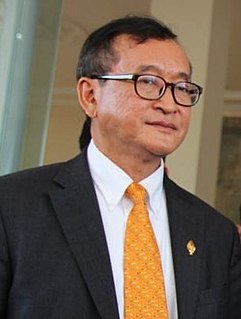
Sam Rainsy is a Cambodian activist and politician who most recently served as the Leader of the Opposition. He is now the president of the Cambodia National Rescue Movement (CNRM), launched in January 2018. He was a Member of Parliament (MP) for Kampong Cham, first from 1998 until 2005, then from 2008 to 2011, and finally from 2014 until 2015; he has been revoked of parliamentary immunity three times. He was previously the MP for Siem Reap from 1993 until 1995 when he was expelled from the Constituent Assembly. A co-founder of the Cambodia National Rescue Party (CNRP), Rainsy was previously a member of the royalist Funcinpec Party and served as the Minister of Economy and Finance during Norodom Ranariddh's administration from 1993 until his sacking in 1994. In June 1995, he was expelled from the National Assembly, and formed the Khmer Nation Party (KNP), which changed its name before the 1998 elections to the Sam Rainsy Party (SRP) to avoid registration issues. From 2000 to 2002 and again from 2012 to 2014, Rainsy was the chairperson of the Council of Asian Liberals and Democrats.

Kem Sokha Cambodian politician

Kem Sokha is a Cambodian politician and activist who most recently served as the President of the Cambodia National Rescue Party (CNRP). He served as the Minority Leader, the highest ranking opposition parliamentarian, of the National Assembly from December 2016 to January 2017, and previously as the First Vice President of the National Assembly from August 2014 to October 2015. He represented Kampong Cham as its Member of Parliament (MP) from 2008 to 2017. From 2007 to 2012, Sokha was the leader of the Human Rights Party, which he founded.

The Minority Leader, or the Leader of the Opposition, leads the largest political party not in government in the National Assembly of Cambodia. The Minority Leader acts as a dialogue partner of the Prime Minister, and the Majority Leader. The official minority party must secure at least 25% of the total seats in Parliament.

On 11 February 2017, Sam Rainsy announced his resignation as President of the Cambodia National Rescue Party, and was replaced by his deputy Kem Sokha. [11] On 3 September, Sokha was arrested and charged of "treason", raising questions about the party's future. [12] Another act of repression by the government was the closure of the Cambodia Daily newspaper. [13] On 16 November 2017, the opposition CNRP was dissolved, eliminating any real challenge to the long-ruling CPP. [1] Its seats in parliament were distributed to three other parties. [14]

Results

The legitimacy of the 2018 election has been called into question by various commentators and media outlets. [15] [16] There were a record number of invalid ballots, accounting for 8.6% of the total votes cast, more than any votes received by a political party barring the CPP. [17] Various international governments including Australia, Canada, the European Union, and the United States dismissed the election results, and threatened to impose sanctions on Hun Sen's government. [18] China, the Philippines, Laos and Thailand were among the countries to congratulate the CPP on their victory. [19] Meanwhile the former opposition Cambodia National Rescue Party accused the National Election Committee of misleading the number of voter turnout. [20]

Australia Country in Oceania

Australia, officially the Commonwealth of Australia, is a sovereign country comprising the mainland of the Australian continent, the island of Tasmania and numerous smaller islands. It is the largest country in Oceania and the world's sixth-largest country by total area. The neighbouring countries are Papua New Guinea, Indonesia and East Timor to the north; the Solomon Islands and Vanuatu to the north-east; and New Zealand to the south-east. The population of 25 million is highly urbanised and heavily concentrated on the eastern seaboard. Australia's capital is Canberra, and its largest city is Sydney. The country's other major metropolitan areas are Melbourne, Brisbane, Perth and Adelaide.

Canada Country in North America

Canada is a country in the northern part of North America. Its ten provinces and three territories extend from the Atlantic to the Pacific and northward into the Arctic Ocean, covering 9.98 million square kilometres, making it the world's second-largest country by total area. Canada's southern border with the United States is the world's longest bi-national land border. Its capital is Ottawa, and its three largest metropolitan areas are Toronto, Montreal, and Vancouver. As a whole, Canada is sparsely populated, the majority of its land area being dominated by forest and tundra. Consequently, its population is highly urbanized, with over 80 percent of its inhabitants concentrated in large and medium-sized cities, many near the southern border. Canada's climate varies widely across its vast area, ranging from arctic weather in the north, to hot summers in the southern regions, with four distinct seasons.

European Union Economic and poitical union of states located in Europe

The European Union (EU) is a political and economic union of 28 member states that are located primarily in Europe. It has an area of 4,475,757 km2 (1,728,099 sq mi) and an estimated population of about 513 million. The EU has developed an internal single market through a standardised system of laws that apply in all member states in those matters, and only those matters, where members have agreed to act as one. EU policies aim to ensure the free movement of people, goods, services and capital within the internal market, enact legislation in justice and home affairs and maintain common policies on trade, agriculture, fisheries and regional development. For travel within the Schengen Area, passport controls have been abolished. A monetary union was established in 1999 and came into full force in 2002 and is composed of 19 EU member states which use the euro currency.

Assemblee cambodge 2018.svg
PartyVotes%Seats+/–
Cambodian People's Party 4,889,11376.85125+57
FUNCINPEC 374,5105.8900
League for Democracy Party 309,3644.8600
Khmer Will Party 212,8693.350New
Khmer National United Party 99,3771.560New
Grassroots Democratic Party 70,5671.110New
Beehive Social Democratic Party 56,0240.880New
Khmer Anti-Poverty Party 55,2980.8700
Khmer United Party48,7850.770New
Cambodian Nationality Party45,3700.7100
Khmer Republican Party 41,6310.650New
Cambodian Youth Party 39,3330.620New
Dharmacracy Party29,0600.460New
Khmer Economic Development Party23,2550.3700
Khmer Rise Party22,0020.350New
Ponleu Thmey Party13,5090.210New
Cambodia Indigenous People's Democracy Party10,1970.160New
Our Motherland Party9,1740.140New
Democratic Republican Party8,5910.1400
Reaksmey Khemara Party4,2120.070New
Invalid/blank votes594,659
Total6,956,900100125+2
Registered voters/turnout8,380,21783.02
Source: National Election Committee
125
CPP

Related Research Articles

Hun Sen Prime Minister of Cambodia

Hun Sen is a Cambodian politician and the Prime Minister of Cambodia, President of the Cambodian People's Party (CPP) and Member of Parliament (MP) for Kandal. He has served as Prime Minister since 1985, making him the world’s longest-serving prime minister, the longest-serving head of government of Cambodia and one of the longest-serving leaders in the world. From 1979 to 1986 and again from 1987 to 1990, Hun Sen also served as Cambodia's foreign minister. His full honorary title is Samdech Akka Moha Sena Padei Techo Hun Sen. Born Hun Bunal, he changed his name to Hun Sen in 1972 two years after joining the Khmer Rouge.
FUNCINPEC political party

FUNCINPEC, National United Front for an Independent, Neutral, Peaceful and Cooperative Cambodia in English, is a royalist political party in Cambodia. Founded in 1981 by Norodom Sihanouk, it started off as a resistance movement against the People's Republic of Kampuchea (PRK) government. In 1982, it formed a resistance pact, the Coalition Government of Democratic Kampuchea (CGDK), together with the Khmer People's National Liberation Front (KPNLF) and the Khmer Rouge. It was one of the signatory parties of the 1991 Paris Peace Accords, which paved the way for the formation of the United Nations Transitional Authority in Cambodia (UNTAC). In 1992, FUNCINPEC became a political party and participated in the 1993 general elections organised by UNTAC. It won the elections, and formed a coalition government with the Cambodian People's Party (CPP), with which it jointly headed. Norodom Ranariddh, Sihanouk's son who had succeeded him as the party president, became First Prime Minister while Hun Sen, who was from the CPP, became Second Prime Minister.

Kampong Cham Province Province in Cambodia

Kampong Cham is a province (khaet) of Cambodia located on the central lowlands of the Mekong River. It borders the provinces of Kampong Chhnang to the west, Kampong Thom and Kratié to the north, Tbong Khmum to the east, and Prey Veng and Kandal to the south. Kampong Cham was officially divided into two provinces on 31 December 2013 in what was seen by many as a political move by the ruling party. All land west of the Mekong remained Kampong Cham while land east of the river became Tbong Khmum province. Prior to this division, Kampong Cham extended eastward to the international border with Vietnam, was the eleventh largest province in Cambodia, and with a population of 1,680,694, was the most populous province in Cambodia. Its capital and largest city is Kampong Cham.

Candlelight Party

The Candlelight Party is a personalist liberal party in Cambodia. The party was a member of the Council of Asian Liberals and Democrats, Liberal International, and the Alliance of Democrats.

Norodom Ranariddh 20th and 21st-century Cambodian politician

Norodom Ranariddh is a Cambodian royal politician and law academic. He is the second son of Norodom Sihanouk of Cambodia and a half-brother of the current king, Norodom Sihamoni. Ranariddh is the president of FUNCINPEC, a Cambodian royalist party. He was also the First Prime Minister of Cambodia following the restoration of the monarchy, serving between 1993 and 1997, and subsequently as the President of the National Assembly between 1998 and 2006.
Chea Sim Cambodian politician

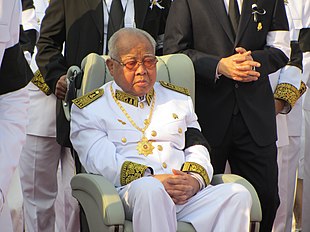
Chea Sim was a Cambodian politician. He was President of the Cambodian People's Party from 1991 to 2015, President of the National Assembly of Cambodia from 1981 to 1998 and President of the Senate from 1999 to 2015. His official title was Samdach Akeak Moha Thomak Pothisal Chea Sim, Protean Protsaphea ney Preah Reacheanachak Kampuchea.

Sar Kheng Cambodian Minister of the Interior

Sar Kheng is a Cambodian politician. One of the highest-ranking members of the ruling Cambodian People's Party, he is the current Minister of the Interior and has served as a Deputy Prime Minister since 1992. He also represents the province of Battambang in the Cambodian Parliament. Kheng has been the Minister of the Interior since 1992. Until March 2006, he shared the position with FUNCINPEC party member You Hockry as co-Ministers of the Interior, but then became sole interior minister in a cabinet reshuffle as FUNCINPEC ended its coalition with the CPP. He is currently the second longest serving government minister of Cambodia after Prime Minister Hun Sen. On June 14, 2015, King Norodom Sihamoni awarded Kheng the honorary title of "Samdech". His official title is "Samdech Kralahom Sar Kheng". Kheng is married to Nhem Sakhan with whom he has three children.

Human Rights Party (Cambodia) Cambodia

The Human Rights Party or was a Cambodian political party founded on 22 July 2007 led by Kem Sokha. Critics allege that its foundation is meant to weaken opposition parties and is driven by the ruling party. This sentiment, however, seems to be driven by the ruling party themselves as Kem Sokha has long been a very vocal critic of the ruling CPP party.

Tioulong Saumura Cambodian politician

Tioulong Saumura is a Cambodian former politician. She was a member of the Cambodia National Rescue Party and was elected to represent Phnom Penh in the National Assembly of Cambodia in 2003. She was also the Deputy Governor of Cambodia's Central Bank from 1993 to 1995.
Norodom Ranariddh Party political party

The Norodom Ranariddh Party is a Cambodian political party created by Prince Norodom Ranariddh, who has left the Royalist FUNCINPEC party of which he was previously leader/chairman.

Mu Sochua Cambodian politician

Mu Sochua is a Cambodian politician and rights activist. She was a Member of Parliament (MP) for Battambang from 2013 to 2017, a seat which she previously held from 1998 to 2003. She was a member and Vice President of the Cambodia National Rescue Party (CNRP) until its dissolve, and previously a member of the Sam Rainsy Party (SRP) prior to its merger with the Human Rights Party. As a member of FUNCINPEC, she also served as Minister of Women and Veterans' Affairs in Hun Sen's coalition government from 1998 to 2004. She is currently one of 118 senior opposition figures serving a five-year ban from politics following a court ruling on 16 November 2017.

1997 clashes in Cambodia

The 1997 clashes in Cambodia, also referred to as the 1997 coup in Cambodia, took place in Cambodia in July to September 1997. As a result, co-premier Hun Sen ousted the other co-premier Norodom Ranariddh. Dozens of people were killed during the conflict.

2013 Cambodian general election

General elections were held in Cambodia on 28 July 2013. The National Election Committee (NEC) announced that some 9.67 million Cambodians were eligible to cast their ballots to elect the 123-seat National Assembly. Voter turnout was reported to be 69.6%, making it the lowest turnout in history. Polling precincts opened 7:00 a.m. and closed at 3:00 p.m. The Cambodian Minister of Information, Khieu Kanharith announced in preliminary results that the Cambodian People's Party won 68 seats and the opposition Cambodia National Rescue Party won all the remaining 55 seats. This election marked the largest seat loss by the Cambodian People's Party to date, and their lowest share of seats since 1998.

2013–14 Cambodian protests Cambodian anti-government protests in 2013 and 2014

Anti-government protests were ongoing in Cambodia from July 2013 to July 2014. Popular demonstrations in Phnom Penh have taken place against the government of Prime Minister Hun Sen, triggered by widespread allegations of electoral fraud during the Cambodian general election of 2013. Demands to raise the minimum wage to $160 a month and resentment at Vietnamese influence in Cambodia have also contributed to the protests. The main opposition party refused to participate in parliament after the elections, and major demonstrations took place throughout December 2013. A government crackdown in January 2014 led to the deaths of 4 people and the clearing of the main protest camp.

Tboung Khmum Province Province in Cambodia

Tboung Khmum, officially Tbong Khmum, is a province (khaet) of Cambodia located on the central lowlands of the Mekong River. It borders the provinces of Kampong Cham to the west, Kratié to the north, Prey Veng to the south, and shares an international border with Vietnam to the east. Its capital and largest city is Suong. The province's name consists of two words in Khmer, tboung and khmum (bee), which together mean "amber".

Community of Royalist Peoples Party

The Community of Royalist People's Party was a Cambodian political party that lasted from March 2014 until January 2015. It was founded and led by Norodom Ranariddh, who had been ousted from FUNCINPEC back in 2006. Ideologically a royalist party, the CRPP drew its inspiration from the political legacy of the former King of Cambodia, Norodom Sihanouk, and competed for its voter base with both FUNCINPEC and the Cambodia National Rescue Party (CNRP). In January 2015, the CRPP was dissolved when Ranariddh returned to FUNCINPEC.

General Neth Savoeun is the National Police Chief of Cambodia. Savoeun was promoted from Deputy National Police Chief to the most senior law enforcement position of the country in November 2008 after his predecessor, Hok Lundy, whose tenure was mired in controversy and accusations of corruption, died in a helicopter crash. Savoeun, who was 52 years old at the time of his appointment, is married to Prime Minister Hun Sen's niece, Hun Kimleng. Prior to the National Police force, Savoeun was the police chief of Phnom Penh during the State of Cambodia and then, after the 1993 elections, head of the justice department in the Interior Ministry’s Penal Crimes Division.

References

  1. 1 2 "Supreme Court rules to dissolve CNRP". The Phnom Penh Post . 16 November 2017. Retrieved 16 November 2017.
  2. "Rights Groups Call Out Cambodia's 'Sham' Election". VOA Cambodia. Voice of America. 29 July 2018.
  3. "Hun Sen's CPP wins all parliamentary seats in Cambodia election". Al Jazeera . 15 August 2018.
  4. Heng Reaksmey and Men Kimseng (7 March 2014). "Opposition Standing Firm on Election Reform Demand". Voice of America . Retrieved 18 July 2014.
  5. Dara, Mech (23 December 2013). "CNRP Holds Biggest Demonstration in Decades". The Cambodia Daily . Retrieved 18 July 2014.
  6. "Hun Sen Agrees to Hold Early Election, Wants Deal Signed Before King". Radio Free Asia. 10 April 2014. Retrieved 9 July 2014.
  7. "Political deadlock broken". The Phnom Penh Post. 22 July 2014. Retrieved 24 July 2014.
  8. "Rainsy Pledges to Return Home Before 2018 National Election". The Cambodia Daily. 21 December 2015. Retrieved 24 November 2016.
  9. "Hun Sen Rejects CNRP Request for Pardons". The Cambodia Daily . 14 October 2016. Retrieved 24 November 2016.
  10. "Sokha to Replace Rainsy in Parliamentary Position". The Cambodia Daily . 6 December 2016. Retrieved 8 December 2016.
  11. Prak Chan Thul (11 February 2017). "Cambodia opposition leader Rainsy resigns from party". Reuters . Retrieved 12 February 2017.
  12. "Cambodia Arrests Opposition Leader, Accusing Him of Treason". The New York Times. 3 September 2017. Retrieved 8 September 2017.
  13. "Cambodia's government is preparing for elections with repression". The Economist . 7 September 2017.
  14. "List of new National Assembly members approved". The Phnom Penh Post . 24 November 2017. Retrieved 24 November 2017.
  15. "Cambodia election: Ruling party claims landslide in vote with no main opposition". BBC News. Retrieved 29 July 2018.
  16. Beech, Hannah. "Cambodia Votes for a Leader, With the Result Predetermined by One". New York Times. Retrieved 29 July 2018.
  17. "Spoilt Cambodian ballot papers seen as protest over 'sham' election". Reuters . 30 July 2018. Retrieved 30 July 2018.
  18. "International Community Condemns Cambodia Elections as 'Setback to Democracy'". Voice of America . 30 July 2018. Retrieved 31 July 2018.
  19. "China says foreigners should not interfere in Cambodia after election". Reuters . 2 August 2018. Retrieved 3 August 2018.
  20. "Former Cambodia Opposition Rejects Election Results". Voice of America . 30 July 2018. Retrieved 3 August 2018.