Carrara Formation

Last updated
Carrara Formation
Stratigraphic range: Lower Cambrian–Middle Cambrian
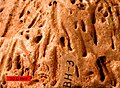
Olenellus terminatus Pyramid Shale Carrara Formation.jpg
Fossils from the Pyramid Shale member, Carrara Formation
Type Formation
Sub-units See: Members
Overlies Zabriskie Quartzite
Thickness0–2,000 feet (0–610 m) [1]
Lithology
Primary Siltstone
Other Shale, Limestone, Quartzite, Sandstone
Location
Region California and Nevada
Country United States

The Carrara Formation is a geologic formation in California and Nevada. It preserves fossils dating back to the Cambrian period. [2] [3] [1]

Contents

Geology

The Carrara Formation is primarily composed of olive-gray and greenish-gray siltstones and shales, as well as medium-gray limestone in the lower half of the formation, with medium-gray to yellowish-brown silty limestone and limy limestone in the upper half of the formation. [1] The lower half also contains quartzite rocks, similar to that seen in the underlying Zabriskie Quartzite. In other areas of the lower half, there are olive-gray, greenish-gray or dusky-yellow siltstones and sandy siltstones, along with small amounts of sandstone and limestone. The upper half also contains fine to medium-grained quartzites, white in colour, forming a distinctive band. [1] In other areas of the formation, it instead consists of inter-stratified siltstones, shales and very fine to medium-grained quartzite. [1]

Members

The Carrara Formation contains in total nice Members, which are as follows, in ascending age: [4]

Paleobiota

The Carrara Formation contains an abundance of arthropods, like the spiny Bristolia , as well as ichnotaxon like Skolithos , a type of burrow trace fossil. [1] It also contains some examples of Archaeocyatha, a clade of sponges that went extinct during this time. [5]

Color key
Taxon Reclassified taxonTaxon falsely reported as presentDubious taxon or junior synonym Ichnotaxon Ootaxon Morphotaxon
Notes
Uncertain or tentative taxa are in small text; crossed out taxa are discredited.

Arthropoda

GenusSpeciesNotesImages
Houcaris (?)
  • H?. magnabasis
Radiodont arthropod. Previously described as Anomalocaris magnabasis in 2019, but was reassigned to Houcaris in 2021, [6] although this assignment is now up in the air with subsequent analysis suggesting H. magnabasis may not form a monophyletic clade with other species of Houcaris. [7]
20191221 Radiodonta frontal appendage Anomalocaris magnabasis.png
Ursulinacaris [8]
  • H. grallae
A Hurdiid radiodont.
20191229 Radiodonta frontal appendage Ursulinacaris grallae.png
Bristolia [1]
  • B. bristolensis
An olenellid trilobite.
Bristolia mohavensis 2x CRF.jpg
Olenellus
  • O. clarki
  • O. terminatus
An olenellid trilobite.
Olenellus terminatus Pyramid Shale Carrara Formation.jpg

Lophotrochozoa

GenusSpeciesNotesImages
Microcornus [4]
  • Microcornus sp.
Lophotrochozoan hyolith.
Parkula [4]
  • Parkula sp.
Lophotrochozoan hyolith.
Hyolithellus (?) [4]
  • Hyolithellus (?) sp.
Lophotrochozoan hyolith.

Chancelloriidae

GenusSpeciesNotesImages
Allonia [4]
  • Allonia sp.
Chancelloriid.
Chancelloria [4]
  • Chancelloria sp.
Chancelloriid.

Porifera (Sponges)

GenusSpeciesNotesImages
Archaeocyathus [5]
  • Archaeocyathus sp.
Archaeocyathide sponge.
Archaeocyathus atlanticus.jpg

Ichnogenera

GenusSpeciesNotesImages
Skolithos [1] [9]
  • S. linearis
Burrows.
Skolithos.jpg

Undescribed

GenusSpeciesNotesImages
Disc-shaped fossils [10]
  • "Carrara specimens"
Disc-shaped organisms, resemble either porpitids or eldonids, especially to Discophyllum .


See also

References

  1. 1 2 3 4 5 6 7 8 9 Stewart, J. H. "Upper Precambrian and Lower Cambrian Strata, in the Southern Great Basin California and Nevada" (PDF). U.S. Geological Survery. Geological Survey Professional.
  2. Palmer and Halley 1979, Physical Stratigraphy and Trilobite Biostratigraphy of the Carrara Formation (Lower and Middle Cambrian)in the Southern Great Basin. USGS Prof. Pap. 1047
  3. Lieberman et al. 2017, Disc-shaped fossils resembling porpitids or eldonids from the early Cambrian (Series 2: Stage 4) of western USA. PeerJ 5:e3312
  4. 1 2 3 4 5 6 Wotte, Thomas; Sundberg, Frederick A. (2017). "Small shelly fossils from the Montezuman–Delamaran of the Great Basin in Nevada and California". Journal of Paleontology. 91 (5): 883–901. Bibcode:2017JPal...91..883W. doi:10.1017/jpa.2017.8. ISSN   0022-3360. JSTOR   48572351.
  5. 1 2 Pruss, Sara B.; Karbowski, Grace; Zhuravlev, Andrey Yu; Webster, Mark; Smith, Emily F. (30 June 2024). "DEAD CLADE WALKING: THE PERSISTENCE OF ARCHAEOCYATHUS IN THE AFTERMATH OF EARLY CAMBRIAN REEF EXTINCTION IN THE WESTERN UNITED STATES". PALAIOS. 39 (6): 210–224. Bibcode:2024Palai..39..210P. doi:10.2110/palo.2024.005.
  6. Wu, Yu; Fu, Dongjing; Ma, Jiaxin; Lin, Weiliang; Sun, Ao; Zhang, Xingliang (June 2021). "Houcaris gen. nov. from the early Cambrian (Stage 3) Chengjiang Lagerstätte expanded the palaeogeographical distribution of tamisiocaridids (Panarthropoda: Radiodonta)". PalZ. 95 (2): 209–221. Bibcode:2021PalZ...95..209W. doi:10.1007/s12542-020-00545-4.
  7. McCall, Christian R.A. (September 2023). "A large pelagic lobopodian from the Cambrian Pioche Shale of Nevada". Journal of Paleontology. 97 (5): 1009–1024. Bibcode:2023JPal...97.1009M. doi:10.1017/jpa.2023.63.
  8. Pates, Stephen; Daley, Allison C.; Butterfield, Nicholas J. (December 2019). "First report of paired ventral endites in a hurdiid radiodont". Zoological Letters. 5 (1) 18. doi: 10.1186/s40851-019-0132-4 . PMC   6560863 . PMID   31210962.
  9. Sundberg, Frederick A. (1983). "Skolithos linearis Haldeman from the Carrara Formation (Cambrian) of California". Journal of Paleontology. 57 (1): 145–149. ISSN   0022-3360. JSTOR   1304617.
  10. Lieberman, Bruce S.; Kurkewicz, Richard; Shinogle, Heather; Kimmig, Julien; MacGabhann, Breandán Anraoi (6 June 2017). "Disc-shaped fossils resembling porpitids or eldonids from the early Cambrian (Series 2: Stage 4) of western USA". PeerJ. 5 e3312. Bibcode:2017PeerJ...5e3312L. doi: 10.7717/peerj.3312 . PMC   5463991 . PMID   28603667.