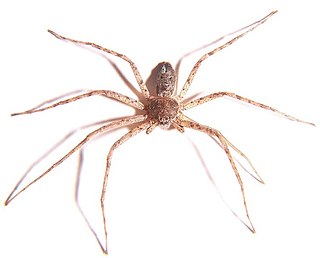
Philodromidae, also known as philodromid crab spiders and running crab spiders, is a family of araneomorph spiders first described by Tord Tamerlan Teodor Thorell in 1870. It contains over 500 species in thirty genera.

Amaurobiidae is a family of three-clawed cribellate or ecribellate spiders found in crevices and hollows or under stones where they build retreats, and are often collected in pitfall traps. Unlidded burrows are sometimes quite obvious in crusty, loamy soil. They are difficult to distinguish from related spiders in other families, especially Agelenidae, Desidae and Amphinectidae. Their intra- and interfamilial relationships are contentious. According to the World Spider Catalog, 2023, the family Amaurobiidae includes 286 species in 50 genera.
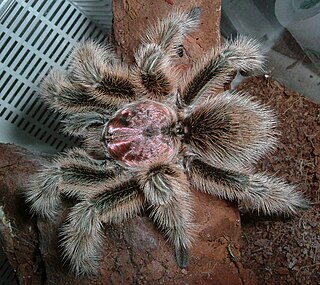
Grammostola is a genus of South American tarantulas that was first described in text by Eugène Louis Simon in 1892. These medium- to large-sized spiders are native to tropical South America, and are usually brown in color, with pinkish or orangish-red hairs. The very docile Chilean rose tarantulas are popular as a beginner's spider among tarantula enthusiasts.

Castianeira is a genus of ant-like corinnid sac spiders first described by Eugen von Keyserling in 1879. They are found in Eurasia, Africa, and the Americas, but are absent from Australia. Twenty-six species are native to North America, and at least twice as many are native to Mexico and Central America.

Phormictopus is a genus of spiders in the family Theraphosidae (tarantulas) that occurs in the West Indies, mainly Cuba and Hispaniola, with three species probably misplaced in this genus found in Brazil and Argentina.

Ero is a genus of pirate spiders first described in 1836. They resemble comb-footed spiders due to their globular abdomen, which is higher than it is long.

Oxyopes is a genus of lynx spiders found worldwide. It includes arounds 300 species and is classified under the lynx spider family Oxyopidae. Like other lynx spiders, they are easily recognizable by the six larger eyes arranged hexagonally on top of the head (prosoma), with the remaining smaller two eyes in front. They are also characterized by long spine-like bristles (setae) on their legs. They are ambush predators, actively hunting prey by sight. Though they produce and use silk, they do not build webs to capture prey.

Synema is a genus of spider in the family Thomisidae, found in most parts of the world.

Sidymella is a genus of spider in the family Thomisidae, found in South America, Australia and New Zealand. It was originally named Sidyma, but this was later found to have been used already for a genus of moths.
Auximella is a genus of South American tangled nest spiders first described by Embrik Strand in 1908.
Centroctenus is a genus of South American wandering spiders first described by Cândido Firmino de Mello-Leitão in 1929.
Gephyroctenus is a genus of South American wandering spiders first described by Cândido Firmino de Mello-Leitão in 1936.
Nothroctenus is a genus of South American wandering spiders first described by H. D. Badcock in 1932.
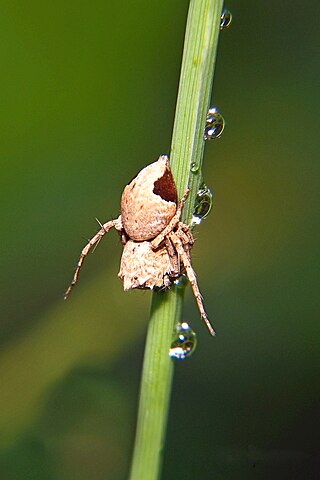
Hamataliwa is a genus of lynx spiders that was first described by Eugen von Keyserling in 1887.
Fageia is a genus of running crab spiders that was first described by Cândido Firmino de Mello-Leitão in 1929.
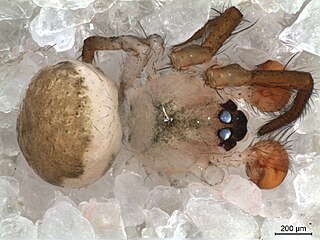
Onocolus is a genus of South American crab spiders first described by Eugène Simon in 1895. It is considered a senior synonym of Paronocolus.


