
Guru Tegh Bahadur was the ninth of ten Gurus who founded the Sikh religion and the leader of Sikhs from 1665 until his beheading in 1675. He was born in Amritsar, Punjab, India in 1621 and was the youngest son of Guru Hargobind, the sixth Sikh guru. Considered a principled and fearless warrior, he was a learned spiritual scholar and a poet whose 115 hymns are included in Sri Guru Granth Sahib, the main text of Sikhism.
The following outline is provides an overview of Sikhism, or Sikhi.

Anandpur Sahib, sometimes referred to simply as Anandpur, is a city in Rupnagar district (Ropar), on the edge of Shivalik Hills, in the Indian state of Punjab. Located near the Sutlej River, the city is one of the most sacred places in Sikhism, being the place where the last two Sikh Gurus, Guru Tegh Bahadur and Guru Gobind Singh, lived. It is also the place where Guru Gobind Singh founded the Khalsa Panth in 1699. The city is home to Takhat Sri Kesgarh Sahib, Third of the five Takhts in Sikhism.

The Takht Sri Darbar Sahib Damdama Sahib, Fourth Takhts or Seat of Temporal Authority of Sikhism, Takht Sri Damdama Sahib is in Talwandi Sabo in Punjab, India and is the place where Guru Gobind Singh, the tenth Sikh Guru, prepared the full version of the Sikh scriptures called Sri Guru Granth Sahib in 1705. The other four Takhts are the Akal Takht, Takht Sri Keshgarh Sahib, Takht Sri Patna Sahib and Takht Sri Hazur Sahib.

Bhai Mani Singh was an 18th-century Sikh scholar and martyr. He was a childhood companion of Guru Gobind Singh and took the vows of Sikhism when the Guru inaugurated the Khalsa in March 1699. Soon after that, the Guru sent him to Amritsar to take charge of Harmandir Sahib, which had been without a custodian since 1696. He took control and steered the course of Sikh destiny at a critical stage in Sikh history.

Fateh Singh Sodhi, commonly referred to with honorifics as Baba Fateh Singh or Sahibzada Baba Fateh Singh was the fourth and youngest son of Guru Gobind Singh. The honorary prefix, Baba is considered as Learned or Respected, while Sahibzada means the "Prince". Fateh Singh and his elder brother Zorawar Singh are among the most hallowed martyrs in Sikhism.

Ajit Singh, also referred to with honorifics as Sahibzada Ajit Singh or Baba Ajit Singh, was the eldest son of Guru Gobind Singh and the son of Mata Sundari. His younger brothers were Jujhar Singh, Zorawar Singh and Fateh Singh. He was martyred in battle during the Second Battle of Chamkaur along with his brother Jujhar Singh. His other two brothers, Zorawar Singh and Fateh Singh, nine and seven years old, respectively, were bricked alive at Fatehgarh Sahib on order of Wazir Khan, governor of Sirhind-Fategarh.
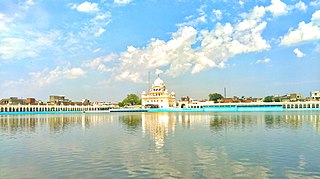
Sri Muktsar Sahib is a historical city and district headquarters in Punjab, India. The 2011 Census of India put the total population of Sri Muktsar Sahib municipality to 117,085, making it the 14th largest city of Punjab, in terms of population. Historically known as Khidrana or Khidrane di dhab, the city was made the district headquarters in 1995. Chronological evidence indicates that the city was named Muktsar after the battle of Muktsar in 1705. Also Guru Angad Dev ji was born in Matte di Sarai (Sarainaga) in same district of Sri Muktsar Sahib. The government officially changed the name of the city to Sri Muktsar Sahib in 2012, though the city is still primarily referred to by its unofficial name – Muktsar.

Mai Bhago also known as Mata Bhag Kaur, was a Sikh woman who led Sikh soldiers against the Mughals in 1705. She was an exceptionally skilled warrior on the battlefield and is revered as a warrior saint in Sikhism. She was known for rallying the 40 Sikhs who abandoned Guru Gobind Singh at the siege of Anandpur Sahib and bringing them back to fight.

Parivar Vichora is a Gurdwara situated on the bank of the river Sirsa in India. This is where the 10th Guru of Sikh, Guru Gobind SIngh Ji's, family got separated.
Gurdwara Mata Sundri is considered to be one of the major historical Gurudwara of the Sikh; it is a landmark on the Mata Sundri road in the heart of Delhi. It is situated behind JP Nayak Hospital, the Gurudwara is a tribute to Mata Sundri, the wife of the 10th Guru – Guru Gobind Singh [4].
Chhotte Sahibzade attained martyrdom on 26 December 1704 at a very young age of 7 & 5 only. This is known as Saka Sirhind or the Chhotte Sahibzada Saka. Every year on 24 to 26 December, Shaheedi Jor Mela also known as Shaheedi Jor Mel/Sabha is organised at Fatehgarh Sahib Punjab, India, to commemorate the supreme sacrifice at the place of their martyrdom.
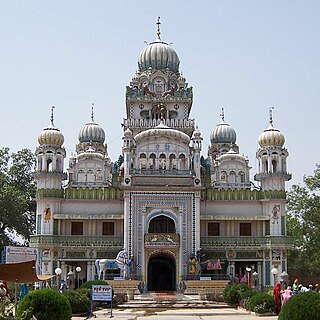
Gurdwara Mehdiana Sahib, also called the 'School of Sikh History' is a Sikh gurdwara located in the village of Mehdiana, just outside Mallha,near Jagraon in Ludhiana district, India.
Baba Jiwan Singh, born Jaitha, was a Sikh general and companion of Guru Gobind Singh.
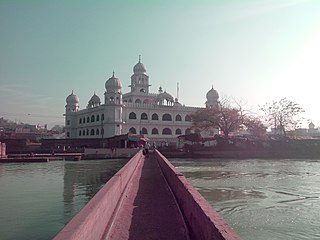
Kiratpur also known as Kiratpur Sahib is a town in Rupnagar district, Punjab, India. The town is the location of the Gurdwara Patal Puri where many Sikhs take ashes of their deceased.
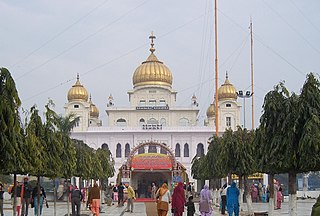
Gurdwara Fatehgarh Sahib is a Sikh gurdwara or place of worship in the city of Fatehgarh Sahib in the Indian state of Punjab. The gurdwara marks the 1710 conquest of the city by the Sikhs under the leadership of Banda Singh Bahadur. Sikhs captured the area and razed the fort built by Ferozshah Tughlaq to the ground.
Sharan Kaur Pabla was a Sikh martyr who was slain in 1705 by Mughal soldiers while cremating the bodies two older sons of Guru Gobind Singh, the 10th Sikh Guru, after the Battle of Chamkaur. She was from the village Raipur Rani which is 2 km from the famous town of Chamkaur.

Hazur Sahib, also known as Takht Sachkhand Sri Hazur Abchalnagar Sahib, is one of the five takhts in Sikhism. The gurdwara was built between 1832 and 1837 by Maharaja Ranjit Singh (1780–1839). It is located on the banks of the Godavari River at the city of Nanded in the state of Maharashtra, India.

Chabhal Kalan is a town in the Tarn Taran district of Punjab, India and is located 13 miles (21 km) away from Amritsar city.


 India
India 
