The white marlin, also known as Atlantic white marlin, marlin, skilligalee, is a species of billfish that lives in the epipelagic zone of the tropical and subtropical Atlantic Ocean. They are found between the latitudes of 45° N and 45° S in waters deeper than 100 m. Even though white marlin are found in bodies of water that are deeper than 100 m they tend to stay near the surface. White marlin have been found near banks, shoals, and canyons, but they are not limited to those locations. They prefer warm surface temperatures greater than 22 °C.

The Atlantic threadfin is a species of ray-finned fish, a threadfin from the family Polynemidae native to subtropical and temperate waters of the western Atlantic Ocean and the Gulf of Mexico.
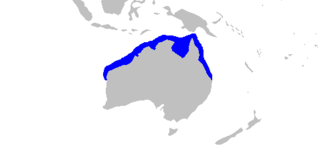
The creek whaler is a common species of requiem shark, and part of the family Carcharhinidae, endemic to northern Australia. It frequents shallow waters close to shore, including estuaries. This small, stocky shark usually grows to 1.0–1.3 m (3.3–4.3 ft) long and is brownish in color without conspicuous fin markings. It can be identified by its long snout, large, triangular pectoral fins, and large, anteriorly positioned first dorsal fin.

The Borneo shark is a species of requiem shark, and part of the family Carcharhinidae. Extremely rare, it is known only from inshore waters around Mukah in northwestern Borneo, though it may once have been more widely distributed. A small, gray shark reaching 65 cm (26 in) in length, this species is the only member of its genus with a row of enlarged pores above the corners of its mouth. It has a slender body with a long, pointed snout and a low second dorsal fin placed posterior to the anal fin origin.
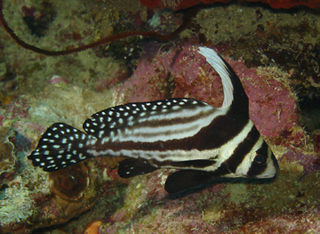
The spotted drum or spotted ribbonfish, is a species of marine ray-finned fish belonging to the family Sciaenidae, the drums and croakers. This species is found in the western Atlantic Ocean.

The giant African threadfin is a species of ray-finned fish from the threadfin family Polynemidae. It is found in the eastern Atlantic Ocean off the west coast of Africa.

Bellator militaris, the horned sea robin, is a species of marine ray-finned fish belonging to the family Triglidae, the sea robins. This fish is found in the western Atlantic Ocean.

The yellow shiner is a species of ray-finned fish in the genus Notropis. It is endemic to Mexico where it is found in the Rio Lerma - Rio Grande de Santiago and Rio Pánuco in central Mexico. It forms a species complex within the genus Notropis with the Ameca shiner and the now-extinct Durango shiner.
The flagtail swellshark is a little-known species of catshark, belonging to the family Scyliorhinidae, found at a depth of 480–700 m (1,570–2,300 ft) off northeastern Queensland, and possibly also nearby islands. This stout-bodied shark has a short, broad, and flattened head with a capacious mouth. Adults have a variegated brown coloration with 9–10 darker dorsal saddles and V-shaped blotch at the tip of the upper caudal fin lobe. Juveniles are yellow with narrow brown bars instead of saddles, and a distinctive marking between the spiracles shaped like two loops connected by a line. Like other swellsharks, this species can inflate its body when threatened.

Bellator egretta, the streamer searobin, is a species of marine ray-finned fish belonging to the family Triglidae, the sea robins. This fish is found in the western Atlantic Ocean.
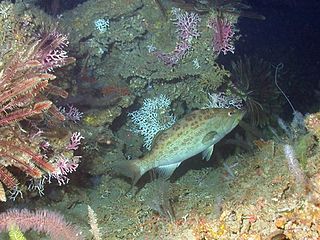
The scamp grouper, also known as scamp, is a species of marine ray-finned fish, a grouper from the subfamily Epinephelinae which is part of the family Serranidae, which also includes the anthias and sea basses. It is found in the western Atlantic Ocean.
The yellowmouth grouper, also known as the crossband rockfish, grey mannock, hamlet, harlequin rockfish, princess rockfish, rockfish, salmon grouper, salmon rock fish or scamp, is a species of marine ray-finned fish, a grouper from the subfamily Epinephelinae which is part of the family Serranidae, which also includes the anthias and sea basses. It is found in the Caribbean and in the tropical waters of the Atlantic Ocean. It is also found in pockets in Brazil. It is a fairly large fish and it gets its name from the yellow around its mouth.

The lunar fusilier, also known as the blue fusilier or moon fusilier, is a species of marine ray-finned fish, a fusilier belonging to the family Caesionidae. It is widespread throughout the tropical waters of the Indo-West Pacific area.
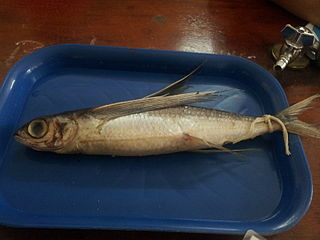
Cheilopogon nigricans, the blacksail flyingfish, also known as African flyingfish, or leaping flyingfish, is a flying fish in the family Exocoetidae. It is an oceanodromous, plankton-eating marine fish which has commercial value.
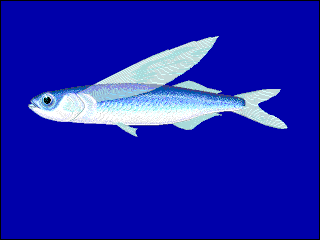
Exocoetus volitans, commonly known as the tropical two-wing flyingfish or blue flyingfish, is a species of ray-finned fish native to tropical and subtropical seas. It can glide above the surface of the sea to escape predators.

Exocoetus obtusirostris, commonly known as the oceanic two-wing flyingfish or the blunt-snouted flyingfish, is a species of ray-finned fish native to the tropical and subtropical western Atlantic Ocean. It has the ability to glide above the surface of the water to escape from predators.

The royal threadfin is a species of ray-finned fish, a threadfin from the family Polynemidae, the threadfins. It is found in the eastern Atlantic Ocean along the western coast of Africa.
Exocoetus peruvianus, commonly known as the Peruvian flyingfish, is a species of ray-finned fish endemic to the tropical southeast Pacific Ocean in the waters off Peru and Ecuador.

Lepidotrigla papilio, the spiny gurnard, butterfly gurnard, Eastern spiny gurnard or Southern spiny gurnard. is a species of demersal marine ray-finned fish belonging to the family Triglidae, the gurnards and sea robins. This species is endemic to Australia.

The brownmargin flathead is a species of marine ray-finned fish belonging to the family Platycephalidae, the flatheads. It is found off northern Australia.