
The Boletales are an order of Agaricomycetes containing over 1300 species with a diverse array of fruiting body types. The boletes are the best known members of this group, and until recently, the Boletales were thought to only contain boletes. The Boletales are now known to contain distinct groups of agarics, puffballs, and other fruiting-body types.

Suillus is a genus of basidiomycete fungi in the family Suillaceae and order Boletales. Species in the genus are associated with trees in the pine family (Pinaceae), and are mostly distributed in temperate locations in the Northern Hemisphere, although some species have been introduced to the Southern Hemisphere.

Suillus luteus is a bolete fungus, and the type species of the genus Suillus. A common fungus native all across Eurasia from Ireland to Korea, it has been introduced widely elsewhere, including North and South America, southern Africa, Australia and New Zealand. Commonly referred to as slippery jack or sticky bun in English-speaking countries, its names refer to the brown cap, which is characteristically slimy in wet conditions. The fungus, initially described as Boletus luteus by Carl Linnaeus in 1753, is now classified in a different fungus family as well as genus. Suillus luteus is edible, though not as highly regarded as other bolete mushrooms. It is commonly prepared and eaten in soups, stews or fried dishes. The slime coating, however, may cause indigestion if not removed before eating. It is often sold as a dried mushroom.

Caloboletus calopus, commonly known as the bitter bolete, bitter beech bolete or scarlet-stemmed bolete, is a fungus of the bolete family, found in Asia, Northern Europe and North America. Appearing in coniferous and deciduous woodland in summer and autumn, the stout fruit bodies are attractively coloured, with a beige to olive cap up to 15 cm (6 in) across, yellow pores, and a reddish stipe up to 15 cm (6 in) long and 5 cm (2 in) wide. The pale yellow flesh stains blue when broken or bruised.
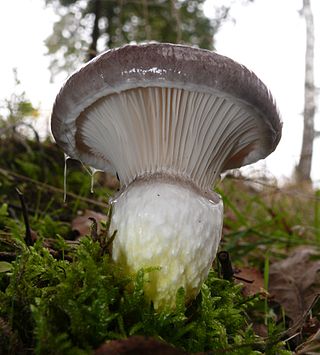
The Gomphidiaceae are a family of mushroom-forming fungi in the order Boletales. Unlike other boletes, all members of Gomphidiaceae are agarics, having gills instead of pores. Member genera include Chroogomphus, Cystogomphus, Gomphidius and Gomphogaster, the last being a monotypic genus that may be incorporated into Gomphidius in the future after molecular assessment. The similarly named genus Gomphus is unrelated to this family. Another genus Brauniellula has since been sunk into Chroogomphus.
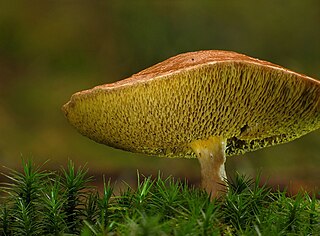
Suillus bovinus, also known as the Jersey cow mushroom or bovine bolete, is a pored mushroom of the genus Suillus in the family Suillaceae. A common fungus native to Europe and Asia, it has been introduced to North America and Australia. It was initially described as Boletus bovinus by Carl Linnaeus in 1753, and given its current binomial name by Henri François Anne de Roussel in 1806. It is an edible mushroom, though not highly regarded.

Chroogomphus is a genus of mushrooms commonly known as pine-spikes or spike-caps based on their shape and because they are often found growing in association with pine trees. The genus is distributed throughout the Northern Hemisphere including North America and Eurasia.

Chroogomphus vinicolor, commonly known as the wine-cap Chroogomphus or the pine spike, is a species of mushroom in the family Gomphidiaceae. Found in North America and the Dominican Republic, mushrooms grow on the ground under pine trees. Fruit bodies have reddish-brown, shiny caps atop tapered stems. The gills are thick, initially pale orange before turning blackish, and extend a short way down the length of the stem. Although the mushroom is edible, and sold in local markets in Mexico, it is not highly rated. Distinguishing this species from some other similar Chroogomphus species is difficult, as their morphology is similar, and cap coloration is too variable to be a reliable characteristic. C. vinicolor is differentiated from the European C. rutilus and the North American C. ochraceus by the thickness of its cystidial walls.
Gomphidius glutinosus, commonly known as the slimy spike-cap, hideous gomphidius, or glutinous gomphidius is a gilled mushroom found in Europe & North America. Although it has gills, it is a member of the order Boletales, along with the boletes. The fruiting bodies sprout in pine, fir and spruce woodland in Europe in autumn. Initially, are completely covered with a slimy veil, breaking through to reveal a greyish or brownish-capped mushroom with decurrent greyish gills which sometimes resembles a child's top. Opinions differ on the suitability of this mushroom for the table, some guides hold it in high regard, while others view it with caution.

Bothia is a fungal genus in the family Boletaceae. A monotypic genus, it contains the single species Bothia castanella, a bolete mushroom first described scientifically in 1900 from collections made in New Jersey. Found in the eastern United States, Costa Rica, China, and Taiwan, it grows in a mycorrhizal association with oak trees. Its fruit body is chestnut brown, the cap is smooth and dry, and the underside of the cap has radially elongated tubes. The spore deposit is yellow-brown. The edibility of the mushroom is unknown. Historically, its unique combination of morphological features resulted in the transfer of B. castanella to six different Boletaceae genera. Molecular phylogenetic analysis, published in 2007, demonstrated that the species was genetically unique enough to warrant placement in its own genus.

Aureoboletus mirabilis, commonly known as the admirable bolete, the bragger's bolete, and the velvet top, is an edible species of fungus in the Boletaceae mushroom family. The fruit body has several characteristics with which it may be identified: a dark reddish-brown cap; yellow to greenish-yellow pores on the undersurface of the cap; and a reddish-brown stem with long narrow reticulations. Aureoboletus mirabilis is found in coniferous forests along the Pacific Coast of North America, and in Asia. Unusual for boletes, A. mirabilis sometimes appears to fruit on the wood or woody debris of Hemlock trees, suggesting a saprobic lifestyle. Despite the occasional appearances to the contrary, Aureoboletus mirabilis is mycorrhizal, and forms a close association with the tree's roots.
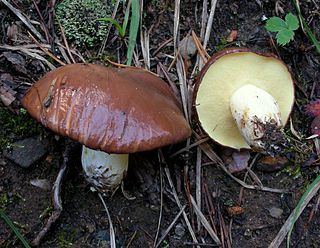
Suillus brevipes is a species of fungus in the family Suillaceae. First described by American mycologists in the late 19th century, it is commonly known as the stubby-stalk or the short-stemmed slippery Jack. The fruit bodies (mushrooms) produced by the fungus are characterized by a chocolate to reddish-brown cap covered with a sticky layer of slime, and a short whitish stipe that has neither a partial veil nor prominent, colored glandular dots. The cap can reach a diameter of about 10 cm, while the stipe is up to 6 cm long and 2 cm thick. Like other bolete mushrooms, S. brevipes produces spores in a vertically arranged layer of spongy tubes with openings that form a layer of small yellowish pores on the underside of the cap.

Suillus lakei, commonly known as the matte Jack, Lake's bolete, or the western painted Suillus, is a species of fungus in the family Suillaceae. It is characterized by the distinctive reddish-brown tufted fibers or small scales on the cap, and the presence of a woolly veil on the stem. The caps can reach diameters of up to 15 cm, while the stems are between 6 and 12 cm long and usually 1–3 cm thick. On the underside of the cap is a layer of spongy yellow to yellow-brown angular pores; these pores are covered with a whitish partial veil when young. A mycorrhizal fungus, S. lakei grows in association with Douglas fir, and is found where this tree occurs. It is native to northwestern North America, but has been introduced to Europe, South America, and New Zealand. The mushroom is edible, but opinions vary considerably as to its quality.
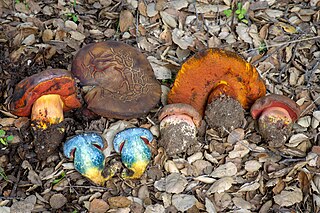
Suillellus amygdalinus is a fungus of the bolete family found in western North America. The fruit bodies, or mushrooms, are characterized by their thick, red to brown caps, red pores, and the strong bluing reaction observed when the mushroom tissue is injured or cut. The cap can reach diameters of up to 12 cm (4.7 in) and the stipe 9 cm (3.5 in) long by 3 cm (1.2 in) thick at maturity. This mushroom has been found in manzanita and madrone woodlands of central California north to southern Oregon. Although the edibility of the mushroom is not known with certainty, it may be poisonous, and is not recommended for consumption. Other similar red-pored, bluing boletes from North America, including Rubroboletus eastwoodiae, Boletus luridiformis, and B. subvelutipes, can be distinguished from S. amygdalinus either by the color of the cap, the degree of reticulation on the stipe, or by location.

Suillus pungens, commonly known as the pungent slippery jack or the pungent suillus, is a species of fungus in the genus Suillus. The fruit bodies of the fungus have slimy convex caps up to 14 cm (5.5 in) wide. The mushroom is characterized by the very distinct color changes that occur in the cap throughout development. Typically, the young cap is whitish, later becoming grayish-olive to reddish-brown or a mottled combination of these colors. The mushroom has a dotted stem (stipe) up to 7 cm (2.8 in) long, and 2 cm (0.8 in) thick. On the underside on the cap is the spore-bearing tissue consisting of minute vertically arranged tubes that appear as a surface of angular, yellowish pores. The presence of milky droplets on the pore surface of young individuals, especially in humid environments, is a characteristic feature of this species. S. pungens can usually be distinguished from other similar Suillus species by differences in distribution, odor and taste. The mushroom is considered edible, but not highly regarded.

Suillus salmonicolor, commonly known as the Slippery Jill, is a fungus in the family Suillaceae of the order Boletales. First described as a member of the genus Boletus in 1874, the species acquired several synonyms, including Suillus pinorigidus and Suillus subluteus, before it was assigned its current binomial name in 1983. It has not been determined with certainty whether S. salmonicolor is distinct from the species S. cothurnatus, described by Rolf Singer in 1945. S. salmonicolor is a mycorrhizal fungus—meaning it forms a symbiotic association with the roots of plants such that both organisms benefit from the exchange of nutrients. This symbiosis occurs with various species of pine, and the fruit bodies of the fungus appear scattered or in groups on the ground near the trees. The fungus is found in North America, Hawaii, Asia, the Caribbean, South Africa, Australia and Central America. It has been introduced to several of those locations via transplanted trees.

Boletus subluridellus is a species of bolete fungus in the family Boletaceae. Described as new to science in 1971 by American mycologists, the bolete is found in the eastern United States and Canada. It grows on the ground in coniferous and mixed forests in a mycorrhizal association with deciduous trees, especially oak. The fruit bodies (mushrooms) have orangish-red, broadly convex caps that are up to 10 cm (3.9 in) in diameter, with small, dark reddish pores on the underside. The pale yellow stipe measures 4–9 cm (1.6–3.5 in) long by 1.5–2.3 cm (0.6–0.9 in) thick. All parts of the fruit body will quickly stain blue when injured or touched.
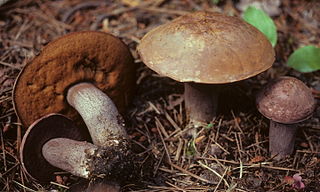
Sutorius eximius, commonly known as the lilac-brown bolete, is a species of fungus in the family Boletaceae. This bolete produces fruit bodies that are dark purple to chocolate brown in color with a smooth cap, a finely scaly stipe, and a reddish-brown spore print. The tiny pores on the cap underside are chocolate to violet brown. It is widely distributed, having been recorded on North America, South America, and Asia, where it grows in a mycorrhizal relationship with both coniferous and deciduous trees.
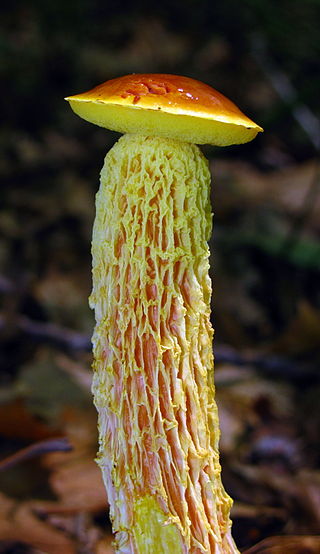
Aureoboletus betula is a species of mushroom producing fungus in the family Boletaceae. It is commonly known as the Shaggy Stalked Bolete.

Chroogomphus subfulmineus is a basidiomycete fungus in the family Gomphidiaceae, described as new to science in 2018.


