| Italian cuisine |
|---|
Cuisine of Veneto or Venetian cuisine (from the city of Venice [1] or more widely in the region of Veneto, Italy) has a centuries-long history, and it is significantly different from the other cuisines of North Italy as well as neighbouring Austria and the cuisines of the Slavic countries, despite sharing some commonalities.
Venice is a city in northeastern Italy and the capital of the Veneto region.
Veneto is one of the 20 regions of Italy. Its population is about five million, ranking fifth in Italy. The region's capital is Venice.
Italy, officially the Italian Republic, is a country in Southern and Western Europe. Located in the middle of the Mediterranean Sea, Italy shares open land borders with France, Switzerland, Austria, Slovenia and the enclaved microstates San Marino and Vatican City. Italy covers an area of 301,340 km2 (116,350 sq mi) and has a largely temperate seasonal and Mediterranean climate. With around 61 million inhabitants, it is the fourth-most populous EU member state and the most populous country in Southern Europe.
Cuisine in Veneto may be divided into three main categories, based on geography: the coastal areas, the plains, and the mountains. Each one (especially the plains) can have many local cuisines, each city with its own dishes.
The most common dish is polenta , which is cooked in various ways within the local cuisines of Veneto. Polenta once was the universal staple food of the poorer classes, who could afford little else. In Veneto, the corns are ground in much smaller fragments in comparison with the rest of Italy: so, when cooked, it tastes like a pudding.
Polenta is a dish of boiled cornmeal that was historically made from other grains. It may be served as a hot porridge, or it may be allowed to cool and solidify into a loaf that can be baked, fried, or grilled.
A staple food, food staple, or simply a staple, is a food that is eaten routinely and in such quantities that it constitutes a dominant portion of a standard diet for a given people, supplying a large fraction of energy needs and generally forming a significant proportion of the intake of other nutrients as well. A staple food of a specific society may be eaten as often as every day or every meal, and most people live on a diet based on just a small number of food staples. Specific staples vary from place to place, but typically are inexpensive or readily available foods that supply one or more of the macronutrients needed for survival and health: carbohydrates, proteins, and fats. Typical examples include tubers and roots, grains, legumes, and seeds.
Typical of many coastal areas, communities along the coast of the Laguna Veneta serve mainly seafood dishes.
Seafood is any form of sea life regarded as food by humans. Seafood prominently includes fish and shellfish. Shellfish include various species of molluscs, crustaceans, and echinoderms. Historically, sea mammals such as whales and dolphins have been consumed as food, though that happens to a lesser extent in modern times. Edible sea plants, such as some seaweeds and microalgae, are widely eaten as seafood around the world, especially in Asia. In North America, although not generally in the United Kingdom, the term "seafood" is extended to fresh water organisms eaten by humans, so all edible aquatic life may be referred to as seafood. For the sake of completeness, this article includes all edible aquatic life.
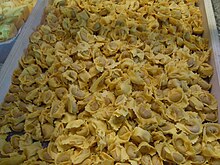
In the plains it is very popular to serve grilled meat (often by a barbecue, and in a mix of pork, beef and chicken meat) together with grilled polenta, potatoes or vegetables. Other popular dishes include risotto , rice cooked with many different kinds of food, from vegetables, mushrooms, pumpkin or radicchio to seafood, pork meat or chicken livers. Bigoli (a typical Venetian fresh pasta, similar to Udon ), fettuccine (hand-made noodles), ravioli and the similar tortelli (filled with meat, cheese, vegetables or pumpkin) and gnocchi (potatoes-made fresh pasta), are fresh and often hand-made pasta dishes (made of eggs and wheat flour), served together with meat sauce (ragù) often made with duck meat, sometimes together with mushrooms or peas, or simply with melted butter. [2]
Barbecue or barbeque is a cooking method, a style of food, and a name for a meal or gathering at which this style of food is cooked and served.
Risotto is a northern Italian rice dish cooked with broth until it reaches a creamy consistency. The broth can be derived from meat, fish, or vegetables. Many types of risotto contain butter, onion, white wine, and parmesan cheese. It is one of the most common ways of cooking rice in Italy. Saffron was originally used for flavour and its attractive yellow colour.
Radicchio is a perennial cultivated form of leaf chicory sometimes known as Italian chicory because it is commonly used in Italian cuisine. It is grown as a leaf vegetable and usually has white-veined red leaves. Radicchio has a bitter and spicy taste, which mellows if it is grilled or roasted.
Cuisine from the mountain areas is mainly made of pork or game meat, with polenta, as well as mushrooms or cheeses (made by cow milk), and some dish from Austrian or Tyrolese tradition, such as canederli or strudel . A typical dish is casunziei , hand-made fresh pasta similar to ravioli.
Game or quarry is any animal hunted for sport or for food, and the meat of those animals. The type and range of animals hunted for food varies in different parts of the world.
Austria, officially the Republic of Austria, is a country in Central Europe comprising 9 federated states. Its capital, largest city and one of nine states is Vienna. Austria has an area of 83,879 km2 (32,386 sq mi), a population of nearly 9 million people and a nominal GDP of $477 billion. It is bordered by the Czech Republic and Germany to the north, Hungary and Slovakia to the east, Slovenia and Italy to the south, and Switzerland and Liechtenstein to the west. The terrain is highly mountainous, lying within the Alps; only 32% of the country is below 500 m (1,640 ft), and its highest point is 3,798 m (12,461 ft). The majority of the population speaks local Bavarian dialects as their native language, and German in its standard form is the country's official language. Other regional languages are Hungarian, Burgenland Croatian, and Slovene.
The history of Tyrol, a historical region in the middle alpine area of Central Europe, dates back to early human settlements at the end of the last glacier period, around 12,000 BC. Sedentary settlements of farmers and herders can be traced back to 5000 BC. Many of the main and side valleys were settled during the early Bronze Age, from 1800 to 1300 BC. From these settlements, two prominent cultures emerged: the Laugen-Melaun culture in the Bronze Age, and the Fritzens-Sanzeno culture in the Iron Age.
Among the typical seasoning of Venetian cuisine, you can find butter, olive oil, sunflower oil, vinegar, kren , senape , mostarda , salsa verde .
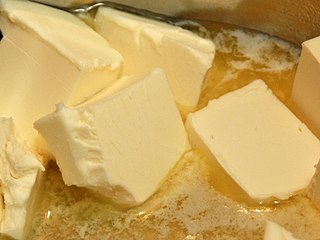
Butter is a dairy product with high butterfat content which is solid when chilled and at room temperature in some regions, and liquid when warmed. It is made by churning fresh or fermented cream or milk to separate the butterfat from the buttermilk. It is generally used as a spread on plain or toasted bread products and a condiment on cooked vegetables, as well as in cooking, such as baking, sauce making, and pan frying. Butter consists of butterfat, milk proteins and water, and often added salt.
Olive oil is a liquid fat obtained from olives, a traditional tree crop of the Mediterranean Basin. The oil is produced by pressing whole olives. It is commonly used in cooking, whether for frying or as a salad dressing. It is also used in cosmetics, pharmaceuticals, and soaps, and as a fuel for traditional oil lamps, and has additional uses in some religions. There is limited evidence of its possible health benefits. The olive is one of three core food plants in Mediterranean cuisine; the other two are wheat and grapes.
Sunflower oil is the non-volatile oil pressed from the seeds of sunflower. Sunflower oil is commonly used in food as a frying oil, and in cosmetic formulations as an emollient. The world's total production of sunflower oil in 2014 was nearly 16 million tonnes, with Ukraine and Russia as the largest producers.
The following are dishes typical of the three subregions of the Veneto. The page for Venetian language provides additional information on writing and pronouncing the dishes' names.
Among the many Venetian desserts, the most well-known are:
Vicenza, along with Venice, has one of the most distinctive cuisines in the Veneto. Previously, the Vicentians were often referred to as the magnagati or mangiagatti (meaning "cat eaters") due to the alleged presence of cats in their cuisine (caused from poverty in the past and during World War II), though the cooking of cats is now illegal in Italy. Typical plates of the city and the surrounding area include:
Tripe is a type of edible lining from the stomachs of various farm animals. Most tripe is from cattle and sheep.
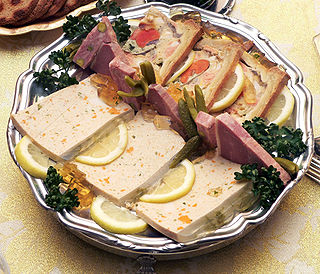
Offal, also called variety meats, pluck or organ meats, refers to the internal organs and entrails of a butchered animal. The word does not refer to a particular list of edible organs, which varies by culture and region, but includes most internal organs excluding muscle and bone. As an English mass noun, the term "offal" has no plural form. Some cultures strongly consider offal as food to be taboo, while others use it as everyday food, or in delicacies. Certain offal dishes—including foie gras, pâté and sweetbread—are considered gourmet food in international cuisine. Others remain part of traditional regional cuisine and may be consumed especially in connection with holidays. This includes Scottish haggis, Jewish chopped liver, U.S. chitterlings, Mexican menudo as well as many other dishes. Intestines are traditionally used as casing for sausages.
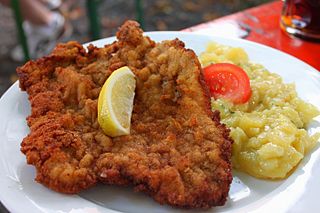
A schnitzel is meat, usually thinned by pounding with a meat tenderizer, that is fried in some kind of oil or fat. The term is most commonly used to refer to meats coated with flour, beaten eggs and bread crumbs, and then fried, but some variants such as Walliser Schnitzel are not breaded. Originating in Austria, the breaded schnitzel is popular in many countries and made using either chicken, veal, mutton, beef, turkey, or pork. It is very similar to the French dish escalope, tonkatsu in Japan, and the milanesa of Mexico, Uruguay, Argentina and Brazil.
Romanian cuisine is a diverse blend of different dishes from several traditions with which it has come into contact, but it also maintains its own character. It has been mainly influenced by a series of European cuisines such as the Austrian cuisine, German cuisine, Greek cuisine, or Hungarian cuisine, yet it also includes culinary elements stemming from the cuisines of the Slavic-speaking countries of Eastern and Central Europe, most notably Serbian and Bulgarian as well as Polish, Ukrainian, and Russian.
Singaporean cuisine is diverse and contains elements derived from several ethnic groups, as a result of its history as a seaport with a large immigrant population. Influences include the cuisines of the native Malays, the largest ethnic group, the Chinese and the third largest ethnic group, the Indians as well as Indonesian, Peranakan and Western traditions. Influences from other regions such as Sri Lanka, Thailand and the Middle East are also present.
Czech cuisine has both influenced and been influenced by the cuisines of surrounding countries. Many of the cakes and pastries that are popular in Central Europe originated within the Czech lands. Contemporary Czech cuisine is more meat-based than in previous periods; the current abundance of farmable meat has enriched its presence in regional cuisine. Traditionally, meat has been reserved for once-weekly consumption, typically on weekends. The body of Czech meals typically consists of two or more courses; the first course is traditionally soup, the second course is the main dish, and the third course can include supplementary courses, such as dessert or compote. In the Czech cuisine, thick soups and many kinds of sauces, both based on stewed or cooked vegetables and meats, often with cream, as well as baked meats with natural sauces (gravies), are popular dishes.
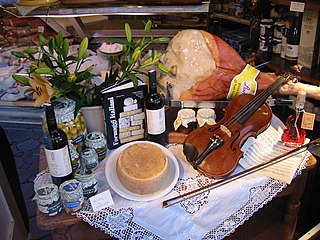
Italian cuisine is food typical of Italy. It has developed through centuries of social and economic changes, with roots stretching to antiquity.
Javanese cuisine is the cuisine of Javanese people, a major ethnic group in Indonesia, more precisely the province of Central Java, Yogyakarta and East Java. Though the cuisine of Sumatra is known for its spiciness with notable Indian and Arabic influences, Javanese cuisine is more indigenously developed and noted for its simplicity. Some of Javanese dishes demonstrate foreign influences, most notably Chinese.
Neapolitan cuisine has ancient historical roots that date back to the Greco-Roman period, which was enriched over the centuries by the influence of the different cultures that controlled Naples and its kingdoms, such as that of Aragon and France.
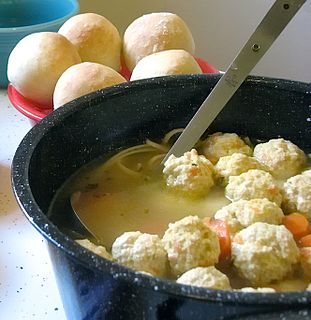
A meatball is ground meat rolled into a small ball, sometimes along with other ingredients, such as bread crumbs, minced onion, eggs, butter, and seasoning.
The regional cuisine of Lombardy is heavily based upon ingredients like maize, rice, beef, pork, butter, and lard. Despite being a form of Italian cuisine, Lombard food, like other cuisine of Northern Italy, tends to have little in common with Central or Southern Italian dishes, in many cases lacking the presence of tomato and olive oil, being more meat-based and buttery. In many aspects, Lombard cuisine has much in common with that of Austria and central Europe in general.
Betawi cuisine is rich, diverse and eclectic, in part because the Betawi people that create them were composed from numbers of regional immigrants that coming from various places in the archipelago, as well as Chinese, Indian, Arab, and European traders, visitors and immigrants that were attracted to the port-city of Batavia since centuries ago.
Barbadian cuisine, also called Bajan cuisine, is a mixture of African, Indian, Irish, Creole and British influences. A typical meal consists of a main dish of meat or fish, normally marinated with a mixture of herbs and spices, hot side dishes, and one or more salads. The meal is usually served with one or more sauces.
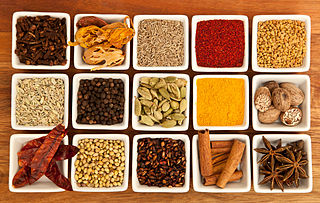
Mizo cuisine is the traditional cuisine of the Mizo people. Mizo are traditionally rice eaters.
|publisher= (help)