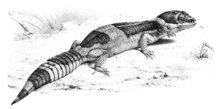
Gehyra mutilata, also known commonly as the common four-clawed gecko, Pacific gecko, stump-toed gecko, sugar gecko in Indonesia, tender-skinned house gecko, and butiki in Filipino, is a species of lizard in the family Gekkonidae. The species is native to Southeast Asia. It has made its way to several areas of the world including Sri Lanka, Indochina, and many of the Pacific Islands. Compared to the common house gecko, the appearance of G. mutilata is somewhat plump, with delicate skin. The skin is usually colored a soft purplish/pinkish gray, with golden spots on younger specimens; these spots eventually fade with age.

Platyceps gracilis, commonly known as the graceful racer or slender racer, is a species of snake endemic to India.

The Indian golden gecko or Beddome's golden gecko is a species of gecko endemic to the Eastern Ghats of India. It was rediscovered from the hills near present-day Tirupati. The rediscovery was after over 100 years since its description.

Calliophis nigriscens, commonly known as the black coral snake or striped coral snake, is a species of venomous elapid snake endemic to the Western Ghats, India.
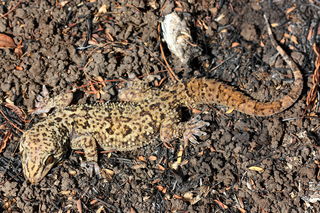
Hemidactylus maculatus, also known as the spotted leaf-toed gecko or giant spotted gecko, is a species of large gecko found in the Western Ghats of India and in parts of Sri Lanka.
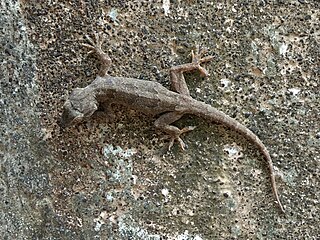
Leschenault's leaf-toed gecko is a species of gecko, a lizard in the family Gekkonidae. The species is endemic to South Asia and parts of West Asia. It is often found inside homes. Its scientific name commemorates French botanist Jean Baptiste Leschenault de la Tour.
Jerdon's day gecko is a species of gecko, a lizard in the family Gekkonidae. The species is endemic to India and Sri Lanka.
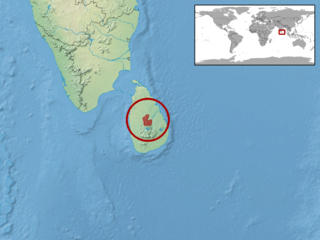
The Kandyan day gecko or Kandyan rock gecko is a species of diurnal gecko found in Sri Lanka.

Cyrtodactylus deccanensis, also commonly known as Deccan ground gecko, Günther's Indian gecko, or the banded ground gecko, is a species of gecko found in the northern Western Ghats of India. It has been found from northern Maharashtra, with a habitat range possibly extending to southern Gujarat. Cyrtodactylus albofasciatus was previously considered conspecific with Cyrtodactylus deccanensis but is now accepted as a valid species.
Cyrtodactylus nebulosus, also known as the clouded Indian gecko, is a species of gecko found in India.

The Malayan forest gecko or banded bent-toed gecko is a species of gecko found in Southeast Asia.
Lawder's bent-toed gecko is a species of gecko, a lizard in the family Gekkonidae. The species is endemic to northern India. Its type locality is "Kumaon", restricted to Almora by Malcolm Arthur Smith. It is named after Mr. A. Lawder who collected the holotype. His identity is not known for sure, but he is likely to have been A.W. Lawder who was a member of the Geological Society of London, as was Ferdinand Stoliczka who described the species. It is sometimes placed in the genus Cyrtopodion.
Hemidactylus karenorum, commonly known as the Burmese leaf gecko, the Burmese leaf-toed gecko, or the Burmese spotted gecko, is a species of gecko, a lizard in the family Gekkonidae. The species is endemic to Southeast Asia.

Hemidactylus persicus, also known as the Persian leaf-toed gecko or Persian gecko, is a species of gecko found in West Asia.
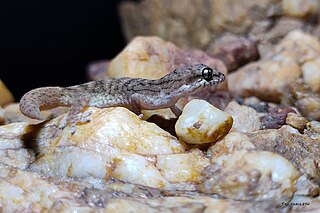
The reticulate leaf-toed gecko is a species of terrestrial, nocturnal, insectivorous gecko found in rocky areas of South India. It takes refuge under stones on ground during day time and emerges out at night for its activities.
Hemidactylus subtriedrus, also known as Jerdon's gecko or Madras blotched gecko, is a species of gecko found in India and Sri Lanka.

Hemidactylus triedrus, also known as the termite hill gecko, Dakota's leaf-toed gecko, or blotched house gecko, is a species of gecko found in South Asia. The race lankae of Sri Lanka, is now given species status and known as Hemidactylus lankae

The spine-bellied sea snake, also commonly known as Hardwicke's sea snake and Hardwicke's spine-bellied sea snake, is a species of venomous sea snake in the family Elapidae.
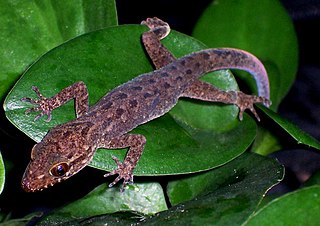
The marbled bow-fingered gecko is a species of gecko found in Southeast Asia.

Eublepharis pictus, the painted leopard gecko, is a species of gecko. It lives in Andhra Pradesh and Odisha, in India. It can grow to 117 mm (4.6 in) in snout–vent length. The species lives in dry evergreen forest mixed in with scrubs and meadows. Eublepharis pictus is nocturnal and has been observed foraging along trails after dusk using its tongue as a sensory organ by licking surfaces. Eublepharis pictus has 23 to 26 rows of large flat tubercle-like keeled scales across the dorsum intermixed with smaller scales. A single pale band between the nuchal loop and the caudal constriction. Smooth subdigital lamellae on digital IV of pes 19; 17–18 precloacal pores in an angulate series lacking a diastema. E. pictus was discovered on the year of 2022 in Andhra Pradesh, in India. The species is widespread in the forest but may be near threatened due to wildlife trade and the illegal smuggling of Eublepharis pictus.