| Football in Morocco | |
|---|---|
| Cameroon's Benoît Assou-Ekotto jostles for possession with Morocco's Mustapha Allaoui during an international friendly match in 2009. | |
| Country | Morocco |
| Governing body | Royal Moroccan Football Federation |
| National teams | Men's national football team, Women's national football team |
| National competitions | |
| Club competitions | |
| International competitions | |
Introduced during French colonial rule football quickly became ingrained in Moroccan culture and the most popular sport in Morocco. Approximately 55% of the Moroccans are considered football fans. [1] Gaining independence in 1956 Moroccan football fell under the control of The governing body of Moroccan football the Royal Moroccan Football Federation. [2] Football in Morocco has witnessed significant development in recent years, with increased international fame. Morocco hosted the 2013 FIFA Club World Cup, in which Moroccan team Raja reached the final, finishing runners-up to German Bundesliga heavyweights Bayern Munich. [3] The most popular clubs in the country are Wydad Casablanca, Raja Casablanca and AS FAR.
The Morocco national football team have won the 1976 African Cup of Nations, three African Nations Championships, and the FIFA Arab Cup once. They have participated in the FIFA World Cup six times. [4] [5] [6] Their best result came in the 2022 World Cup, when they became the first African and Arab national team to reach the semi-finals. [7]
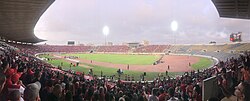
Football was introduced and developed in Morocco under French colonial rule, becoming a large part of Moroccan identity and culture. [8] Since it's introduction football has been used as a voice for people and played an important role in national movements. Teams such as Wydad AC and Raja Club Athletic became important clubs for Moroccan liberation movements as they provided legal places for Moroccans to gather and express themselves and their dissastifaction with French rule. [9] Moroccan clubs continue to be a voice for the public with many ultras groups using chants as a tool to protest against the government. Since its independence Moroccan football has since grown to include a league with a tier system and a club tournament known as the Throne Cup.
Nationally, professional football is divided into 2 leagues: the top-tier GNF 1 and the second-tier GNF 2. Founded in 1915 the Botola Pro 1 is the top-tier division in Morocco and was organized by the Moroccan Football League Association until 1956. In 1956 Morocco gained independence and the league fell under jurisdiction of the Royal Moroccan Football Federation (FRMF). The competition consists of 16 teams with the bottom two teams being relegated to the Botola Pro 2 and the top two teams qualifying for the CAF Champions League. The competition runs from September to May with each team playing a total of 30 matches. The Botola Pro 2 follows the same format with 16 teams with the top two teams being promoted and the bottom two teams being relegated to the third division. [10]
In the top division 20 of 31 clubs have managed to win the league: Wydad AC (22), USM Casablanca (15), AS FAR (13), Raja CA (13), Maghreb Fes (4), KAC Kenitra (4), Racing de Casablanca (3), Kawkab Marrakech (2), Hassania Agadir (2), Moghreb Tétouan (2), FUS Rabat (1), Olympique Khouribga (1), Renaissance de Settat (1), IR Tanger (1), Olympique de Casablanca (1), Mouloudia Oujda (1), CODM de Meknès (1), Chabab Mohammédia (1), Raja de Beni Mellal (1), and Étoile de Casablanca (1), RSB Berkane (1)
The Moroccan Throne Cup was founded in 1957 one year after Moroccos independence and replaced the old Moroccan cup that was played under French colonialism. The tournament features teams from both the first and second division as well as clubs from the first amateur division. The tournament is formated in a knock out format starting with the round of 32 with the winners advancing to the next round. [11]
19 clubs have won the cup: AS FAR (12), Wydad Casablanca (9), Raja Casablanca (8), FUS de Rabat (6), Kawkab Marrakesh (6), MAS Fès (4), Mouloudia Oujda (4), Renaissance Berkane (3), Olympique Casablanca (3), Olympique Khouribga (2), Chabab Mohammédia (2), Difaa El Jadida (1), KAC Kenitra (1), Renaissance de Settat (1), CODM Meknès (1), Racing Casablanca (1), TAS Casablanca (1), Olympic Club Safi (1) and Majd Casablanca (1).
The Morocco national football team, nicknamed Lions de l'Atlas (Atlas Lions), is the national team of Morocco and is controlled by the Royal Moroccan Football Federation. They were the first African team to qualify directly for the World Cup finals, doing so in 1970. They were also the first African team to win a group at the World Cup, finishing ahead of Portugal, Poland, and England in 1986. Morocco fell to eventual runner-up West Germany 1-0 in the second round. [12] In 2022 Morocco finished top of Group F, ahead of Croatia, Belgium and Canada. In the Round of 16, they beat Spain in a penalty shootout, becoming the first Arab country to reach the quarter-finals. The Atlas Lions then defeated Portugal by one goal, before bowing out to France in a close-fought semi-final . [13]
Morocco won the African Nations Cup once, in 1976. [14] They also won the African Nations Championship in 2018, 2020 and 2024 making them the nation with the most amount of wins. [15] [16] [17] Morocco’s U-20 national team accomplished a historic victory in 2025 by winning the U-20 World Cup in Chile, winning against Argentina 2-0 in the final. [18] Moroccan club have also hosted and competed in multiple FIFA Club World Cups, including the tournaments held in 2013, 2014, and 2022. [19] Morocco is also hosting the 2025 Africa Cup of Nations (AFCON). [20] Morocco will become the second African nation to host the FIFA World Cup when it will host the 24th FIFA World Cup in June and July 2030 along with Portugal and Spain.
The Morocco women's national football team represents Morocco in international women's football and is controlled by the Royal Moroccan Football Federation. [21] The team played its first international match in 1998, as part of the 3rd African Women's Championship. In the 14th edition of the Women's Africa Cup of Nations, the Morocco women's team managed to secure a silver medal after a 2-1 loss against South Africa in the 2022 Women's Africa Cup of Nations. [22] They also qualified for the 2023 FIFA Women's World Cup and will be the first Arab country ever to participate in the Women's World Cup. [23] [24] In their first participation in the FIFA Women's World Cup, They placed 2nd after losing 6-0 to Germany, [25] winning 1-0 against South Korea and winning 1-0 against Colombia. [26] [27] This qualified them to the Knock-out stages. [28] In preparation for the 2024 Women's Africa Cup of Nations the team spent a month at the Mohamed VI Football Complex to train, they are led by Ghizlane Chebbak. [29]
While women's football has been present in Morocco, it wasn't until recent years it has gained support among citizens. Some of this new support originated in 2016 when a plan was made in order to support women's football by increasing salaries and accessibility to training for coaching. Morocco's Football Federation also made a new women's proffesional league. [30]
Moroccan clubs are the second most decorated in African competitions with 25 titles: 1 African Cup Winners' Cup, 2 CAF Cup, 8 CAF Confederation Cup, 7 CAF Champions League, 5 CAF Super Cup and 2 Afro-Asian Club Championship.
| Image | Stadium | Capacity | Opened | City | Club |
|---|---|---|---|---|---|
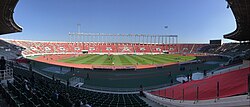
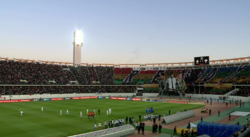
| | Stade Mohamed V | 45,000 [31] | 1955 | Casablanca | Moroccan team Raja Casablanca Wydad Casablanca |
| Ibn Batouta Stadium | 65,000 [32] | 2011 | Tanger | IR Tanger | |
| | Prince Moulay Abdellah Stadium | 53,000 [33] | 1983 | Rabat | Moroccan team FAR Rabat |
| | Adrar Stadium | 45,480 | 2013 | Agadir | Hassania Agadir |
| | Marrakesh Stadium | 45,240 | 2011 | Marrakech | KAC Marrakech |
| | Fez Stadium | 45,000 | 2007 | Fes | Maghreb de Fès Wydad de Fès |
Twitter research from 2015 found that the most popular English Premier League club in Morocco was by far Arsenal, with 55% of Moroccan Premier League fans following the club, followed by Chelsea (14%) and Manchester City (10%). [34]
{{cite web}}: |last= has numeric name (help)