
Tetraodontiformes, also known as the Plectognathi, is an order of ray-finned fishes which includes the pufferfishes and related taxa. This order has been classified as a suborder of the order Perciformes, although recent studies have found that it, as the Tetraodontoidei, is a sister taxon to the anglerfish order Lophiiformes, called Lophiodei, and have placed both taxa within the Acanthuriformes. The Tetraodontiformes are represented by 10 extant families and at around 430 species overall. The majority of the species within this order are marine but a few may be found in freshwater. They are found throughout the world.

The American horned owls and the Old World eagle-owls make up the genus Bubo, at least as traditionally described. The genus name Bubo is Latin for owl.

Phalacrocoracidae is a family of approximately 40 species of aquatic birds commonly known as cormorants and shags. Several different classifications of the family have been proposed, but in 2021 the International Ornithologists' Union (IOU) adopted a consensus taxonomy of seven genera. The great cormorant and the common shag are the only two species of the family commonly encountered in Britain and Ireland and "cormorant" and "shag" appellations have been later assigned to different species in the family somewhat haphazardly.

Gannets are seabirds comprising the genus Morus in the family Sulidae, closely related to boobies, commonly named 'gugas' in Scotland.

The black geese of the genus Branta are waterfowl belonging to the true geese and swans subfamily Anserinae. They occur in the northern coastal regions of the Palearctic and all over North America, migrating to more southerly coasts in winter, and as resident birds in the Hawaiian Islands. Alone in the Southern Hemisphere, a self-sustaining feral population derived from introduced Canada geese is also found in New Zealand.
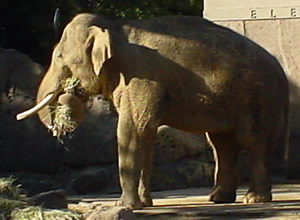
Elephas is one of two surviving genera in the family of elephants, Elephantidae, with one surviving species, the Asian elephant, Elephas maximus. Several extinct species have been identified as belonging to the genus, extending back to the Pliocene or possibly late Miocene.
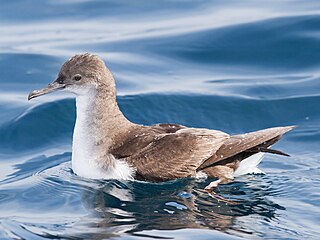
Puffinus is a genus of seabirds in the order Procellariiformes that contains about 20 small to medium-sized shearwaters. Two other shearwater genera are named: Calonectris, which comprises three or four large shearwaters, and Ardenna with another seven species.

Ciconia is a genus of birds in the stork family. Six of the seven living species occur in the Old World, but the maguari stork has a South American range. In addition, fossils suggest that Ciconia storks were somewhat more common in the tropical Americas in prehistoric times.

Eucladoceros is an extinct genus of large deer whose fossils have been discovered across Eurasia, from Europe to China, spanning from the Late Pliocene-Early Pleistocene. It is noted for its unusual comb-like or branching antlers.

Aracanidae, the deep sea boxfishes or temperate boxfishes, are a family of marine ray-finned fishes belonong to the order Tetraodontiformes, which also includes the pufferfishes, triggerfishes and ocean sunfishes. The fishes in this family are found in the Indo-West Pacific region, particularly in the waters around Australia.

The spikefishes are ray-finned fishes related to the pufferfishes and triggerfishes. They live in deep waters; more than 50 m (160 ft), but above the continental shelves. They are found in the Atlantic, Indian Ocean, and the west-central Pacific.

Euthecodon is an extinct genus of long-snouted crocodile. It was common throughout much of Africa during the Neogene, with fossils being especially common in Kenya, Ethiopia, and Libya. Although superficially resembling that of gharials, the long snout was a trait developed independently from that of other crocodilians and suggests a diet of primarily fish. Euthecodon coexisted with a wide range of other crocodiles in the areas it inhabited before eventually going extinct during the Pleistocene.
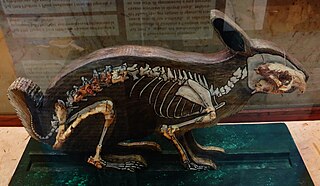
Hypolagus is an extinct genus of lagomorph, first recorded in the Hemingfordian of North America. It entered Asia during the early Turolian and spread to Europe not much later, where it survived until the Middle Pleistocene. Though unknown in the Iberian Peninsula, fossils of this genus have been found in the Balearic Islands, suggesting an eastern migration during the dry period in the Mediterranean region known as the Messinian Salinity Crisis.

Orcinus citoniensis is an extinct species of orca identified in the Late Pliocene of Italy and the Early Pleistocene of England. It was smaller than the modern killer whale, 4 m (13 ft) versus 7 to 10 m, and had around 8 more teeth in its jaw. It may have resembled the modern killer whale in appearance, and could represent a transitional species between the modern killer whale and other dolphins. O. citoniensis could have hunted fish and squid in pods, and coexisted with other large predators of the time such as the orcinine Hemisyntrachelus and the extinct shark Otodus megalodon.

Aracana is a genus of marine ray-finned fishes belonging to the family Aracanidae, the deepwater boxfishes or temperate boxfishes. These fishes are endemic to the waters around Australia.

Kentrocapros is a genus of marine ray-finned fishes belonging to the family Aracanidae, the deepwater boxfishes or temperate boxfishes. These fishes are found in the coastal waters of the Indian and Pacific Oceans.

Aracana ornata, the ornate cowfish or ornate boxfish, is a species of marine ray-finned fish belonging to the family Aracanidae, the deepwater boxfishes or temperate boxfishes. This species is endemic to the seas off southern Australia.

Neolicaphrium is an extinct genus of ungulate mammal belonging to the extinct order Litopterna. This animal lived from the Late Pliocene (Chapadmalalan) to the Late Pleistocene (Lujanian) in southern South America, being the last survivor of the family Proterotheriidae.
Alligator hailensis, or Haile alligator, is a large, extinct species of Alligator known from the early Pleistocene of Florida. It is named after the town of Haile, Florida, where it was found. Its age and skeletal morphology is intermediate between the geologically older Alligator mefferdi and the modern American alligator, making it a transitional fossil.

Solitudo is an extinct genus of tortoise that was found during the Pliocene and Pleistocene on the Mediterranean islands of Menorca, Malta and Sicily. The genus includes three described species, Solitudo robusta, Solitudo gymnesica and Solitudo sicula as well as a likely fourth, undescribed species from Monte Pellegrino in Sicily. Solitudo sicula, the youngest of the species, died out approximately 12.5 thousand years BP. The largest species, Solitudo gymnesica, has been estimated to have reached a carapace length of 1.1–1.3 m (3.6–4.3 ft).


