
Pinus cembroides, also known as pinyon pine, Mexican pinyon, Mexican nut pine, and Mexican stone pine, is a pine in the pinyon pine group, native to western North America. It grows in areas with low levels of rainfall and its range extends southwards from Arizona, Texas and New Mexico in the United States into Mexico. It typically grows at altitudes between 1,600 and 2,400 metres. It is a small pine growing to about 20 m (66 ft) with a trunk diameter of up to 50 cm (20 in). The seeds are large and form part of the diet of the Mexican jay and Abert's squirrel. They are also collected for human consumption, being the most widely used pine nut in Mexico. This is a common pine with a wide range and the International Union for Conservation of Nature has rated its conservation status as being of "least concern".

Doryanthes excelsa, commonly known as the gymea lily, is a flowering plant in the family Doryanthaceae that is endemic to coastal areas of New South Wales near Sydney. It has sword-like leaves more than 1 metre (3 ft) long and it grows a flower spike up to 6 metres (20 ft) high. The apex of the spike bears a large cluster of bright red flowers, each 10 centimetres (4 in) across. Its common name is derived from the name given to the plant by the indigenous [Dharawal] people. The Sydney suburbs of Gymea and Gymea Bay are named after the lily.

Cyrilla racemiflora, the sole species in the genus Cyrilla, is a flowering plant in the family Cyrillaceae, native to warm temperate to tropical regions of the Americas, from the southeastern United States, south through the Caribbean, Mexico and Central America to northern Brazil and Venezuela in South America. Common names include swamp cyrilla, swamp titi, palo colorado, red titi, black titi, white titi, leatherwood, ironwood, he huckleberry, and myrtle.

Abies firma, the momi fir, is a species of fir native to central and southern Japan, growing at low to moderate altitudes of 50–1200 m.

Abies religiosa, the oyamel fir or sacred fir, is a fir native to the mountains of central and southern Mexico and western Guatemala. It grows at high elevations of 2,100–4,100 metres (6,900–13,500 ft) in cloud forests with cool, humid summers and dry winters in most of its habitat regime. In the state of Veracruz, it grows with precipitation all year long. The tree is resistant to regular winter snowfalls.

Brachychiton rupestris is a tree in the family Malvaceae, endemic to Queensland, Australia. Described by Sir Thomas Mitchell and John Lindley in 1848, it earned its name from its bulbous trunk, which can be up to 3.5 metres (11 ft) in diameter at breast height (DBH). Reaching around 10–25 metres (33–82 ft) high, the Queensland bottle tree is deciduous, losing its leaves seasonally, between September and December. The leaves are simple or divided, with one or more narrow leaf blades up to 11 centimetres (4 in) long and 2 centimetres (0.8 in) wide. Cream-coloured flowers appear from September to November, and are followed by woody, boat-shaped follicles that ripen from November to May. No subspecies are recognised.

Adansonia za is a species of baobab in the genus Adansonia of the family Malvaceae. It was originally named in French as anadzahé. Common names in Malagasy include bojy, boringy, bozy, bozybe, ringy, and za, the last of which gives the plant its specific epithet. Eight Adansonia species are recognized, with six endemic to Madagascar. Adansonia za is the most widespread of the Madagascar endemics.
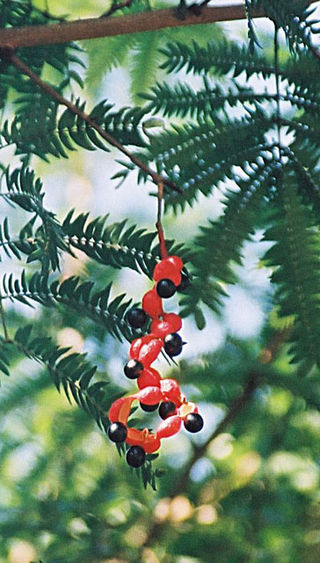
Cojoba arborea is a leguminous tree of the family Fabaceae found in the Caribbean, Mexico, and Central America, southward to Ecuador in South America at elevations of 0–1,300 metres (0–4,265 ft). The tree is not common in naturalized forests, but it can be found in open sites and transition zones.

Agave guiengola, common name "Creme Brulee Agave", is an evergreen plant belonging to the family Asparagaceae. This species is endemic to the State of Oaxaca, Mexico. It grows on limestone slopes, at an elevation of about 100–1,000 metres (330–3,280 ft) above sea level. It is associated with cacti and succulents. The species name guiengola refers to the Cerro Guiengola, the mountain where the species was first discovered.
Melica longiflora is a grass species in the family Poaceae that is endemic to Chile where it can be found from Coquimbo to Talca.

Monstera punctulata is a species of flowering plant from the family Araceae found in the southern part of Mexico and in Central America.
Melica kozlovii is a species of grass found on mountain slopes in Mongolia and China at 2,000–3,900 metres (6,600–12,800 ft) above sea level.
Melica rigida is a species of grass found in Argentina, Brazil, and Uruguay.

Melica penicillaris is a species of grass in the Poaceae family. It is endemic to Inner Anatolia, Turkey, where it grows on bushy hills, rocky slopes, limestone surfaces, and in gullies at 1,000–1,800 metres (3,300–5,900 ft) above sea level.

Agrostis vinealis is a species of grass known by the common names brown bentgrass and brown bent, which can be found from Russia to Mongolia, China, Pakistan, India and Alaska. It was introduced to Greenland and South Georgia and the South Sandwich Islands.
Agrostis tolucensis is a species of grass which is found in South America, the United States, and Mexico.
Alchornea latifolia is a species of tree in the family Euphorbiaceae. It is native to Central and South America, as well as the Caribbean, where its common names include aguacatillo, baconá and chote.

Costus curvibracteatus is a tropical rhizomatous perennial native to Costa Rica and Panama. A member of the spiral ginger family of plants, its common name is orange tulip ginger. It is also sometimes referred to as spiral ginger; however, this common name is better associated with Costus barbatus, a more widely cultivated and very similar species. Despite the name and its relation to the ginger family (Zingiberaceae), the rhizomes of the orange tulip ginger are not edible.

Petrea volubilis, commonly known as purple wreath, queen's wreath or sandpaper vine, is an evergreen flowering vine in the family Verbenaceae, native to Tropical America, that is valued especially for its display of violet flowers.

Arisarum simorrhinum is species of flowering plant of the family Araceae. It is native to the western Mediterranean Basin.


