
Chinatown is the catch-all name for an ethnic enclave of Chinese people located outside Greater China, most often in an urban setting. Areas known as "Chinatown" exist throughout the world, including Europe, Asia, Africa, Oceania, and the Americas.

Fresno County, officially the County of Fresno, is a county located in the central portion of the U.S. state of California. As of the 2020 Census, the population was 1,008,654. The county seat is Fresno, the fifth-most populous city in California.

Madera County, officially the County of Madera, is located at the geographic center of the U.S. state of California. It features a varied landscape, encompassing the eastern San Joaquin Valley and the central Sierra Nevada, with Madera serving as the county seat. Established in 1893 from part of Fresno County, Madera County reported a population of 156,255 in the 2020 census.

Fresno is a major city in the San Joaquin Valley of California, United States. It is the county seat of Fresno County and the largest city in the greater Central Valley region. It covers about 115 square miles (300 km2) and had a population of 542,107 as of the 2020 Census, making it the fifth-most populous city, in California, the most populous inland city in California, and the 34th-most populous city in the nation.

A tong is a type of organization found among Chinese immigrants predominantly living in the United States, with smaller numbers in Canada, Australia, and the United Kingdom. In Chinese, the word tong means "hall" or "gathering place". These organizations are described as secret societies or sworn brotherhoods and are often tied to criminal activity. In the 1990s, in most American Chinatowns, clearly marked tong halls could easily be found, many of which have had affiliations with Chinese organized crime.
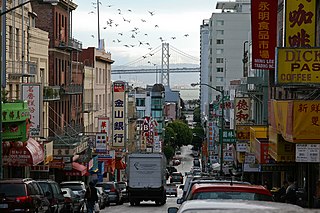
The Chinatown centered on Grant Avenue and Stockton Street in San Francisco, California, is the oldest Chinatown in North America and one of the largest Chinese enclaves outside Asia. It is also the oldest and largest of the four notable Chinese enclaves within San Francisco. Since its establishment in the early 1850s, it has been important and influential in the history and culture of ethnic Chinese immigrants in North America. Chinatown is an enclave that has retained its own customs, languages, places of worship, social clubs, and identity.

Little Saigon is a name given to ethnic enclaves of expatriate Vietnamese mainly in English-speaking countries. Alternate names include Little Vietnam and Little Hanoi, depending on the enclave's political history. To avoid political undertones due to the renaming of Saigon to Ho Chi Minh City, it is occasionally called by the neutral name Vietnamtown. Saigon is the former name of the capital of the former South Vietnam, where a large number of first-generation Vietnamese immigrants emigrating to the United States originate from, whereas Hanoi is the current capital of Vietnam.
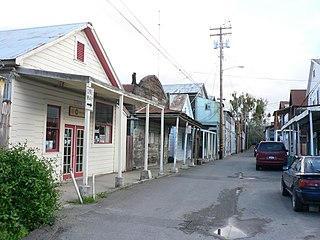
Locke, also known as Locke Historic District, is an unincorporated community in the Sacramento–San Joaquin River Delta of California, United States. The 14-acre town (5.7 ha) was first developed between 1893 and 1915 approximately one mile north of the town of Walnut Grove in Sacramento County.

The San Joaquin Valley is the southern half of California's Central Valley. Famed as a major breadbasket, the San Joaquin Valley is an important source of food, producing a significant part of California's agricultural output.
This article discusses Chinatowns in the Americas, urban areas with a large population of people of Chinese descent. The regions include: Canada, the United States, and Latin America.

The history of Chinese Americans or the history of ethnic Chinese in the United States includes three major waves of Chinese immigration to the United States, beginning in the 19th century. Chinese immigrants in the 19th century worked in the California Gold Rush of the 1850s and the Central Pacific Railroad in the 1860s. They also worked as laborers in Western mines. They suffered racial discrimination at every level of White society. Many Americans were stirred to anger by the "Yellow Peril" rhetoric. Despite provisions for equal treatment of Chinese immigrants in the 1868 Burlingame Treaty between the U.S. and China, political and labor organizations rallied against "cheap Chinese labor".
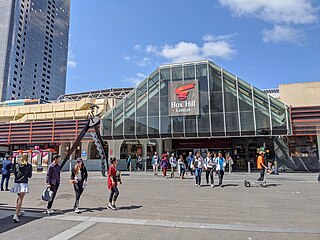
An ethnoburb is a suburban residential and business area with a notable cluster of a particular ethnic minority population. Although the group may not constitute the majority within the region, it is a significant amount of the population. That can greatly influence the social geography within the area because of cultural and religious traditional values exhibited. Ethnoburbs allow for ethnic minority groups to maintain their individual identity, but that may also restrict their ability to fully assimilate into mainstream culture and society.

Millerton was a settlement located on the San Joaquin River and was the original county seat of Fresno County. Millerton was populated from about 1853 to the 1880s and is now inundated by the waters of Millerton Lake.

Fort Miller, also known as Camp Barbour, was a fort on the south bank of the San Joaquin River in what is now Fresno County, California. It lay at an elevation of 561 feet. The site is now under Millerton Lake, formed by the Friant Dam in 1944. It is registered as California Historical Landmark #584.
Chinatowns are enclaves of Chinese people outside of China. The first Chinatown in the United States was San Francisco's Chinatown in 1848, and many other Chinatowns were established in the 19th century by the Chinese diaspora on the West Coast. By 1875, Chinatowns had emerged in eastern cities such as New York City, Boston, and Philadelphia. The Chinese Exclusion Act of 1882 barred Chinese immigration to the United States, but the Magnuson Act of 1943 repealed it, and the population of Chinatowns began to rise again.
Visible minorities have become highly concentrated in Vancouver and its suburbs. The proportion of visible minorities in Vancouver increased from 14 percent to 55 percent of the population between 1981 and 2021. Vancouver has less residential segregation of its ethnic minorities compared to older Canadian cities such as Montreal. However, Vancouver exhibits some residential segregation, as demographic data shows visible minority concentrations vary by neighbourhood in Vancouver. In general, East Vancouver has higher visible minority concentrations than the West Side. Higher visible minority concentrations are also found in nearby suburbs such as Richmond, Surrey, Burnaby, and New Westminster. Most recent immigrants choose to locate in peripheral neighbourhoods in Greater Vancouver. It is speculated that Canada's multiculturalism policies may have prevented greater segregation from the dominant groups in both the residential location and the labour market.
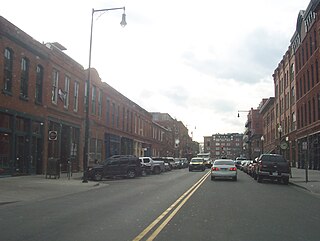
Chinatown in Denver, Colorado, was a residential and business district of Chinese Americans in what is now the LoDo section of the city. It was also referred to as "Hop Alley", based upon a slang word for opium. The first Chinese resident of Denver, Hong Lee, arrived in 1869 and lived in a shanty at Wazee and F Streets and ran a washing and ironing laundry business. More Chinese immigrants arrived in the town the following year. Men who had worked on the construction of the first transcontinental railroad or had been miners in California crossed over the Rocky Mountains after their work was completed or mines were depleted in California.
Anti-Chinese violence in California includes a number of massacres, riots, expulsions and other violent actions that were directed at Chinese American communities in the 19th century. The attacks on Chinese were often sparked by labor disputes. In the 1880s alone, Chinese communities were attacked in 34 towns in California, often resulting in the local Chinatown being looted and burned.

Old Chinatown, or original Chinatown, is a retronym that refers to the location of a former Chinese-American ethnic enclave enforced by legal segregation that existed near downtown Los Angeles, California in the United States from the 1860s until the 1930s. Old Chinatown included the former Calle de los Negros and extended east across Alameda Street to Apablasa, Benjamin, Jeannete, Juan, Marchessault, and Macy Streets. This Chinatown was at its commercial and communal peak between 1890 and 1910.

The Madera Sugar Pine Company was a lumber company that operated in the Sierra Nevada region of California during the late 19th and early 20th centuries. The company distinguished itself through the use of innovative technologies, including the southern Sierra's first log flume and logging railroad, along with the early adoption of the Steam Donkey engine. Its significant regional impact led to the establishment of towns such as Madera, Fish Camp, and Sugar Pine, as well as the growth of Fresno Flats and the formation of Madera County.

