
Fomitopsis betulina, commonly known as the birch polypore, birch bracket, or razor strop, is a common bracket fungus and, as the name suggests, grows almost exclusively on birch trees. The brackets burst out from the bark of the tree, and these fruit bodies can last for more than a year.
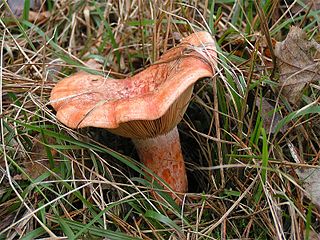
Lactarius deliciosus, commonly known as the delicious milk cap, saffron milk cap, or red pine mushroom, is one of the best known members of the large milk-cap genus Lactarius in the order Russulales. It is native to Europe, but has been accidentally introduced to other countries along with pine trees, with which the fungus is symbiotic.

Tylopilus felleus, commonly known as the bitter bolete or the bitter tylopilus, is a fungus of the bolete family. Its distribution includes east Asia, Europe and eastern North America, extending south into Mexico and Central America. A mycorrhizal species, it grows in deciduous and coniferous woodland, often fruiting under beech and oak. Its fruit bodies have convex to flat caps that are some shade of brown, buff or tan and typically measure up to 15 cm (6 in) in diameter. The pore surface is initially white before turning pinkish with age. Like most boletes it lacks a ring and it may be distinguished from Boletus edulis and other similar species by its unusual pink pores and the prominent dark-brown net-like pattern on its stalk.

Hydnellum peckii is a fungus in the genus Hydnellum of the family Bankeraceae. It is a hydnoid species, producing spores on the surface of vertical spines or tooth-like projections that hang from the undersurface of the fruit bodies. It is found in North America, Europe, and was recently discovered in Iran (2008) and Korea (2010). Hydnellum peckii is a mycorrhizal species, and forms mutually beneficial relationships with a variety of coniferous trees, growing on the ground singly, scattered, or in fused masses.
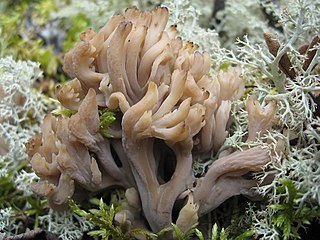
Clavulina cristata, commonly known as the wrinkled coral fungus, white coral fungus or the crested coral fungus, is a white- or light-colored edible coral mushroom present in temperate areas of the Americas and Europe. It is the type species of the genus Clavulina.

Hydnellum aurantiacum is an inedible fungus, commonly known as the orange spine or orange hydnellum for its reddish orange or rusty red colored fruit bodies. Like other tooth fungi, it bears a layer of spines rather than gills on the underside of the cap. Due to substantial declines in sightings, this species is listed as critically endangered in the United Kingdom.

Mycena haematopus, commonly known as the bleeding fairy helmet, the burgundydrop bonnet, or the bleeding Mycena, is a species of fungus in the family Mycenaceae, of the order Agaricales. It is widespread and common in Europe and North America, and has also been collected in old Japan and Venezuela. It is saprotrophic—meaning that it obtains nutrients by consuming decomposing organic matter—and the fruit bodies appear in small groups or clusters on the decaying logs, trunks, and stumps of deciduous trees, particularly beech. The fungus, first described scientifically in 1799, is classified in the section Lactipedes of the genus Mycena, along with other species that produce a milky or colored latex.

Pseudoplectania nigrella, commonly known as the ebony cup, the black false plectania, or the hairy black cup, is a species of fungus in the family Sarcosomataceae. The fruit bodies of this saprobic fungus are small blackish cups, typically up to 2 cm broad.

Hygrophorus eburneus, commonly known as the ivory waxy cap or the cowboy's handkerchief, is a species of edible mushroom in the waxgill family of fungi. Hygrophorus eburneus is the type species of the genus Hygrophorus. The fruit bodies are medium-sized, pure white, and when wet are covered in a layer of slime thick enough to make the mushroom difficult to pick up. The gills are broadly attached to the stem or running down it; as the family name suggests, they feel waxy when rubbed between the fingers.
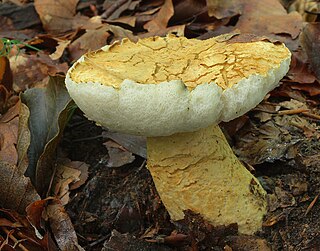
Gyroporus cyanescens, commonly known as the bluing bolete or the cornflower bolete, is a species of bolete fungus in the family Gyroporaceae. First described from France in 1788, the species is found in Asia, Australia, Europe, and eastern North America, where it grows on the ground in coniferous and mixed forests.
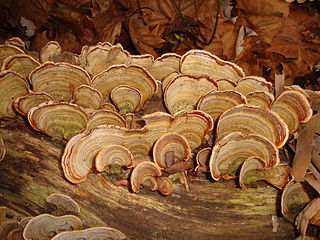
Stereum ostrea, also called false turkey-tail and golden curtain crust, is a basidiomycete fungus in the genus Stereum. It is a plant pathogen and a wood decay fungus. The name ostrea, from the word 'oyster', describes its shape. With concentric circles of many colors, it highly resembles Trametes versicolor, turkey-tail, and is thus called the 'false turkey-tail'. The stemless fruiting body is shell-like and grows 1–7 cm (0.39–2.76 in) high. It is tough and inedible. It grows on tree bark. This fungus is native to the island of Java, Indonesia and has been misapplied to the North American Stereum species Stereum fasciatum, Stereum lobatum, and Stereum subtomentosum.

Mycena aurantiomarginata, commonly known as the golden-edge bonnet, is a species of agaric fungus in the family Mycenaceae. First formally described in 1803, it was given its current name in 1872. Widely distributed, it is common in Europe and North America, and has also been collected in North Africa, Central America, and Japan. The fungus is saprobic, and produces fruit bodies (mushrooms) that grow on the floor of coniferous forests. The mushrooms have a bell-shaped to conical cap up to 2 cm in diameter, set atop a slender stipe up to 6 cm long with yellow to orange hairs at the base. The fungus is named after its characteristic bright orange gill edges. A microscopic characteristic is the club-shaped cystidia that are covered with numerous spiky projections, resembling a mace. The edibility of the mushroom has not been determined. M. aurantiomarginata can be distinguished from similar Mycena species by differences in size, color, and substrate. A 2010 publication reported the discovery and characterization of a novel pigment named mycenaaurin A, isolated from the mushroom. The pigment is responsible for its color, and it has antibiotic activity that may function to prevent certain bacteria from growing on the mushroom.

Thelephora palmata commonly known as the fetid false coral or stinking earthfan, is a species of clavarioid fungus in the family Thelephoraceae. The fruit bodies are leathery and coral-like, with branches that are narrow at the base before widening out like a fan and splitting into numerous flattened prongs. The wedge-like tips are whitish when young, but darken as the fungus matures. The common names of the fungus refers to its pungent odor, likened to fetid garlic. A widely distributed but uncommon species, it is found in Asia, Australia, Europe, North America, and South America, where it fruits on the ground in both coniferous and mixed forest.

Hygrophorus olivaceoalbus, commonly known as the olive wax cap or sheathed waxy cap, is a species of fungus in the genus Hygrophorus. The fruit bodies (mushrooms) appear from midsummer to late autumn under conifers in North American and Eurasian mountain forests. The mushrooms have olive-brown, slimy caps with dark streaks and a dark umbo; the caps measure 3 to 12 cm in diameter. Other characteristic features include a slimy stem up to 12 cm long that is spotted with ragged scales up to a ring-like zone. As its name implies, the mushroom has a waxy cap and gills. It is native to North America and across the northern regions of Europe. According to a publication by the Council of Europe, the fungus is nearly extinct in France.

Boletus curtisii is a species of fungus in the family Boletaceae. It produces small- to medium-sized fruit bodies (mushrooms) with a convex cap up to 9.5 cm (3.7 in) wide atop a slender stem that can reach a length of 12 cm (4.7 in). In young specimens, the cap and stem are bright golden yellow, although the color dulls to brownish when old. Both the stem and cap are slimy or sticky when young. On the underside of the cap are small circular to angular pores. The mushroom is edible, but not appealing. It is found in eastern and southern North America, where it grows in a mycorrhizal association with hardwood and conifer trees. Once classified as a species of Pulveroboletus, the yellow color of B. curtisii is a result of pigments chemically distinct from those responsible for the yellow coloring of Pulveroboletus.
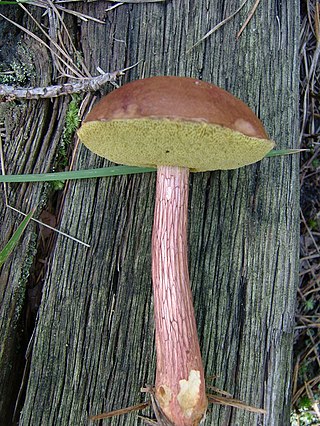
Aureoboletus projectellus is a species of bolete fungus in the family Boletaceae. Found in North America, and recently in Europe, it grows in a mycorrhizal association with pine trees.

Boletinellus merulioides, commonly known as the ash-tree bolete, is a species of bolete fungus in the family Boletinellaceae. Described as new to science in 1832, it is found in Asia and eastern North America, where it grows on the ground near ash trees.

Imleria badia, commonly known as the bay bolete, is an edible, pored mushroom found in Eurasia and North America, where it grows in coniferous or mixed woods on the ground or on decaying tree stumps, sometimes in prolific numbers. Both the common and scientific names refer to the bay- or chestnut-coloured cap, which is almost spherical in young specimens before broadening and flattening out to a diameter up to 15 cm (6 in). On the cap underside are small yellowish pores that turn dull blue-grey when bruised. The smooth, cylindrical stipe, measuring 4–9 cm long by 1–2 cm thick, is coloured like the cap, but paler. Some varieties have been described from eastern North America, differing from the main type in both macroscopic and microscopic morphology.
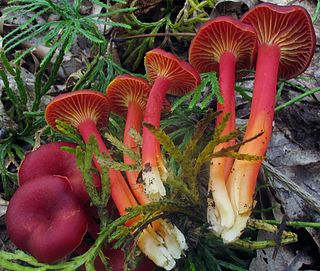
Hygrocybe appalachianensis, commonly known as the Appalachian waxy cap, is a gilled fungus of the waxcap family. It is found in the eastern United States, where it fruits singly, in groups, or clusters on the ground in deciduous and mixed forests. The species, described in 1963 from collections made in the Appalachian Mountains, was originally classified in the related genus Hygrophorus. It was transferred to Hygrocybe in 1998, in which it has been proposed as the type species of section Pseudofirmae.

Sarcodontia setosa is a species of toothed crust fungus in the family Meruliaceae. It is a white rot species that is found in Europe and North America.


