
Arachnids are arthropods in the class Arachnida of the subphylum Chelicerata. Arachnida includes, among others, spiders, scorpions, ticks, mites, pseudoscorpions, harvestmen, camel spiders, whip spiders and vinegaroons.

Pseudoscorpions, also known as false scorpions or book scorpions, are small, scorpion-like arachnids belonging to the order Pseudoscorpiones, also known as Pseudoscorpionida or Chelonethida.

Ricinulei is a small order of arachnids. Like most arachnids, they are predatory; eating small arthropods. They occur today in west-central Africa (Ricinoides) and the Americas from South America to as far north as Texas, where they either inhabit leaf-litter or caves. As of 2022, 103 extant species of ricinuleids have been described worldwide, all in the single family Ricinoididae. In older works they are sometimes referred to as Podogona. Due to their obscurity they do not have a proper common-name, though in academic literature they are occasionally referred to as hooded tickspiders.

Arachnology is the scientific study of arachnids, which comprise spiders and related invertebrates such as scorpions, pseudoscorpions, and harvestmen. Those who study spiders and other arachnids are arachnologists. More narrowly, the study of spiders alone is known as araneology.
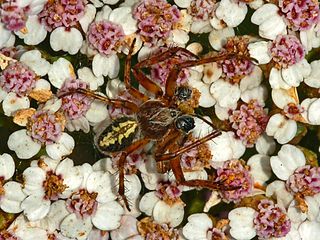
Aculepeira ceropegia, the oak spider, is an orb-weaving spider species belonging to the family Araneidae.
Fissilicreagris is a genus of pseudoscorpions in family Neobisiidae, first described by Božidar Ćurčić in 1984.
Anisoditha is a genus of pseudoscorpions in the family Chthoniidae. There is at least one described species in Anisoditha, A. curvidigitata.

Herbert Walter Levi was professor emeritus of zoology and curator of arachnology at the Museum of Comparative Zoology, Harvard University. He was born in Germany, and was educated there and at Leighton Park School, Reading in England. He then received his higher education at the University of Connecticut and the University of Wisconsin. Levi authored about 150 scientific papers on spiders and on biological conservation. He is the author of the popular Golden Guide Spiders and their Kin, with Lorna Rose Levi and Herbert Zim.
The British Arachnological Society (BAS) is the UK’s first body devoted exclusively to the study of arachnids. The primary objectives of the Society are to encourage interest in arachnology in people of all ages and to generate, promote and disseminate arachnological knowledge and understanding by all suitable means. In particular, it works to foster co-operation between amateur and professional arachnologists.

Chelifer cancroides, the house pseudoscorpion, is a species of pseudoscorpion. It is the most widely distributed species of pseudoscorpion in the world, it occurs in a range of habitats, but it is mostly synanthropic and harmless to humans.

Pseudogarypus synchrotron is an extinct species of pseudoscorpion in the family Pseudogarypidae known from only two Eocene fossils found in Europe. P. synchrotron is one of four species in the genus Pseudogarypus to have been described from fossils.

Arthur Stanley Hirst also known as Stanley Hirst, was an English arachnologist and myriapodologist on the staff of the British Museum, and was an authority on Arachnida, especially Acari Myriapoda.

Hans Henderickx (1961–2016) was a Belgian entomologist specializing in Invertebrates born in Mol, Belgium.
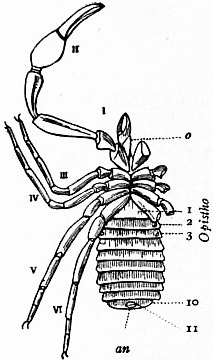
Garypus is a genus of pseudoscorpions in the family Garypidae. It was described by German arachnologist Ludwig Carl Christian Koch in 1873. The species are found mainly in tropical and subtropical areas, where they occupy supralittoral and littoral zones in seashore habitats.
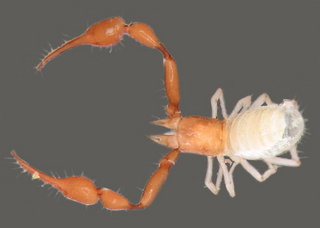
Syarinidae is a family of pseudoscorpions in the order Pseudoscorpiones. There are at least 20 genera and 110 described species in Syarinidae.
Cladolasma, is a genus of harvestmen belonging to the family Nemastomatidae. The genus is monotypic containing a single species Cladolasma parvulum. They are endemic to Japan, with records in Ehime and Tokushima Prefectures. The genus was described by Seisho Suzuki, with the type species Cladolasma parvulum Suzuki, 1963, subsequently revised to Dendrolasma parvulum in Suzuki (1974), but later restored as a valid genus.

Steatoda paykulliana is a species of false black widow spider in the tangle-web spiders family, native to the Mediterranean countries, Southern Europe and Western Asia. The species is named in honor of the Swedish naturalist Gustaf von Paykull (1757–1826).

Wilhelmus Egbertus Antonius Janssen, better known as Father Chrysanthus OFMCap, was a Dutch priest and biology teacher. He was known for his studies in arachnology. Initially he was concerned with the spiders of the Netherlands but he became a specialist on New Guinea spiders. Two spider species were named in his honor following his death.

Geogarypus longidigitatus is a species of pseudoscorpion in the family Geogarypidae. It was first described in 1897 by Australian arachnologist William Joseph Rainbow. Subsequently, several other described species were synonymised with it by Mark Harvey.

Larca is a genus of pseudoscorpions. It is the only genus in the family Larcidae. They are found in North America and Europe.

