Lodoicea, commonly known as the sea coconut, coco de mer, or double coconut, is a monotypic genus in the palm family. The sole species, Lodoicea maldivica, is endemic to the islands of Praslin and Curieuse in the Seychelles. It has the biggest seed in a plant. It formerly also was found on the small islets of St Pierre, Chauve-Souris, and Ile Ronde, all located near Praslin, but had become extinct there for a time until recently reintroduced.

The Brazil nut is a South American tree in the family Lecythidaceae, and it is also the name of the tree's commercially harvested edible seeds. It is one of the largest and longest-lived trees in the Amazon rainforest. The fruit and its nutshell – containing the edible Brazil nut – are relatively large, possibly weighing as much as 2 kg (4.4 lb) in total weight. As food, Brazil nuts are notable for diverse content of micronutrients, especially a high amount of selenium. The wood of the Brazil nut tree is prized for its quality in carpentry, flooring, and heavy construction.

Melicoccus bijugatus is a fruit-bearing tree in the soapberry family Sapindaceae, native or naturalized across the New World tropics including South and Central America, and parts of the Caribbean. Its stone-bearing fruits are edible. It is also called Bajan ackee, genip, guinep, genipe, ginepa, kenèp, quenepa, quenepe, quenette, chenet, skinup, talpa jocote, mamón, limoncillo, canepa, skinip, kenepa, kinnip, huaya, or mamoncillo.

Monstera deliciosa, the Swiss cheese plant or split-leaf philodendron is a species of flowering plant native to tropical forests of southern Mexico, south to Panama. It has been introduced to many tropical areas, and has become a mildly invasive species in Hawaii, Seychelles, Ascension Island and the Society Islands. It is very widely grown in temperate zones as a houseplant.

Cassia fistula, also known as golden shower, purging cassia, Indian laburnum, Kani Konna, or pudding-pipe tree, is a flowering plant in the family Fabaceae. The species is native to the Indian subcontinent and adjacent regions of Southeast Asia. It is the official state flower of Kerala state in India. It is also a popular ornamental plant and is also used in herbal medicine.

Attalea maripa, commonly called maripa palm is a palm native to tropical South America and Trinidad and Tobago. It grows up 35 m (115 ft) tall and can have leaves or fronds 10–12 m (33–39 ft) long. This plant has a yellow edible fruit which is oblong ovoid and cream. An edible oil can be extracted from the pulp of the fruit and from the kernel of the seed.

Diospyros nigra, the black sapote, is a species of persimmon. Common names include chocolate pudding fruit, black soapapple and zapote prieto. The tropical fruit tree is native to Mexico, Central America, and Colombia. The common name sapote refers to any soft, edible fruit. Black sapote is not related to white sapote nor mamey sapote. The genus Diospyros has numerous other fruit bearing tree species in addition to the persimmons and black sapote.

Lonicera caerulea, also known by its common names blue honeysuckle, sweetberry honeysuckle, fly honeysuckle, blue-berried honeysuckle, or the honeyberry, is a non-climbing honeysuckle native throughout the cool temperate Northern Hemisphere regions of North America, Europe, and Asia.

Castanea pumila, commonly known as the Allegheny chinquapin, American chinquapin or dwarf chestnut, is a species of chestnut native to the southeastern United States. The native range is from Massachusetts and New York to Maryland and extreme southern New Jersey and southeast Pennsylvania south to central Florida, west to eastern Texas, and north to southern Missouri and Kentucky. The plant's habitat is dry sandy and rocky uplands and ridges mixed with oak and hickory to 1000 m elevation. It grows best on well-drained soils in full sun or partial shade.

Pachira aquatica is a tropical wetland tree in the mallow family Malvaceae, native to Central and South America where it grows in swamps. It is known by its common names Malabar chestnut, French peanut, Guiana chestnut, Provision tree, Saba nut, Monguba (Brazil), Pumpo (Guatemala) and is commercially sold under the names Money tree and Money plant. This tree is sometimes sold with a braided trunk and is commonly grown as a houseplant, although more commonly what is sold as a "Pachira aquatica" houseplant is in fact a similar species, P. glabra.

Lecythis pisonis, the cream nut or monkey pot, is a tropical tree in the Brazil nut family Lecythidaceae. It is known in its native tropical America as sapucaia or castanha-de-sapucaia. The fruit is shaped like a cooking pot and contains edible seeds.
Lecythis ollaria is a species of tree found growing in forests in Brazil, Guyana, and Venezuela. The tree is known locally as coco de mono, and accumulates selenium in its tissues.

Dypsis ambositrae is a species of flowering plant in the family Arecaceae. It is found only in Madagascar where it is threatened by habitat loss.

Illicium floridanum is an evergreen shrub native to the Gulf Coast area of the Southern United States, from Florida to Louisiana.
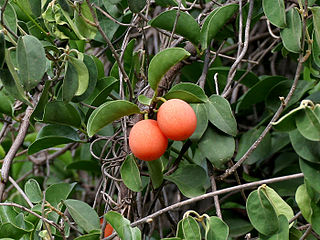
Ximenia americana, commonly known as tallow wood, hog plum, yellow plum, sea lemon, or pi'ut (Chamorro), is bush-forming shrub/small tree; a species from the Ximenia genus in the Olacaceae family. It is mainly found in the tropics, ranging from Africa, India and southeast Asia, to Australia, New Zealand, Pacific Islands, West Indies, Central, North and South America. It is especially common in Africa and South America. It is not domesticated so it is only found occurring in the wild.

Semecarpus australiensis, commonly known as the tar tree, native cashew, marking nut, or cedar plum, is a species of tree in the cashew, sumac and mango family Anacardiaceae, native to parts of Melanesia and northern Australia. Contact with the plant can cause serious allergic reactions, a common characteristic of this family.

Elaeocarpus bancroftii, commonly known as Kuranda quandong, Johnstone River almond, ebony heart, grey nut, or nut tree is a large rainforest tree in the family Elaeocarpaceae which is endemic to Queensland. It has coriaceous leaves, attractive white flowers and relatively large fruit containing an edible kernel.

Inocarpus fagifer, commonly known as the Tahitian chestnut or Polynesian chestnut, is a species of flowering plant in the subfamily Faboideae of the legume family, Fabaceae. The tree has a wide range in the tropics of the south-west Pacific and south-east Asian regions, and a history of traditional use by the peoples of Polynesia and Melanesia. It is the only edible and culturally important member of the genus Inocarpus.

Lecythis zabucajo, the sapucaia or paradise nut, is a large nut-producing tree occurring in the Guianas, Suriname, Venezuela, Ecuador, Honduras and Brazil, and which distribution range is much the same as that of the greater spear-nosed bat. Although not singling out Lecythis zabucajo, Jacques Huber noted in 1909 that fruit bats played the most important role in seed dispersal in Amazonian forests. The quality of its nuts led to the species' being introduced to numerous tropical countries, notably Trinidad, where it has flourished. The nuts are a valuable food resource and yield oil suitable for cooking and domestic use.

Lecythis ampla is a species of woody plant in the family Lecythidaceae, which also includes the Brazil nut. Common names include coco, olla de mono, jicaro and salero. It is found in Central and South America. It has been considered an endangered species in Costa Rica.