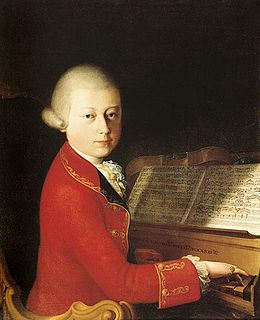
Wolfgang Amadeus Mozart's operas comprise 22 musical dramas in a variety of genres. They range from the small-scale, derivative works of his youth to the full-fledged operas of his maturity. Three of the works were abandoned before completion and were not performed until many years after the composer's death. His mature works are all considered classics and have never been out of the repertory of the world's opera houses. [1]
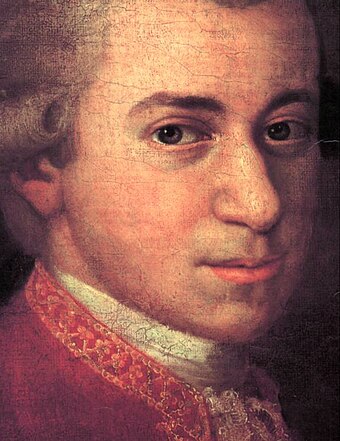
Wolfgang Amadeus Mozart, baptised as Johannes Chrysostomus Wolfgangus Theophilus Mozart, was a prolific and influential composer of the classical era.
Opera is a form of theatre in which music has a leading role and the parts are taken by singers, but is distinct from musical theater. Such a "work" is typically a collaboration between a composer and a librettist and incorporates a number of the performing arts, such as acting, scenery, costume, and sometimes dance or ballet. The performance is typically given in an opera house, accompanied by an orchestra or smaller musical ensemble, which since the early 19th century has been led by a conductor.
From a very young age Mozart had, according to opera analyst David Cairns, "an extraordinary capacity [...] for seizing on and assimilating whatever in a newly encountered style (was) most useful to him". [2] In a letter to his father, dated 7 February 1778, Mozart wrote, "As you know, I can more or less adopt or imitate any kind and style of composition". [3] He used this gift to break new ground, becoming simultaneously "assimilator, perfector and innovator". [2] Thus, his early works follow the traditional forms of the Italian opera seria and opera buffa as well as the German Singspiel. In his maturity, according to music writer Nicholas Kenyon, he "enhanced all of these forms with the richness of his innovation", [1] and, in Don Giovanni , he achieved a synthesis of the two Italian styles, including a seria character in Donna Anna, buffa characters in Leporello and Zerlina, and a mixed seria-buffa character in Donna Elvira. [1]
David Adam Cairns is a British journalist, non-fiction writer and musician. He is a leading authority on the life of Berlioz.
Opera seria is an Italian musical term which refers to the noble and "serious" style of Italian opera that predominated in Europe from the 1710s to about 1770. The term itself was rarely used at the time and only attained common usage once opera seria was becoming unfashionable and beginning to be viewed as a historical genre. The popular rival to opera seria was opera buffa, the 'comic' opera that took its cue from the improvisatory commedia dell'arte.
Opera buffa is a genre of opera. It was first used as an informal description of Italian comic operas variously classified by their authors as commedia in musica, commedia per musica, dramma bernesco, dramma comico, divertimento giocoso.
Ideas and characterisations introduced in the early works were subsequently developed and refined. For example, Mozart's later operas feature a series of memorable, strongly drawn female characters, in particular the so-called "Viennese soubrettes" who, in opera writer Charles Osborne's phrase, "contrive to combine charm with managerial instinct". [4] Music writer and analyst Gottfried Kraus has remarked that all these women were present, as prototypes, in the earlier operas; Bastienne (1768), and Sandrina ( La finta giardiniera , 1774) are precedents for the later Constanze and Pamina, while Sandrina's foil Serpetta is the forerunner of Blonde, Susanna, Zerlina and Despina. [5]
Charles Thomas Osborne was an Australian journalist, theatre and opera critic, poet and novelist. He was the assistant editor of The London Magazine from 1958 until 1966, literature director of the Arts Council of Great Britain from 1971 until 1986, and chief theatre critic of Daily Telegraph (London) from 1986 to 1991.
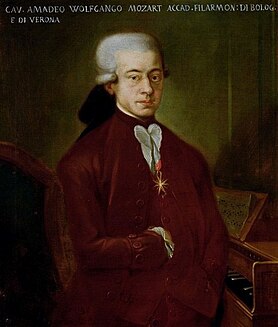
La finta giardiniera, K. 196, is an Italian-language opera by Wolfgang Amadeus Mozart. Mozart wrote it in Munich in January 1775 when he was 18 years old and it received its first performance on 13 January at the Salvatortheater in Munich. There is debate over the authorship of the libretto; often ascribed to Calzabigi, some have attributed it to Giuseppe Petrosellini, but it is questioned whether it is in the latter's style.
Mozart's texts came from a variety of sources, and the early operas were often adaptations of existing works. [6] The first librettist chosen by Mozart himself appears to have been Giambattista Varesco, for Idomeneo in 1781. [7] Five years later, he began his most enduring collaboration, with Lorenzo Da Ponte, his "true phoenix". [8] The once widely held theory that Da Ponte was the librettist for the discarded Lo sposo deluso of 1783 has now been generally rejected. [9] Mozart felt that, as the composer, he should have considerable input into the content of the libretto, so that it would best serve the music. Musicologist Charles Rosen writes, "it is possible that Da Ponte understood the dramatic necessities of Mozart's style without prompting; but before his association with da Ponte, Mozart had already bullied several librettists into giving him the dramatically shaped ensembles he loved." [10] [11]
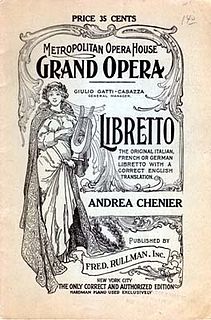
A libretto is the text used in, or intended for, an extended musical work such as an opera, operetta, masque, oratorio, cantata or musical. The term libretto is also sometimes used to refer to the text of major liturgical works, such as the Mass, requiem and sacred cantata, or the story line of a ballet.
Father Giambattista Varesco was a chaplain, musician, poet and librettist to Wolfgang Amadeus Mozart. His given name variously appears as Giambattista, Gianbattista, Giovanni Battista and Girolamo Giovanni Battista. He is sometimes referred to with the Italian title Abate or the French Abbé, both used for priests: he was chaplain at the Salzburg court chapel from 1766.
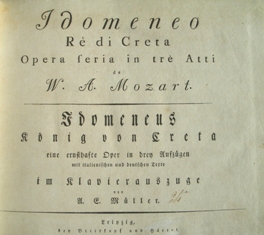
Idomeneo, re di Creta ossia Ilia e Idamante is an Italian language opera seria by Wolfgang Amadeus Mozart. The libretto was adapted by Giambattista Varesco from a French text by Antoine Danchet, which had been set to music by André Campra as Idoménée in 1712. Mozart and Varesco were commissioned in 1780 by Karl Theodor, Elector of Bavaria for a court carnival. He probably chose the subject, though it might have been Mozart. The work premiered on 29 January 1781 at the Cuvilliés Theatre in Munich, Germany.
The list includes all the theatrical works generally accepted as composed by Wolfgang Amadeus Mozart. In this context "theatrical" means performed on a stage, by vocalists singing in character, in accordance with stage directions. Some sources have adopted more specific criteria, leading them to exclude the early "Sacred Singspiel" Die Schuldigkeit des ersten Gebots , [12] which they classify as an oratorio. [13] However, as Osborne makes clear, the libretto contains stage directions which suggest that the work was acted, not merely sung, and it is formally described as a "geistliches Singspiel" (sacred play with music), not as an oratorio. [14] The Singspiel Der Stein der Weisen was written in collaboration with four other composers, so it is only partially credited to Mozart.
Die Schuldigkeit des ersten Gebots, K. 35, is a sacred musical play composed by Wolfgang Amadeus Mozart in 1767 when he was 11 years old. It is Mozart's first opera or, more specifically, sacred drama, as is suggested by the name. The libretto is now attributed to Ignatz Anton von Weiser, although Johann Adam Wieland or Jakob Anton Marianus Wimmer had been suggested earlier. Only the first part of the opera was composed by Mozart; the second and third parts were contributed by Michael Haydn and Anton Cajetan Adlgasser respectively. However, these other two parts have not survived. Part 1 of the opera was first performed on March 12, 1767, in the Knight's Hall of the Palace of the Archbishop, the Salzburg Residenz. Part 2 was performed on March 19, and part 3 on March 26.
An oratorio is a large musical composition for orchestra, choir, and soloists. Like most operas, an oratorio includes the use of a choir, soloists, an instrumental ensemble, various distinguishable characters, and arias. However, opera is musical theatre, while oratorio is strictly a concert piece – though oratorios are sometimes staged as operas, and operas are sometimes presented in concert form. In an oratorio the choir often plays a central role, and there is generally little or no interaction between the characters, and no props or elaborate costumes. A particularly important difference is in the typical subject matter of the text. Opera tends to deal with history and mythology, including age-old devices of romance, deception, and murder, whereas the plot of an oratorio often deals with sacred topics, making it appropriate for performance in the church. Protestant composers took their stories from the Bible, while Catholic composers looked to the lives of saints, as well as to Biblical topics. Oratorios became extremely popular in early 17th-century Italy partly because of the success of opera and the Catholic Church's prohibition of spectacles during Lent. Oratorios became the main choice of music during that period for opera audiences.
In general, the list follows the sequence in which the operas were written. There is uncertainty about whether La finta semplice was written before or after Bastien und Bastienne , and in some listings the former is given priority. [15] Thamos was written in two segments, the earlier in 1774, but is listed in accordance with its completion in 1779–80. Die Zauberflöte and La clemenza di Tito were written concurrently. Die Zauberflote was started earlier and put aside for the Tito commission, [16] which was completed and performed first and is usually listed as the earlier work despite having a higher Köchel catalogue number.
La finta semplice, K. 51 (46a) is an opera buffa in three acts for seven voices and orchestra, composed in 1768 by then 12-year-old Wolfgang Amadeus Mozart. Young Mozart and his father Leopold were spending the year in Vienna, where Leopold was trying to establish his son as an opera composer. He was acting on a suggested request from the Emperor Joseph II that the young boy should write an opera.
Bastien und Bastienne, K. 50 is a one-act singspiel, a comic opera, by Wolfgang Amadeus Mozart.
Thamos, King of Egypt is a play by Tobias Philipp, baron von Gebler, for which, between 1773 and 1780, Wolfgang Amadeus Mozart wrote incidental music, K. 345/336a, of an operatic character.
Note: Eng refers to English translation of title
| Köchel No. [17] | Year composed | Title | Language | Type of opera [18] | Librettist [19] | Voice parts [20] | First performance details [21] |
|---|---|---|---|---|---|---|---|
| K.35 | 1767 | Die Schuldigkeit des ersten Gebots , Part I [22] Eng: The Obligation of the first and foremost Commandment Score | German | Sacred Singspiel | Ignaz von Weiser [23] | 3 soprano, 2 tenor | Archbishop's Palace, Salzburg, 12 March 1767 |
| K.38 | 1767 | Apollo et Hyacinthus Eng: Apollo and Hyacinth Score | Latin | Musical setting of a Latin text [24] | Rufinus Widl, after Ovid's Metamorphoses | 2 treble, 2 boy alto, 1 tenor, 2 bass, chorus [25] | Great Hall, University of Salzburg, 13 May 1767 |
| K.50 [26] | 1768 | Bastien und Bastienne Eng: Bastien and Bastienne Score | German | Singspiel in one act | F. W. Weiskern and J. H. Muller [27] | 1 soprano, 1 tenor, 1 bass | First confirmed performance: Architektenhaus, Berlin, 2 October 1890. Unconfirmed performance: Vienna, October 1768, in the garden of Dr Franz Mesmer. [28] |
| K.51 [29] | 1768 | La finta semplice Eng: The Feigned Simpleton Score | Italian | Opera buffa in three acts | Marco Coltellini, after Carlo Goldoni | 2 soprano, 1 contralto (or mezzo-soprano), 2 tenor, 2 bass [30] | Archbishop's Palace, Salzburg, 1 May 1769 |
| K.87 [31] | 1770 | Mitridate, re di Ponto Eng: Mithridates, King of Pontus Score | Italian | Opera seria in three acts | Vittorio Amedeo Cigna-Santi, after an Italian translation of Jean Racine's Mithridate by Giuseppe Parini | 4 soprano, 1 alto, 2 tenor [32] | Teatro Regio Ducal, Milan, 26 December 1770 |
| K.111 | 1771 | Ascanio in Alba Eng: Ascanius in Alba Score | Italian | Festspiel [33] in two acts | Giuseppe Parini | 4 soprano, 1 tenor, chorus [34] | Teatro Regio Ducal, Milan, 17 October 1771 |
| K.126 | 1772 | Il sogno di Scipione Eng: Scipio's Dream Score | Italian | Azione teatrale, or Serenata drammatica, in one act | Metastasio, after Cicero's Somnium Scipionis | 3 soprano, 3 tenor, chorus | Archbishop's Palace, Salzburg, probably 1 May 1772 [35] |
| K.135 | 1772 | Lucio Silla Eng: Lucius Sulla Score | Italian | Dramma per musica in three acts | Giovanni de Gamerra, revised by Metastasio | 4 soprano, 2 tenor, chorus [36] | Teatro Regio Ducal, Milan, 26 December 1772 |
| K.196 | 1774 | La finta giardiniera Eng: The Pretend Garden-Maid | Italian | Dramma giocoso in three acts [37] | Probably Giuseppe Petrosellini [38] | 4 soprano, 2 tenor, 1 bass, chorus [39] | Salvatortheater, Munich, 13 January 1775 |
| K.208 | 1775 | Il re pastore Eng: The Shepherd King Score | Italian | Serenata in two acts | Metastasio, amended by Giambattista Varesco, after Torquato Tasso's Aminta [40] | 3 soprano, 2 tenor [41] | Archbishop's Palace, Salzburg, 23 April 1775 |
| K.345 [42] | 1773 and 1779 | Thamos, König in Ägypten Eng: Thamos, King of Egypt Score | German | Choruses and entr'actes for a heroic drama | Tobias Philipp von Gebler | Chorus and soloists: soprano, alto, tenor, bass | Kärntnertor Theatre, Vienna 4 April 1774 (two choruses); first complete performance Salzburg, 1779–80 |
| K.344 [43] | 1779 | Zaide Eng: Zaide Score | German | Singspiel (incomplete) | Johann Andreas Schachtner | 1 soprano, 2 tenor, 2 bass, ensemble (mini-chorus) of 4 tenors, 1 speaking role | Frankfurt (location unrecorded), 27 January 1866. Not performed during Mozart's lifetime. |
| K.366 | 1780–81 | Idomeneo, re di Creta Eng: Idomeneus, King of Crete Score | Italian | Dramma per musica in three acts | Giambattista Varesco, after Antoine Danchet's Idoménée | 3 soprano, 1 mezzo-soprano, 4 tenor, 1 baritone, 2 bass, chorus [44] | Court Theatre (now Cuvilliés Theatre), Munich, 29 January 1781 |
| K.384 | 1782 | Die Entführung aus dem Serail Eng: The Abduction from the Seraglio Score | German | Singspiel in three acts | Gottlieb Stephanie, after Christoph Friedrich Bretzner's Belmont und Constanze, oder Die Entführung aus dem Serail | 2 soprano, 2 tenor, 1 bass, 2 speaking roles [45] | Burgtheater, Vienna, 16 July 1782 |
| K.422 | 1784 | L'oca del Cairo Eng: The Goose of Cairo Score | Italian | Dramma giocoso (incomplete) in three acts | Giambattista Varesco | (Provisional) 4 soprano, 2 tenor, 2 bass, chorus | Théâtre des Fantaisies-Parisiennes, Paris, 6 June 1867. Not performed in Mozart's lifetime. |
| K.430 [46] | 1784 | Lo sposo deluso Eng: The Deluded Bridegroom Score | Italian | Opera buffa (incomplete) in two acts | Unknown. The libretto was once attributed to Lorenzo Da Ponte [47] but possibly may have been by Giuseppe Petrosellini. [9] [48] | (Provisional) 3 soprano, 2 tenor, 2 bass | Théâtre des Fantaisies-Parisiennes, Paris, 6 June 1867. [49] Not performed in Mozart's lifetime. |
| K.486 | 1786 | Der Schauspieldirektor Eng: The Impresario Score | German | Comedy with music in one act | Gottlieb Stephanie | 2 soprano, 1 tenor, 1 bass, 6 speaking roles | Schönbrunn Palace, Vienna, 7 February 1786 |
| K.492 | 1786 | Le nozze di Figaro Eng: The Marriage of Figaro Score | Italian | Opera buffa in four acts | Lorenzo da Ponte, after Pierre Beaumarchais's La folle journée, ou le Mariage de Figaro | 3 soprano, 2 mezzo-soprano, 2 tenor, 1 baritone, 3 bass, chorus [50] | Burgtheater, Vienna, 1 May 1786 |
| K.527 | 1787 | Don Giovanni [51] Eng: Don Giovanni or Don Juan Score | Italian | Dramma giocoso in two acts | Lorenzo Da Ponte, after Giovanni Bertati's Don Giovanni Tenorio | 3 soprano, 1 tenor, 1 baritone, 3 bass, chorus | Estates Theatre, Prague (also known as Nostitz-Theater and Tyl theatre), 29 October 1787 [52] |
| K.588 | 1790 | Così fan tutte Eng: Women are like that or All women do that [53] Score | Italian | Dramma giocoso in two acts | Lorenzo Da Ponte | 3 soprano, 1 tenor, 1 baritone, 1 bass, chorus | Burgtheater, Vienna, 26 January 1790 |
| K.592a | 1790 | Der Stein der Weisen Eng: The Philosopher's Stone Note: Pasticcio, co-composed with Johann Baptist Henneberg, Franz Xaver Gerl, Benedikt Schack and Emmanuel Schikaneder | German | Singspiel in two acts | Emanuel Schikaneder | 3 soprano, 2 tenor, 2 baritone, 1 bass, 1 speaking role | Theater auf der Wieden, Vienna, 11 September 1790 |
| K.621 | 1791 | La clemenza di Tito Eng: The Clemency of Titus Score | Italian | Opera seria in two acts | Metastasio, revised by Caterino Mazzolà | 2 soprano, 2 mezzo-soprano, 1 tenor, 1 bass, chorus [54] | Estates Theatre, Prague, 6 September 1791 |
| K.620 | 1791 | Die Zauberflöte Eng: The Magic Flute Score | German | Singspiel in two acts | Emanuel Schikaneder | 6 soprano, 2 mezzo-soprano, 1 alto, 4 tenor, 1 baritone, 4 bass, chorus | Theater auf der Wieden, Vienna, 30 September 1791 |
Antonio Salieri was an Italian classical composer, conductor, and teacher. He was born in Legnago, south of Verona, in the Republic of Venice, and spent his adult life and career as a subject of the Habsburg Monarchy.
The Barber of Seville, or The Useless Precaution is an opera buffa in two acts by Gioachino Rossini with an Italian libretto by Cesare Sterbini. The libretto was based on Pierre Beaumarchais's French comedy Le Barbier de Séville (1775). The première of Rossini's opera took place on 20 February 1816 at the Teatro Argentina, Rome, with designs by Angelo Toselli.
A soprano[soˈpraːno] is a type of classical female singing voice and has the highest vocal range of all voice types. The soprano's vocal range (using scientific pitch notation) is from approximately middle C (C4) = 261 Hz to "high A" (A5) =880 Hz in choral music, or to "soprano C" (C6, two octaves above middle C) =1046 Hz or higher in operatic music. In four-part chorale style harmony, the soprano takes the highest part, which often encompasses the melody. The soprano voice type is generally divided into the coloratura, soubrette, lyric, spinto, and dramatic soprano.
The year 1791 in music involved some significant events.
Exsultate, jubilate, K. 165, is a 1773 motet by Wolfgang Amadeus Mozart.
L'oca del Cairo is an incomplete Italian opera buffa in three acts, begun by Wolfgang Amadeus Mozart in July 1783 but abandoned in October. The complete libretto by Giovanni Battista Varesco remains. Mozart composed seven of the ten numbers of the first act, plus some recitative, as well a sketch of the finale (lost); the extant music amounts to about 45 minutes.
Cecilia Bartoli, Cavaliere OMRI is an Italian coloratura mezzo-soprano opera singer and recitalist. She is best known for her interpretations of the music of Bellini, Mozart and Rossini, as well as for her performances of lesser-known Baroque and Classical music. She is known for having the versatility to sing soprano and mezzo roles.
The word coloratura is originally from Italian, literally meaning "coloring", and derives from the Latin word colorare. When used in English, the term specifically refers to elaborate melody, particularly in vocal music and especially in operatic singing of the 18th and 19th centuries, with runs, trills, wide leaps, or similar virtuoso-like material. Its instrumental equivalent is ornamentation. It is also now widely used to refer to passages of such music, operatic roles in which such music plays a prominent part, and singers of these roles.
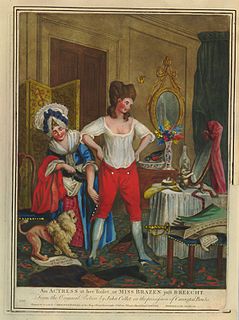
A breeches role is a role in which an actress appears in male clothing. Breeches, tight-fitting knee-length pants, were the standard male garment at the time breeches roles were introduced.
A soubrette is a type of operatic soprano voice fach, often cast as a female stock character in opera and theatre. The term arrived in English from Provençal via French, and means "conceited" or "coy". A soubrette is also defined as a young woman regarded as flirtatious or frivolous.
Lorenzo Da Ponte was an Italian, later American opera librettist, poet and Roman Catholic priest. He wrote the libretti for 28 operas by 11 composers, including three of Mozart's most celebrated operas, Don Giovanni, The Marriage of Figaro and Così fan tutte.
Caterina Magdalena Giuseppa Cavalieri was an Austrian soprano.
Symphony No. 7 in D major, K. 45, by Wolfgang Amadeus Mozart, was completed in Vienna in January 1768 after the family's return from a visit to Olomouc and Brno in Moravia. The symphony is in four movements. Its first performance was probably at a private concert. The symphony was reworked to become the overture to Mozart's opera, La finta semplice, K. 51, composed and performed later that year, and the overture itself was subsequently adapted further to create a new symphony, known in the Köchel 1964 (K6) catalogue as K. 46a. The autograph of the score is preserved in the Staatsbibliothek Preusischer Kulturbesitz in Berlin.
This list of Mozart symphonies of spurious or doubtful authenticity contains 39 symphonic works where an initial attribution to Wolfgang Amadeus Mozart has subsequently been proved spurious, or is the subject of continuing doubt. The number of symphonies actually written by Mozart is imprecisely known; of the 41 formally numbered, three are established as by other composers and another, No. 11, is considered by scholars to be of uncertain authorship. Outside the accepted sequence 1–41, however, there are around twenty other genuine Mozart symphonies, and beyond these, a larger number of problematic works which have not been authenticated as Mozart's. Some of these may be genuine; dubious works are often treated as authentic by the compilers of collected editions—eight are in the 1991 Neue Mozart-Ausgabe. Some, however, have long been accepted as the works of other composers, who in many instances have been positively identified.
Maria Anna Braunhofer was an operatic soprano, who created several roles in operas by Wolfgang Amadeus Mozart.
Notes
Cited sources
Other sources