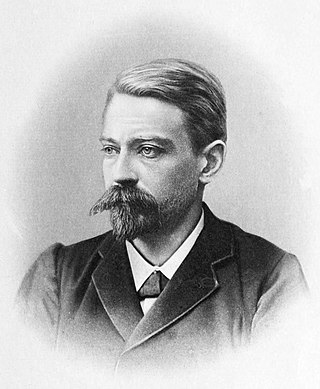
Thomas Joannes Stieltjes was a Dutch mathematician. He was a pioneer in the field of moment problems and contributed to the study of continued fractions. The Thomas Stieltjes Institute for Mathematics at Leiden University, dissolved in 2011, was named after him, as is the Riemann–Stieltjes integral.
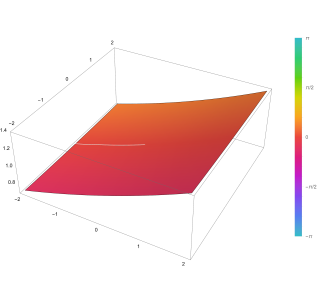
In mathematics, a generalized hypergeometric series is a power series in which the ratio of successive coefficients indexed by n is a rational function of n. The series, if convergent, defines a generalized hypergeometric function, which may then be defined over a wider domain of the argument by analytic continuation. The generalized hypergeometric series is sometimes just called the hypergeometric series, though this term also sometimes just refers to the Gaussian hypergeometric series. Generalized hypergeometric functions include the (Gaussian) hypergeometric function and the confluent hypergeometric function as special cases, which in turn have many particular special functions as special cases, such as elementary functions, Bessel functions, and the classical orthogonal polynomials.
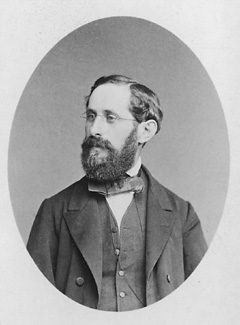
Heinrich Eduard Heine was a German mathematician.

Richard Allen Askey was an American mathematician, known for his expertise in the area of special functions. The Askey–Wilson polynomials are on the top level of the Askey scheme, which organizes orthogonal polynomials of hypergeometric type into a hierarchy. The Askey–Gasper inequality for Jacobi polynomials is essential in de Brange's famous proof of the Bieberbach conjecture.
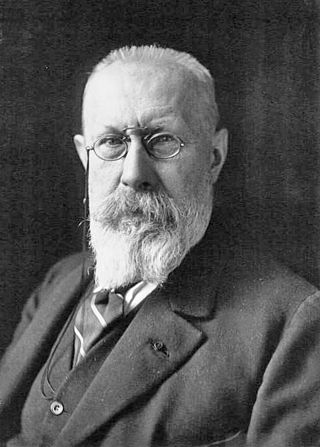
Paul Émile Appell was a French mathematician and Rector of the University of Paris. Appell polynomials and Appell's equations of motion are named after him, as is rue Paul Appell in the 14th arrondissement of Paris and the minor planet 988 Appella.
In mathematics, the Selberg integral is a generalization of Euler beta function to n dimensions introduced by Atle Selberg.
In mathematics, the Askey–Wilson polynomials are a family of orthogonal polynomials introduced by Askey and Wilson (1985) as q-analogs of the Wilson polynomials. They include many of the other orthogonal polynomials in 1 variable as special or limiting cases, described in the Askey scheme. Askey–Wilson polynomials are the special case of Macdonald polynomials for the non-reduced affine root system of type, and their 4 parameters a, b, c, d correspond to the 4 orbits of roots of this root system.
In mathematics, Macdonald-Koornwinder polynomials (also called Koornwinder polynomials) are a family of orthogonal polynomials in several variables, introduced by Koornwinder (1992) and I. G. Macdonald (1987, important special cases), that generalize the Askey–Wilson polynomials. They are the Macdonald polynomials attached to the non-reduced affine root system of type (C∨
n, Cn), and in particular satisfy (van Diejen 1996, Sahi 1999) analogues of Macdonald's conjectures (Macdonald 2003, Chapter 5.3). In addition Jan Felipe van Diejen showed that the Macdonald polynomials associated to any classical root system can be expressed as limits or special cases of Macdonald-Koornwinder polynomials and found complete sets of concrete commuting difference operators diagonalized by them (van Diejen 1995). Furthermore, there is a large class of interesting families of multivariable orthogonal polynomials associated with classical root systems which are degenerate cases of the Macdonald-Koornwinder polynomials (van Diejen 1999). The Macdonald-Koornwinder polynomials have also been studied with the aid of affine Hecke algebras (Noumi 1995, Sahi 1999, Macdonald 2003).
In mathematics, Appell series are a set of four hypergeometric series F1, F2, F3, F4 of two variables that were introduced by Paul Appell (1880) and that generalize Gauss's hypergeometric series 2F1 of one variable. Appell established the set of partial differential equations of which these functions are solutions, and found various reduction formulas and expressions of these series in terms of hypergeometric series of one variable.

In mathematics, Jacobi polynomials are a class of classical orthogonal polynomials. They are orthogonal with respect to the weight on the interval . The Gegenbauer polynomials, and thus also the Legendre, Zernike and Chebyshev polynomials, are special cases of the Jacobi polynomials.
In mathematics, the Askey scheme is a way of organizing orthogonal polynomials of hypergeometric or basic hypergeometric type into a hierarchy. For the classical orthogonal polynomials discussed in Andrews & Askey (1985), the Askey scheme was first drawn by Labelle (1985) and by Askey and Wilson (1985), and has since been extended by Koekoek & Swarttouw (1998) and Koekoek, Lesky & Swarttouw (2010) to cover basic orthogonal polynomials.
In mathematics, Al-Salam–Carlitz polynomialsU(a)
n(x;q) and V(a)
n(x;q) are two families of basic hypergeometric orthogonal polynomials in the basic Askey scheme, introduced by Waleed Al-Salam and Leonard Carlitz (1965). Roelof Koekoek, Peter A. Lesky, and René F. Swarttouw (2010, 14.24, 14.25) give a detailed list of their properties.
In mathematics, the Mehler–Heine formula introduced by Gustav Ferdinand Mehler and Eduard Heine describes the asymptotic behavior of the Legendre polynomials as the index tends to infinity, near the edges of the support of the weight. There are generalizations to other classical orthogonal polynomials, which are also called the Mehler–Heine formula. The formula complements the Darboux formulae which describe the asymptotics in the interior and outside the support.
In mathematics, an orthogonal polynomial sequence is a family of polynomials such that any two different polynomials in the sequence are orthogonal to each other under some inner product.
In mathematics, the discrete q-Hermite polynomials are two closely related families hn(x;q) and ĥn(x;q) of basic hypergeometric orthogonal polynomials in the basic Askey scheme, introduced by Al-Salam and Carlitz (1965). Roelof Koekoek, Peter A. Lesky, and René F. Swarttouw (2010, 14) give a detailed list of their properties. hn(x;q) is also called discrete q-Hermite I polynomials and ĥn(x;q) is also called discrete q-Hermite II polynomials.
In mathematics, the Romanovski polynomials are one of three finite subsets of real orthogonal polynomials discovered by Vsevolod Romanovsky within the context of probability distribution functions in statistics. They form an orthogonal subset of a more general family of little-known Routh polynomials introduced by Edward John Routh in 1884. The term Romanovski polynomials was put forward by Raposo, with reference to the so-called 'pseudo-Jacobi polynomials in Lesky's classification scheme. It seems more consistent to refer to them as Romanovski–Routh polynomials, by analogy with the terms Romanovski–Bessel and Romanovski–Jacobi used by Lesky for two other sets of orthogonal polynomials.