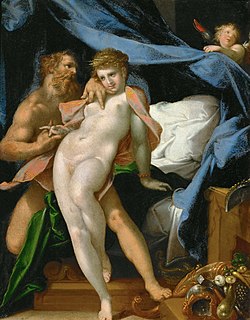
Maia was originally an Italic deity— likely a goddess of spring— who was later adopted by the Romans.[3] After her conflation with the Greek goddess Maia, she became the daughter of the TitanAtlas[4] and the mother of the god Mercury by Jupiter.[5] Her exact functions as a goddess are unclear. She possibly embodied the concept of growth, as her name was thought to be related to maius, meaning "larger," or "greater."[6][7] She may have also abstractly embodied the concept of maiestas: the "majesty" of the Roman people.[8][9]
In an archaic Roman invocational prayer, Maia was named as an attribute of Vulcan, with Gellius comparing their relationship to those of Salacia and Neptune and Lua and Saturn.[10] The female deities named in the list embodied an aspect of their male counterparts' functionality. Maia was additionally associated and theologically intertwined with the Roman goddesses Terra, Fauna, Ops, Juno, Cybele, and Bona Dea.[11][12][13] Her associations with the earth goddesses Fauna and Ops were likely influenced by the scholar Varro, who claimed multiple goddesses were derivatives of an original earth goddess: Terra.[11][14] The association with Juno, whose Etruscan counterpart was the goddess Uni, is suggested by the inscription Uni Mae on the Piacenza Liver.[15]
In the Roman provinces of Gallica Belgia and Germania, Maia was depicted alongside Mercury and his consort: the Gallic goddess Rosmerta. There, both goddesses were associated with fertility and the season of spring. Maia was occasionally depicted holding a caduceus, therefore associating her with her son's healing abilities.[16]
Worship
Worship in August
Maia was closely associated with Vulcan, god of volcanoes and metalsmithing, and was occasionally referred to as Maia Volcani.[17]Maia Volcani was an iteration of the goddess capable of destroying and purifying enemy weapons, similarly to Lua Saturni.[18] They were celebrated at the area Volcani, an ancient cultic site located at the foot of the Capitolium in the northwestern corner of the Roman Forum, and the location of the Vulcanal.[19] The annual Vulcanalia festival was held at the site on August 23rd. Maia was also worshipped during this festival, as Maiae supra comitium ("Maia above Comitium") was recorded on the Fasti Antiates and Fasti Arvalium calendars as being worshipped on the 23rd.[20][18]
Worship in May
The month of May (Maius in Latin) was potentially named after Maia;[21][12] however, ancient etymologists also connected it to the maiores "ancestors," again from the adjective maius ("greater").[22] The Kalends of May (May 1st), was sacred to Maia. Annually, a pregnant sow was sacrificed to the goddess by one of Vulcan's flamens, a sacrifice Macrobius claimed was suitable for an earth goddess.[12][2] The month was also sacred to her son Mercury, and merchants made sacrifices to him on the Ides of May (May 15th).[6]
Cults and temples
Maia and Mercury had cult centers at Delos and the city of Pompeii. At Pompeii, they were worshipped by a college of priests (sodalitas) known as the ministri Mercuii Maiae.[23] Later, in the 2nd century BCE, the names of the divinities were dropped and the sect became the Sodales Augustales, who attended to the cult of Augustus and the Julii.[24][2]
12Turcan, Robert (2001). The Gods of Ancient Rome - Religion in Everyday Life from Archaic to Imperial Times. London: Routledge. p.70. ISBN9780415929745.
↑Seyffert, Oskar. A dictionary of classical antiquities, mythology, religion, literature & art. Page 543. S. Sonnenschein, 1891.
↑In Mario Torelli's diagram of this haruspicial object, the names Uni and Mae appear together in a cell on the edge of the liver; see Nancy Thompson de Grummond, Etruscan Myth, Sacred History, and Legend, University of Pennsylvania Museum of Archaeology, 2006, p. 44 (online).
↑Gordon, Richard L., Georgia Petridou, and Jörg Rüpke. Beyond Priesthood: Religious Entrepreneurs and Innovators in the Roman Empire. de Gruyter, 2017.
↑Samuel Ball Platner; Thomas Ashby (1929). "Volcanal". A Topographical Dictionary of Ancient Rome. London: Oxford University Press. pp.583–584. Retrieved 2007-07-28.
↑Carandini, Andrea, and Stephen Sartarelli. “INTRODUCTION.” Rome: Day One, Princeton University Press, 2011, pp. 1–40. JSTOR, https://doi.org/10.2307/j.ctv1q3xfwm.3. Accessed 26 Dec. 2025.
This page is based on this Wikipedia article Text is available under the CC BY-SA 4.0 license; additional terms may apply. Images, videos and audio are available under their respective licenses.