Edoardo "Eddie" Fenech Adami, is a Maltese politician and Nationalist politician who served as Prime Minister of Malta from 1987 until 1996, and again from 1998 until 2004. Subsequently, he was the seventh President of Malta from 2004 to 2009. He led his party to win five general elections, in 1981, 1987, 1992, 1998 and 2003. Staunchly pro-European, Fenech Adami is the longest serving Maltese prime minister since Malta's independence, and was fundamental for Malta's accession to the European Union.
The European Parliament election of 2004 in Malta was the election of MEP representing Malta constituency for the 2004–2009 term of the European Parliament. It was part of the wider 2004 European election. The vote took place on 12 June 2004 and used Single Transferable Vote. The opposition Malta Labour Party polled strongly.
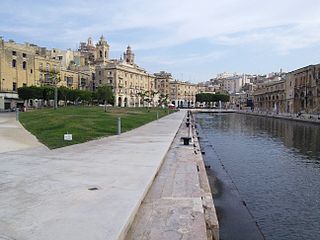
Cospicua, also known by its titles Città Cospicua or Civitas Cottonera, is a double-fortified harbour city in the South Eastern Region of Malta. Along with Birgu and Senglea, it is one of the Three Cities, located within the Grand Harbour to the east of the capital city Valletta. With a population of 5,395 as of March 2014, it is the most dense city of the Three Cities.

St Aloysius College (SAC) is a Catholic college run by the Jesuits in Birkirkara, Malta. It was founded in 1907 to complement the seminaries and tertiary institutions already in existence on the island. Today it is a boys' primary and secondary school with a coeducational sixth form. The College compound also houses a parish church which is used by the school and opened to the public.
L-Għanja tal-Poplu is a popular Maltese song festival first organized by Youth Travel Circle (YTC) on 5 May 1973 at the St. Albert College in Valletta. The founder of YTC is Rev.Maurice Mifsud. Initially the Festival was restricted for YTC members. From 1987 onward, the Festival took a national dimension. Non YTC members were allowed to compose, write and sing in this festival, as long as the lyrics were in the Maltese language. In the nineties the festival started being transmitted on local television stations. In 2010, the Malta Arts Fund of the Government of Malta began to offer some financial support to the festival. As from 2013 various local radio stations started transmitting special programmes dedicated to this festival. In 2015 the festival was transmitted on Malta's Public Broadcasting Services through its Radio and Television Channels. The festival is currently being organised by the voluntary organisation L-Għanja tal-Poplu.
General elections were held in Malta on 26 October 1996. Although the Malta Labour Party received the most votes, the Nationalist Party won the most seats. However, the Labour Party was awarded an additional four seats to ensure they had a majority in Parliament.

Dingli Swallows Football Club is a Maltese football club from the small village of Ħad-Dingli, which currently plays in the Maltese Third Division. The club was founded in 1948.

Luqa St. Andrew's Football Club are a Maltese football club from the south-western town of Luqa in Malta. Founded in 1934, the club currently competes in the Maltese 2nd Division League. In seasons 2010–11 and 2016-2017 the team was promoted to the Maltese 2nd Division League. Team is also known by nickname "Reds".
The European Parliament election of 2009 in Malta was the election of the delegation from Malta to the European Parliament in 2009. The elections were held on 6 June on the same day as the Maltese local council elections, 2009.
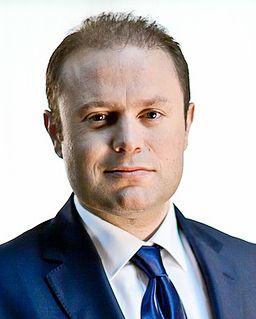
General elections were held in Malta on Saturday, 3 June 2017. The elections were contested by the Labour Party, led by Prime Minister Joseph Muscat, the Nationalist Party, led by opposition leader Simon Busuttil, and four other parties; making it the most parties fielding candidates since 1962. The result was a victory for the Labour Party, with 55% of the popular vote. Voter turnout reached 92%.
The designers of Maltese stamps have been creating their works for the last 150 years. The most prolific designer of Maltese stamps was Emvin Cremona, who designed most of Malta's stamps from the late 1950s to the 1970s. Dates indicate the years stamps with the artist's design were used.
Although Malta is a small island in the middle of the Mediterranean Sea with a small population, it is nonetheless rich in its history and its culture. When in the 1950s, in nearby Italy the San Remo Festival, and later in Switzerland, the Eurovision Song Contest came into existence, Malta soon followed suit by organizing its own National Song Festival.
The Nationalist Party Shadow Cabinet of Dr Simon Busuttil was announced on May 14, 2013. It was formed following the 9 March election which replaced the PN majority with a Labour majority.
The Malta Independence Fiftieth Anniversary Medal is a national commemorative medal of the Republic of Malta. The medal is awarded by the President of Malta to recognize contributions to the development and well-being of Malta as a nation and a member of the international community of nations since the State of Malta gained independence in 1964. The medal, which may be awarded posthumously, has been awarded to former Presidents, Prime Ministers, and other notable Maltese politicians.