Related Research Articles

Interdisciplinarity or interdisciplinary studies involves the combination of multiple academic disciplines into one activity. It draws knowledge from several other fields like sociology, anthropology, psychology, economics, etc. It is about creating something by thinking across boundaries. It is related to an interdiscipline or an interdisciplinary field, which is an organizational unit that crosses traditional boundaries between academic disciplines or schools of thought, as new needs and professions emerge. Large engineering teams are usually interdisciplinary, as a power station or mobile phone or other project requires the melding of several specialties. However, the term "interdisciplinary" is sometimes confined to academic settings.
Social science is one of the branches of science, devoted to the study of societies and the relationships among individuals within those societies. The term was formerly used to refer to the field of sociology, the original "science of society", established in the 19th century. In addition to sociology, it now encompasses a wide array of academic disciplines, including anthropology, archaeology, economics, human geography, linguistics, management science, communication science and political science.

An academic discipline or field of study is a branch of knowledge, taught and researched as part of higher education. A scholar's discipline is commonly defined by the university faculties and learned societies to which they belong and the academic journals in which they publish research.
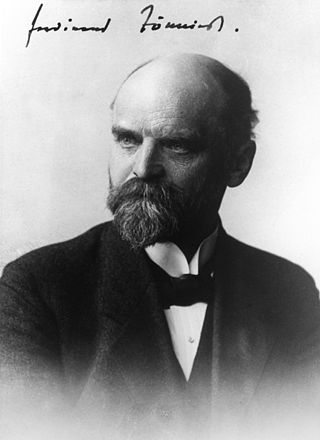
Ferdinand Tönnies was a German sociologist, economist, and philosopher. He was a significant contributor to sociological theory and field studies, best known for distinguishing between two types of social groups, Gemeinschaft and Gesellschaft. He co-founded the German Society for Sociology together with Max Weber and Georg Simmel and many other founders. He was president of the society from 1909 to 1933, after which he was ousted for having criticized the Nazis. Tönnies was regarded as the first proper German sociologist and published over 900 works, contributing to many areas of sociology and philosophy. Tönnies, Max Weber, and Georg Simmel are considered the founding fathers of classical German sociology. Though there has been a resurgence of interest in Weber and Simmel, Tönnies has not drawn as much attention.
Gemeinschaft and Gesellschaft, generally translated as "community and society", are categories which were used by the German sociologist Ferdinand Tönnies in order to categorize social relationships into two types. The Gesellschaft is associated with modern society and rational self-interest, which weakens the traditional bonds of family and local community that typify the Gemeinschaft. Max Weber, a founding figure in sociology, also wrote extensively about the relationship between Gemeinschaft and Gesellschaft. Weber wrote in direct response to Tönnies.

Science studies is an interdisciplinary research area that seeks to situate scientific expertise in broad social, historical, and philosophical contexts. It uses various methods to analyze the production, representation and reception of scientific knowledge and its epistemic and semiotic role.

In the social sciences, social structure is the aggregate of patterned social arrangements in society that are both emergent from and determinant of the actions of individuals. Likewise, society is believed to be grouped into structurally related groups or sets of roles, with different functions, meanings, or purposes. Examples of social structure include family, religion, law, economy, and class. It contrasts with "social system", which refers to the parent structure in which these various structures are embedded. Thus, social structures significantly influence larger systems, such as economic systems, legal systems, political systems, cultural systems, etc. Social structure can also be said to be the framework upon which a society is established. It determines the norms and patterns of relations between the various institutions of the society.
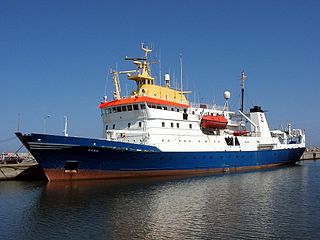
Fisheries science is the academic discipline of managing and understanding fisheries. It is a multidisciplinary science, which draws on the disciplines of limnology, oceanography, freshwater biology, marine biology, meteorology, conservation, ecology, population dynamics, economics, statistics, decision analysis, management, and many others in an attempt to provide an integrated picture of fisheries. In some cases new disciplines have emerged, as in the case of bioeconomics and fisheries law. Because fisheries science is such an all-encompassing field, fisheries scientists often use methods from a broad array of academic disciplines. Over the most recent several decades, there have been declines in fish stocks (populations) in many regions along with increasing concern about the impact of intensive fishing on marine and freshwater biodiversity.
Grounded theory is a systematic methodology that has been largely applied to qualitative research conducted by social scientists. The methodology involves the construction of hypotheses and theories through the collecting and analysis of data. Grounded theory involves the application of inductive reasoning. The methodology contrasts with the hypothetico-deductive model used in traditional scientific research.
Sociology as a scholarly discipline emerged, primarily out of Enlightenment thought, as a positivist science of society shortly after the French Revolution. Its genesis owed to various key movements in the philosophy of science and the philosophy of knowledge, arising in reaction to such issues as modernity, capitalism, urbanization, rationalization, secularization, colonization and imperialism.
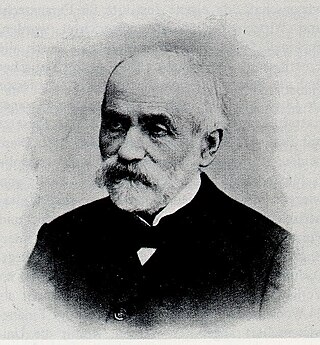
Ludwig Gumplowicz, was a Polish sociologist, jurist, historian, and political scientist, who taught constitutional and administrative law at the University of Graz.
Piotr Sztompka is a Polish sociologist known for his work on the theory of social trust. He is professor of sociology at the Jagiellonian University in Kraków, Poland, and has also frequently served as visiting professor at the University of California, Los Angeles, and at Columbia University in New York City.

Mathematical sociology or the sociology of mathematics is an interdisciplinary field of research concerned both with the use of mathematics within sociological research as well as research into the relationships that exist between maths and society.
The Polskie Towarzystwo Socjologiczne (PTS) (Polish Sociological Association) is the main professional organization of sociologists in Poland. The PTS defines its mission as "supporting the development of sociology and popularizing sociological knowledge within society".

Michael Burawoy is a sociologist working within Marxist social theory, best known as the leading proponent of public sociology and the author of Manufacturing Consent: Changes in the Labor Process Under Monopoly Capitalism—a study on the sociology of industry that has been translated into a number of languages.

Historical sociology is an interdisciplinary field of research that combines sociological and historical methods to understand the past, how societies have developed over time, and the impact this has on the present. It emphasises a mutual line of inquiry of the past and present to understand how discrete historical events fit into wider societal progress and ongoing dilemmas through complementary comparative analysis.
Sociology in Poland has been developing, as has sociology throughout Europe, since the mid-19th century. Although, due to the Partitions of Poland, that country did not exist as an independent state in the 19th century or until the end of World War I, some Polish scholars published work clearly belonging to the field of sociology.
Sociology is a social science that focuses on society, human social behavior, patterns of social relationships, social interaction, and aspects of culture associated with everyday life. In simple words sociology is the scientific study of society. It uses various methods of empirical investigation and critical analysis to develop a body of knowledge about social order and social change. While some sociologists conduct research that may be applied directly to social policy and welfare, others focus primarily on refining the theoretical understanding of social processes and phenomenological method. Subject matter can range from micro-level analyses of society to macro-level analyses.
Empirical sociology is the study of sociology based on methodological methods and techniques for collecting, processing, and communicating primary sociological information. Describes the situation of the aspects of social life such as economy, law, family, and politics during the research. Empirical sociology is often concerned with aspects of everyday life with common sense, which it treats as a resource, a form of knowledge. Empirical sociology inductively studies how people appreciate and get along with each other. Empirical sociology is an American tradition with roots in the social reform movements of the Progressive Era.

Medical sociology is the sociological analysis of medical organizations and institutions; the production of knowledge and selection of methods, the actions and interactions of healthcare professionals, and the social or cultural effects of medical practice. The field commonly interacts with the sociology of knowledge, science and technology studies, and social epistemology. Medical sociologists are also interested in the qualitative experiences of patients, often working at the boundaries of public health, social work, demography and gerontology to explore phenomena at the intersection of the social and clinical sciences. Health disparities commonly relate to typical categories such as class and race. Objective sociological research findings quickly become a normative and political issue.
References
- 1 2 3 Kołodziej−Durnaś, Agnieszka (2014). "Maritime Sociology or Sociology of Maritime Issues? World Literature Review and Some Historical Considerations". Roczniki Socjologii Morskiej. Annuals of Marine Sociology. 23: 54–62.
- ↑ Bavinck, Maarten; Verrips, Jojada (2020). "Manifesto for the marine social sciences". Maritime Studies. 19 (2): 121–123. doi: 10.1007/s40152-020-00179-x . ISSN 2212-9790.
- 1 2 Cocco, Emilio (2013). "Theoretical Implications of Maritime Sociology". Roczniki Socjologii Morskiej. Annuals of Marine Sociology. 22: 5–18.
- 1 2 3 4 5 6 7 8 9 10 Hannigan, John (February 2017). "Toward a Sociology of Oceans". Canadian Review of Sociology/Revue Canadienne de Sociologie. 54 (1): 8–27. doi:10.1111/cars.12136. ISSN 1755-6171. PMID 28220677.
- ↑ Bartlomiejski, R. and M. Kowalewski. 2014. “The Founding Fathers of Sociology on Maritime Social Issues.” Presented at the Congress of the German Sociological Association, Session on “Maritime Sociology: Polish and German Perspectives on a Sociology of Maritime Spaces,” October 6–10, Trier, Germany.
- ↑ Sowa, Frank and Agnieszka Kolodziej-Durnaś. (2014). “A Short Introductory Note on Maritime Sociology.” Presented at the Congress of the German Sociological Association, Session on “Maritime Sociology: Polish and German Perspectives on a Sociology of Maritime Spaces,” October 6–10, Trier, Germany.
- ↑ "List of research streams". European Sociological Association. 2021. Retrieved 2021-02-13.
- ↑ Janiszewski, Ludwik (1988). "Marynizacja. Przyczynek teoretyczny". Roczniki Socjologii Morskiej. 4: 5–14.
- ↑ Kołodziej, Arkadiusz (2019). "The Concept of Marinization by Ludwik Janiszewski". Cultural Interaction Studies of Sea Port Cities. 20: 159–179. doi:10.35158/cisspc.2019.04.20.159. ISSN 2092-8130. S2CID 186484340.
- ↑ Steingerg, P.E. (2001). The Social Construction of the Ocean. Cambridge: Cambridge University Press.
- ↑ Campling, Liam; Colás, Alejandro (2021). Capitalism and the sea : the maritime factor in the making of the modern world. New York: Verso. p. 47. ISBN 978-1-78478-523-9. OCLC 1232452914.
- ↑ Kim, Seung Kuk (2018). "Individualism of Unique Self/Mind: Toward a Mind Sociology". Korean Journal of Sociology. 52 (2): 159–212. doi:10.21562/kjs.2018.05.52.2.159. S2CID 150246478.
- ↑ Tönnies, Ferdinand (1897). "Hafenarbeiter und Seeleute in Hamburg vor dem Strike 1896/97". Archiv für soziale Gesetzgebung und Statistik. 10 (2): 173–238.
- ↑ Tönnies, Ferdinand (1903). Die Ostseehäfen Flensburg, Kiel, Lübeck. pp. 509–614.
{{cite book}}:|work=ignored (help) - ↑ Elias, Norbert (1950). "Studies in the Genesis of the Naval Profession". The British Journal of Sociology. 1 (4): 291–309. doi:10.2307/586890. ISSN 0007-1315. JSTOR 586890.
- ↑ Aubert, Vilhelm; Arner, Oddvar (1958). "On the Social Structure of the Ship". Acta Sociologica. 3 (1): 200–219. doi:10.1177/000169935800300118. ISSN 0001-6993. S2CID 144975264.
- ↑ Poole, Michael (1981). "Maritime sociology: towards a delimation of themes and analytical frameworks". Maritime Policy & Management. 8 (4): 207–222. doi:10.1080/03088838100000046. ISSN 0308-8839.
- ↑ Perry, Nick; Wilkie, Roy (1974). "Social Theory and Shipboard Structure". Maritime Studies and Management. 1 (3): 136–146. doi:10.1080/03088837400000002. ISSN 0306-1957.
- ↑ Gerstenberger, Heide; Welke, Ulrich (2004). Arbeit auf See. Zur Ökonomie und Ethnologie der Globalisierung. Münster: Westfälisches Dampfboot. pp. 17–26. ISBN 978-3-89691-575-7.
- ↑ Grasmeier, Marie C. (2020). Das Schiff als sozialer Ort. pp. 21–34.
{{cite book}}:|work=ignored (help) - ↑ "Seafarers International Research Centre" . Retrieved 2021-02-13.
- ↑ "Home - Asia Pacific Journal of Marine Science&Education". www.msun.ru. Retrieved 2021-02-15.
- ↑ "Constanta Maritime University Annals". annals.cmu-edu.eu. Retrieved 2021-02-15.
- ↑ Marine Policy.
- ↑ "Maritime Policy & Management Aims & Scope". www.tandfonline.com. Retrieved 2021-02-15.
- ↑ "Maritime Studies". Springer. Retrieved 2021-02-15.
- ↑ Pomorstvo (in Croatian). University of Rijeka, Faculty of Maritime Studies. doi:10.31217/p. S2CID 245440085.
- ↑ "Roczniki Socjologii Morskiej Annals of Marine Sociology". Roczniki Socjologii Morskiej Annals of Marine Sociology (in Polish). 2011. ISSN 0860-6552. OCLC 826592291.
- ↑ "WMU Journal of Maritime Affairs". Springer. Retrieved 2021-02-15.