Moth (fractal)

Last updated
Moth, fractal figure FalenafrattaleGiorgioPietrocola 07.jpg
Moth, fractal figure


The moth is a fractal equilateral triangle with sides replaced by the lepidopter curve, a variant of the Koch curve. It has properties similar to those of the siamese, a fractal rhombus based on the Koch curve, and can therefore be broken down into infinite copies of itself. This figure was discovered by Giorgio Pietrocola in March 2024 and published in several Italian mathematics journals. [1] [2]

Contents


Algorithm

The algorithm for creating the Lepidoptera curve is similar to that for the Koch curve. To highlight this, an algorithm is used that converges more slowly than the one normally used to obtain the Koch curve. For both curves, we start with a segment and replace it with two angled segments which, together, would form an isosceles triangle with angles of 30, 120 and 30 degrees. The same transformation is then applied to the segments, which grow at each level as powers of two. The difference between the curves lies in the different alternation to the right or left of the substitutions made on the segments, as shown in the figure.

Comparison between algorithms generating the Koch curve, the terdragon curve and the lepidopteran curve from which the moth also derives. In the last two boxes of each row, the curve obtained is repeated on both sides in the two possible ways, resulting in a column of siamese in the first row and a column of moths in the last row. Algoritmicomparativi.jpg
Comparison between algorithms generating the Koch curve, the terdragon curve and the lepidopteran curve from which the moth also derives. In the last two boxes of each row, the curve obtained is repeated on both sides in the two possible ways, resulting in a column of siamese in the first row and a column of moths in the last row.
Replicating moth (rep-
[?]
{\displaystyle \infty }
) designed by the FMSLogo turtle FMSLogoFalenadiPietrocola.jpg
Replicating moth (rep-) designed by the FMSLogo turtle

FMSLogo programme

to falena :lato :liv right 180 make "nstop int (0.5+(power 2 :liv-1)*4/3)+2 make "mem pos make "hh heading hideturtle  penup forward :lato/2  back :lato/2  pendown make "conta 0 make "mem pos make "hh heading falenarico :lato*3 :liv 1 1 penup  setpos :mem setheading :hh  pendown make "conta 0 make "mem pos make "hh heading falenarico :lato*3 :liv 1 -1 penup  setpos :mem setheading :hh  pendown showturtle right 180 end
to falenarico :x :l :s :t localmake "x :x/sqrt 3 if :l=0 [make "conta :conta+1 if :conta>=:nstop [ stop] forward :x stop ] left 30*:s*:t  falenarico :x :l-1 -1 -:t right 60*:s*:t falenarico :x :l-1 1 -:t  left 30*:s*:t end

The falenarico procedure is used by the falena procedure. After copying and saving them in the editor of FMSLogo, you can enter falena 200 10 in the command line to obtain a moth of the specified size and iteration level. Additional procedures such as falenarep to obtain a replicating moth as shown in the figure are available in the online article. [2]

Comparison of moth and siamese

Comparison between the moth and the siamese. The antifigures are shown in red. The reference fractal polygons are highlighted. FalenafrattaleGiorgioPietrocola 01.jpg
Comparison between the moth and the siamese. The antifigures are shown in red. The reference fractal polygons are highlighted.

While the siamese and anti-siamese are obtained by replacing the sides of a rhombus with Koch curves, the moth is obtained by replacing the sides of an equilateral triangle with outward-facing lepidopteran curves. If they are inward-facing, an anti-moth is created (see figure). The perimeters of these fractal polygons are all infinite. While the area of the siamese increases by 40% of its reference rhombus, the moth increases by 75% of its triangle. The anti-figures decrease by the same amount. [1] . Both the siamese and the moth, together with their anti-figures, break down into infinite similar copies.


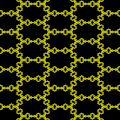
Tessellation of the plane with similar fractal figures


References

  1. 1 2 Pietrocola, Giorgio (2024). "Il siamese e la falena, due frattali per l'arte di Escher". Archimede (in Italian). Vol. 3, no. 3. Le Monnier. doi:10.1400/300129. ISSN   0390-5543.}
  2. 1 2 3 4 Pietrocola, Giorgio (2024). "Affinity between fractal figures Combinatorial algorithms to discover two pairs: dragon, butterfly and moth, siamese". Academia.edu .

Online bibliography