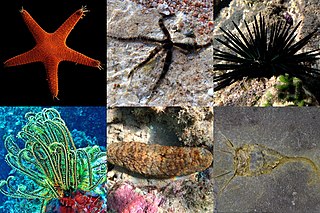
An echinoderm is any deuterostomal animal of the phylum Echinodermata, which includes starfish, brittle stars, sea urchins, sand dollars and sea cucumbers, as well as the sessile sea lilies or "stone lilies". While bilaterally symmetrical as larvae, as adults echinoderms are recognisable by their usually five-pointed radial symmetry, and are found on the sea bed at every ocean depth from the intertidal zone to the abyssal zone. The phylum contains about 7,600 living species, making it the second-largest group of deuterostomes after the chordates, as well as the largest marine-only phylum. The first definitive echinoderms appeared near the start of the Cambrian.

Crinoids are marine invertebrates that make up the class Crinoidea. Crinoids that remain attached to the sea floor by a stalk in their adult form are commonly called sea lilies, while the unstalked forms, called feather stars or comatulids, are members of the largest crinoid order, Comatulida. Crinoids are echinoderms in the phylum Echinodermata, which also includes the starfish, brittle stars, sea urchins and sea cucumbers. They live in both shallow water and in depths over 9,000 metres (30,000 ft).

Starfish or sea stars are star-shaped echinoderms belonging to the class Asteroidea. Common usage frequently finds these names being also applied to ophiuroids, which are correctly referred to as brittle stars or basket stars. Starfish are also known as asteroids due to being in the class Asteroidea. About 1,900 species of starfish live on the seabed in all the world's oceans, from warm, tropical zones to frigid, polar regions. They are found from the intertidal zone down to abyssal depths, at 6,000 m (20,000 ft) below the surface.

Brittle stars, serpent stars, or ophiuroids are echinoderms in the class Ophiuroidea, closely related to starfish. They crawl across the sea floor using their flexible arms for locomotion. The ophiuroids generally have five long, slender, whip-like arms which may reach up to 60 cm (24 in) in length on the largest specimens.

Amphiuridae are a large family of brittle stars of the suborder Gnathophiurina. Some species are used to study echinoderm development and bioluminescence.
Ophiocanops fugiens is a living species in the brittle star family Ophiocanopidae. Though once considered to be the only one living species in this brittle star family, recent research has brought to light three specimens of Ophiocanops that differ substantially from O. fugiens. It has been regarded as the most primitive brittle star, close to Paleozoic forms, though other authors have disagreed with the view. Classification of O. fugiens is highly argued. Ophiocanops is usually placed in the order Oegophiurida or regarded as a genus incertae sedis or even given its own subclass Oegophiuridea. Some recent data suggest its relationship to the extant family Ophiomyxidae.

The Asterozoa are a subphylum in the phylum Echinodermata. Characteristics include a star-shaped body and radially divergent axes of symmetry. The subphylum includes the class Asteroidea, the class Ophiuroidea, and the extinct order Somasteroidea.
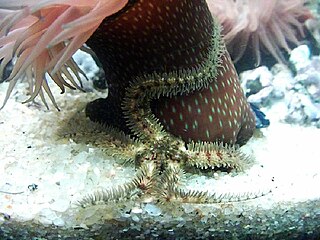
Ophiothrix fragilis is a species of brittle star in the order Ophiurida. It is found around the coasts of western Europe and is known in Britain as the common brittle star. It is also found along the coast of South Africa where it is known as the hairy brittle star.

Ophiura ophiura or the serpent star is a species of brittle star in the order Ophiurida. It is typically found on coastal seabeds around northwestern Europe.
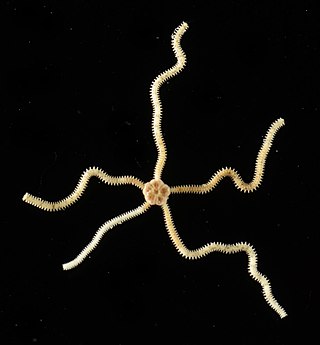
Amphiodia pulchella is a species of brittle star belonging to Amphiuridae, a diverse family of the Ophiurida order.

Ophiocoma scolopendrina is a species of brittle star belonging to the family Ophiocomidae. Restricted to life in the intertidal, they live in the Indo-Pacific. They can typically be found within crevices or beneath borders on intertidal reef platforms. Unlike other Ophiocoma brittle stars, they are known for their unique way of surface-film feeding, using their arms to sweep the sea surface and trap food. Regeneration of their arms are a vital component of their physiology, allowing them to efficiently surface-film feed. These stars also have the ability to reproduce throughout the year, and have been known to have symbiotic relationships with other organisms.

Ophionereis reticulata, the reticulated brittle star, is a brittle star in the family Ophionereididae. It is found in shallow parts of the western Atlantic, Caribbean Sea and Gulf of Mexico.

Gorgonocephalus arcticus is a species of basket star in the class Ophiuroidea. The genus name comes from the Greek, gorgós meaning "dreaded" and cephalus meaning "head", and refers to the similarity between these echinoids and the Gorgon's head from Greek myth with its coiled serpents for hair.

Amphiura chiajei is a species of brittle star belonging to the family Amphiuridae. It is found in the northeastern Atlantic Ocean and adjoining seas to a depth of 1,000 metres (3,300 ft). It digs itself into the soft sediment of the seabed and raises its arms into the water above to suspension feed on plankton. It was first described by the British naturalist Edward Forbes in 1843, and was named for the Italian zoologist Stefano Delle Chiaje (1794–1860).

Ophiopholis aculeata, the crevice brittle star or daisy brittle star, is a species of brittle star in the family Ophiactidae. It has a circum-polar distribution and is found in the Arctic Ocean, the northern Atlantic Ocean and the northern Pacific.

Ophionereis schayeri, Schayer's brittle star, is a brittle star in the family Ophionereididae.
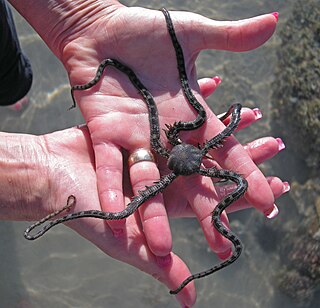
Ophiocomella alexandri, known as Alexander's spiny brittle star or banded brittle star, is a species of marine brittle star. It was first described to science by Theodore Lyman in 1860. Lyman states in his description that the animal is named for his friend, Alexander E. R. Agassiz, the son of Lyman's mentor, Louis Agassiz.
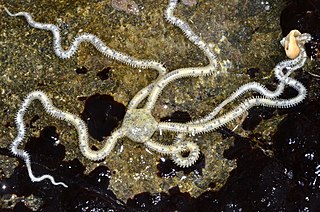
Amphiodia occidentalis, the long-armed brittle star, is a species of brittle star belonging to the family Amphiuridae. It is found in the Eastern Pacific coast from Alaska to USA, often on the seafloor within intertidal and subtidal zones. Within these areas, it is often found buried a few centimeters under the sand with 2 or 3 arms extending through the surface.

Ophiomusa is a genus of echinoderms belonging to the family Ophiolepididae that includes: sea urchins, sand dollars and sea cucumbers. Ophiurida are similar to starfish; they both have a central disc and five arms sprouting from the disc. One of the main distinguishing factors of an Ophiuroid is its arms; the arms of an Ophiurida are longer, thinner, and distinctly separated in comparison to those of a sea star.
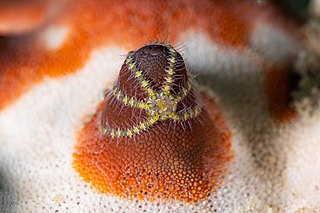
Ophiothela mirabilis is a species of ophiuroid brittle star within the family Ophiotrichidae. O. mirabilis is an epizoic species which have a non-parasitic relationship with host sponges or gorgonians. Although native to the Pacific Ocean, it has invaded the Caribbean and southwestern Atlantic since late 2000. Many of its characteristics, including reproduction and diet, allow O. mirabilis opportunities to quickly propagate and spread through habitats.


