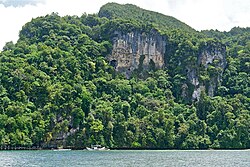
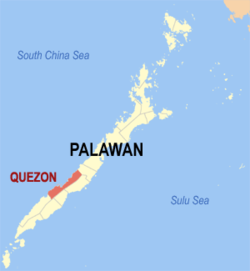
Quezon, officially the Municipality of Quezon (Tagalog: Bayan ng Quezon), is a municipality in the province of Palawan, Philippines. According to the 2024 census, it has a population of 68,532 people.[5]
It is home to the Tabon Caves, where the remains of the Tabon Man were discovered. A population of the critically-endangered Irrawaddy dolphin can also be found in the municipality's waters.[6]
History
In the past, the municipality was named Tabon, but now it is a barangay of Quezon that discovered and found the Manunggul Jar. The old municipality (Tabon) was popular and derived from the name of the Tabon bird.
The Municipality of Quezon was created in 1951 from the barrios of Berong and Alfonso XIII from Aborlan and the barrios of Iraan, Candawaga and Canipaan from Brooke's Point.[7][8]
In 1957, the sitios of Aramaywan, Isugod, Tabon, Sawangan, Calumpang, Campong-Ulay, Ransang, Cadawaga, Culasian, Panalingaan, Taburi, Latud and Canipaan were converted into barrios.[9]
In the 2024 census, the population of Quezon was 68,532 people,[16] with a density of 73 inhabitants per square kilometre or 190 inhabitants per square mile.
Religion
Percentage of religions in Quezon (Palawan), 2024.
In 2024, based on religion, the majority of the population of this municipality was Christianity (92.2%), followed by others (mainly tribal religion; 5.1%), then Islam (2.7%). Christianity, mostly from the Roman Catholic sect, is practiced by the indigenous peoples of Palawan and settlers from Luzon. Tribal religion is practiced by the indigenous tribes in the highlands, especially the Taaw't Bato and Tagbanwa peoples, also Islam is practiced by some of the native Palawano and Molbog peoples, also by Moro migrants such as Tausug and Maranao.
The National Museum of the Philippines opened of the Tabon Caves Museum at the Tabon Cave Complex and Lipuun Point in Quezon, Palawan on February 1, 2024. The inauguration was attended by Governor Victorino Dennis Socrates, 2nd District Palawan Representative Jose Alvarez, Quezon Mayor Joselito Ayala, National Museum of the Philippines Director General Jeremy R. Barns, among others.[25]
Education
There are two schools district offices which govern all educational institutions within the municipality. They oversee the management and operations of all private and public, from primary to secondary schools.[26] These are the Quezon North Schools District, and Quezon South Schools District.
Primary and elementary schools
Alfonso XIII Elementary School
Aramaywan Elementary School
Bagong Pag-asa Elementary School
Balintang Elementary School
Berong Elementary School
Calumpang Elementary School
CCT-Visions of Hope Christian School
Emmanuel Southern Baptist Academy
Faith Christian Academy
Gugnan Elementary School
Immaculate Conception Parochial School
Isugod Elementary School
Kalatabog Elementary School
Kalatagbak Elementary School
Ladayon Elementary School
Lamane Elementary School
Lambatan Elementary School
Luke Society Kiddie Center
Maasin Elementary School
Magara Elementary School
Malatgao Elementary School
Marirong Elementary School
Marnek Elementary School
Matugbong Elementary School
Nabugsuan Elementary School
Natutungan Elementary School
Pag-asa Elementary School
Panibugon Elementary School
Panitian Elementary School
Pinaglabanan Elementary School
Quezon Central School
Quinlogan Elementary School
Reservation Elementary School
Serong Elementary School
Simunong Elementary School
Sowangan Elementary School
Tabon Elementary School
Tabud Elementary School
Tagbae Elementary School
Tagusao ELementary School
Tina Elementary School
Tungib Elementary School
Underground Elementary School
Secondary schools
Berong Barangay High School (Quezon-Aramaywan National High School - Berong Brgy. High School)
This page is based on this Wikipedia article Text is available under the CC BY-SA 4.0 license; additional terms may apply. Images, videos and audio are available under their respective licenses.