 | This article needs additional citations for verification .(January 2021) |
Rakasaha Raksaha sharif | |
|---|---|
Village | |
| Raksaha | |
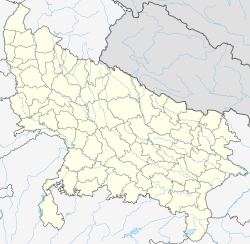  Rakasaha Location of Rakasaha in Uttar Pradesh | |
| Coordinates: 25°26′40″N83°41′14″E / 25.4444496°N 83.6873446°E | |
| Country |  India India |
| State | Uttar Pradesh |
| District | Ghazipur |
| Established | 1585 |
| Founded by | Zamindar Aquif khan |
| Government | |
| • Type | Gram Pradhan |
| • Body | Gram panchayat |
| Area | |
• Total | 1,893.88 ha (4,679.9 acres) |
| • Land | 1,879.766 ha (4,645.00 acres) |
| • Water | 14.114 ha (34.88 acres) |
| Population (2011) | |
• Total | 11,125 |
| • Density | 591.83/km2 (1,532.8/sq mi) |
| Languages_Hindi, Urdu, English, Bhojpuri | |
| • Official | Hindi |
| Time zone | UTC+5:30 (IST) |
| Website | up |
Rakasaha is a village in Kamsaar in the Indian state of Uttar Pradesh. Almost 6500 Kamsaar Pathans (NAWABS) lived in the village as of 2011. [1]
Rakasaha village was established by Mubarak Khan in late 1500ADs. Zamindar Mubarak Khan was a Grandson of Narhar Khan, founder of Dildarnagar kamsar.
The founders were Zamindars (landholders) who held administrative and social power during the late Mughal period. While specific medieval records of Raksaha itself are limited, the broader Ghazipur region was a significant territory during the Sultanate and Mughal eras. Ghazipur’s recorded history goes back to dense ancient forests, ashrams, and early settlements mentioned in regional lore and early travel accounts.
During British colonial rule, rural land administrations and Zamindari Systems influenced Raksaha’s Land Ownership and social structures. The village, like many in Ghazipur, continued as an agrarian society.
After Indian independence in 1947, the zamindari system was gradually abolished, and governance shifted to democratic Panchayati Raj institutions (village councils). The Gram Pradhan (village head) now administers local governance.
It’s known for Sufi heritage, a land of Sufi's in Kamsar which includes Sufis like Sufi Shamsuddin Khan Teghiya, Sufi Tabarak Khan, Sufi Haqique Khan Teghiya, Sufi Qiyamuddin Teghiya & Sufi Rashid Khan Teghiya
The village is sometimes referred to as “Raksaha Sharif” due to its Sufism spiritual importance.
There are two Khanqaah constructed in the memory of Sufi Shamsuddin and Sufi Rashid Teghiya.
Raksaha is the village where first Men Madarsa opened in Kamsar and also later opened Women Madarsa too with full facility accommodations under Maulana Riyaz Khan who is son Sufi Samsuddin Khan. Every year villagers organise Jalsa of Sufi Shamsuddin.
Raksaha is a land where one of the oldest mosque available beside Haji Sohrab Khan Income Tax Officer (former SKBM Manager) house.
That mosque contains very unique history in which some martyrdom graves also available.
Culture, Religion & Local Life
Raksaha is culturally rich and diverse:
Religious Harmony: People of different religions live harmoniously. Major festivals celebrated include Eid, Bakrid, Diwali, Dussehra, and Holi.
Educational Institutions: The village has several primary and secondary schools, including Sun Beam School and Crescent Convent School, contributing to higher literacy levels.
Mosque: Raksaha has an old mosque near the village center that holds historical and cultural significance among locals.
The water tank of the Madrasa also catches the attention of outsiders from far away due to its huge size.
Kohinoor Stadium: A local football ground known for hosting tournaments each year where cricket and volleyball also played.
Before couples of decade this ground is famous for hockey and horse riding too.
Annual Jalsa: Residents organize an annual jalsa (gathering/festival) related to Sufi traditions, attracting people from the region.
The main attraction of Raksaha from North Side is Sun Beam School and from South Side Crescent Convent School. And at both entrance there is main enterance concrete gate welcoming outsiders in Raksaha.
One the way from Dildar Nagar to Raksaha there are two bricks chimney which give a recognization far from many kilometers of this village.
Modern Development & Connectivity:
Connectivity: Regular transport facilities connect Raksaha to nearby towns like Dildarnagar, which is about 3 km away and serves as the nearest hub for economic activities.
Migration: This land is the people of religious faith, humanity, educated, modest, glamorous, advanced culture where all religions people live equally. Majority of Raksaha people works in various fields like farmers, government jobs, engineering, teaching, medicals, sports, advocate and many others.
People of this village are well employees in countries like USA, UK and Australia too that's a proud for villagers. Main festivals of this village is Eid, Bakrid, Diwali, Dussehra and Holi.
