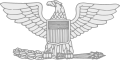
He was promoted to first lieutenant in 1892. He served in various capacities in the Spanish–American War, and in the Philippines from 1902 to 1904. He was made lieutenant colonel in 1906. In 1907, he was special investigator for the U.S. provisional government in Cuba, and the following year was superintendent of public instruction there. In 1911, he was promoted to colonel.[1] He attended the U.S. Army War College from 1911 to 1912.[2]
Bullard's Indians
The 39th Volunteer Infantry was unit of United States Volunteers raised to fight in the Philippine–American War. Bullard was promoted to colonel and given command of the unit. It was nicknamed the "Bullard's Indians" due to the type of tactics the unit employed.[2]
World War I
Major General Bullard (center, facing towards the right), the newly appointed commander of the 1st Division, and members of his divisional staff at Gondrecourt, France, January 17, 1918.
He led his division in the Battle of Cantigny (May 28, 1918) and captured the village of Cantigny. It had been held by the German Eighteenth Army. It was the site of a German advance observation point and strongly fortified. This was the first sustained American offensive of the war. It was considered a success in that it expanded the American front by about a mile.[4] General Pershing said of the attack:
The enemy reaction against our troops at Cantigny was extremely violent, and apparently he was determined at all costs to counteract the most excellent effect the American success had produced. For three days his guns of all calibers were concentrated on our new position and counter-attack succeeded counter-attack. The desperate efforts of the Germans gave the fighting at Cantigny a seeming tactical importance entirely out of proportion to the numbers involved."2
Bullard was fluent in French and often served in joint U.S.–French operations. Due to the success of the Cantigny operation, Bullard was promoted and given command of the newly formed U.S. III Corps in July. His command was put under the French 10th Army and given command of the U.S. 1st and 2nd Division during the Aisne-Marne counter-offensive. Finding his new staff to be inadequate to the task of preparing a corps-level attack on short notice, Bullard made what historian John Eisenhower called a "sensible" and "courageous" (as it invited Pershing's wrath) decision to have the French 20th Corps exercise tactical control of the two U.S. divisions during the Battle of Soissons.[5]
On August 1st, his corps moved to the Vesle area near the Marne river where it assumed command of the U.S. 3rd Division, 28th Division, and 32nd Division. It was during this period that the 32nd and 28th Divisions fought the Battle of Fismes and Fismette (August 3rd-September 1st, 1918), the only notable urban battle for the AEF during World War I.[6] The town of Fismes changed hands five times during the battle. After the fighting concluded, Bullard felt compelled to send a memorandum to Pershing explaining a tragic incident in the battle's final days. Concerned about the exposed nature of the position north of the Vesle River in Fismette, Bullard had ordered the withdrawal of all forces south to Fismes. This order was countermanded by the French general commanding the 6th Army, an order that Bullard reluctantly obeyed. As a result, an entire company in the 28th Division was killed or captured. Bullard considered it "the only accident of my military career".[7]
General John J. Pershing, Major General Robert Lee Bullard and members of Bullard's staff about to leave Chateau Tartigny to attend a review and decoration parade. Tartigny, France, June 30, 1918.
General Pershing created the Second U.S. Army on October 10 and appointed Bullard as its first commander with the temporary rank of lieutenant general. At the same time he turned over command of the U.S. First Army to Lieutenant General Hunter Liggett. Pershing retained his position as commander of the AEF with authority over both of the armies, becoming effectively an army group commander. [8]
Major General Robert Lee Bullard, the newly appointed commander of the U.S. Second Army, pictured here with members of his staff at Second Army's headquarters at Toul, Meurthe-et-Moselle, France, October 20, 1918. On Bullard's left is his chief of staff, Brigadier General Stuart Heintzelman.
Bullard held a low opinion of Black American troops, writing in his diary that they were "hopelessly inferior." Historian Tyler E. Stovall described this view as part of a tradition of white U.S. military officers ascribing any failings on the part of African-American soldiers to "innate racial inadequacies".[9]
Bullard's military actions have also been subject to criticism. In the Battle of Montfaucon, Bullard reportedly refused orders to turn the flank of the German troops with his 4th Division as he did not want to help Major General George H. Cameron, commander of V Corps, get credit for taking the German fortress at Montfaucon.[10] Due to his alleged disobedience or deliberate misinterpretation of orders, the 79th Division, part of Cameron's V Corps, had no support to their right and suffered unnecessarily severe casualties as they performed a frontal attack on the fortress.[11] Additionally, Bullard continued to conduct offensive operations, with full knowledge that the Armistice with Germany was due to take effect in a few hours, was criticized by Alden Brooks in his post-war account of the war, As I Saw It (1930).
The President of the United States of America, authorized by Act of Congress, July 9, 1918, takes pleasure in presenting the Army Distinguished Service Medal to Lieutenant General Robert Lee Bullard, United States Army, for exceptionally meritorious and distinguished services to the Government of the United States, in a duty of great responsibility during World War I. In the course of this war, General Bullard commanded in turn the first American division to take its place in the front lines in France, the 3d Corps, and the Second Army. He participated in operations in reduction of the Marne salient and in the Meuse-Argonne offensive. He was in command of the Second Army when the German resistance west of the Meuse was shattered.[12]
Post war
Bullard (far left) travels to Brazil with Secretary of State Charles Evans Hughes in August 1922.
The Second Army was deactivated in April 1919 and Bullard reverted to his permanent rank of major general in June 1920. He was assigned to corps command in the much smaller post war U.S. Army. He retired from active duty in 1925 to concentrate on writing.[1] He served as last president of the National Security League from 1925 until he disbanded it in 1947.[13]
Bullard wrote American Soldiers Also Fought in 1936.[1][14]
He died on September 11, 1947, at the age of 86.[1] Bullard is buried at the U.S. Military Academy Post Cemetery, with his wife Ella (Reiff) Bullard (5 November 1870 to 3 March 1963).
Writing
He was author of the following books:
Personalities and Reminiscences of the War, New York: Doubleday Page, 1925. ISBN0-7661-9742-5
American Soldiers also Fought, New York: Longmans, Green and Co., 1936. OCLC2854191
Davenport, Matthew J. (2015). First Over There: The Battle of Cantigny, America's First Battle of World War I. Thomas Dunne Books.
Walker, William (2016). Betrayal at Little Gibraltar: A German Fortress, a Treacherous American General, and the Battle to End World War I. Scribner. ISBN978-1-5011-1789-3.
Davis, Henry Blaine Jr. (1998). Generals in Khaki. Raleigh, NC: Pentland Press. ISBN1571970886. OCLC40298151.
Venzon, Anne Cipriano (2013). The United States in the First World War: an Encyclopedia. Hoboken, NJ: Taylor and Francis. ISBN978-1-135-68453-2. OCLC865332376.
↑The Adjutant General's Office, War Department (1926). Official Army Register for 1926(PDF). Washington, D.C.: Government Printing Office. p.688. Retrieved July 22, 2021.
This page is based on this Wikipedia article Text is available under the CC BY-SA 4.0 license; additional terms may apply. Images, videos and audio are available under their respective licenses.