History of the colleges and women's education
Irene Harwarth, Mindi Maline, and Elizabeth DeBra note that "independent nonprofit women's colleges, which included the 'Seven Sisters', were founded to provide educational opportunities to women equal to those available to men and were geared toward women who wanted to study the liberal arts". [12] The colleges also offered broader opportunities in academia to women, hiring many female faculty members and administrators.
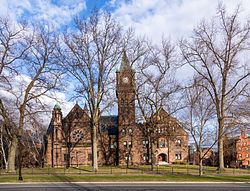
Early proponents of education for women were Sarah Pierce (Litchfield Female Academy, 1792); Catharine Beecher (Hartford Female Seminary, 1823); Zilpah P. Grant Banister (Ipswich Female Seminary, 1828); and Mary Lyon. Lyon was involved in the development of both Hartford Female Seminary and Ipswich Female Seminary. She was also involved in the creation of Wheaton Female Seminary (now Wheaton College, Massachusetts) in 1834. In 1837, Lyon founded Mount Holyoke Female Seminary (Mount Holyoke College). [13] Mount Holyoke received its collegiate charter in 1888 and became Mount Holyoke Seminary and College. It became Mount Holyoke College in 1893. Vassar, however, was the first of the Seven Sisters to be chartered as a college in 1861.
Wellesley College was chartered in 1870 as the Wellesley Female Seminary, and was renamed Wellesley College in 1873. It opened to students in 1875. [14] Smith College was chartered in 1871 and opened its doors in 1875. Bryn Mawr opened in 1885.
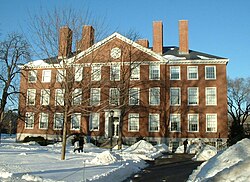
Radcliffe College grew out of the Women's Education Association of Boston, founded by a group of influential women, including Elizabeth Cary Agassiz, whose late husband was a Harvard scientist. Radcliffe College was founded in 1879 and chartered by the Commonwealth of Massachusetts in 1894. It was informally called The Harvard Annex because Harvard professors repeated the lectures they had given to male Harvard students there until 1943. [8] By 1946, the majority of Harvard College courses were offered to both female Radcliffe students and male Harvard students. The schools further integrated in the 1960s, and in 1963 the first Harvard degrees were conferred on Radcliffe women. Despite having joint admissions, women's degrees continued to bear both Harvard and Radcliffe seals until 1999, when the merger of the two schools was completed. Since 1999, all undergraduate students have received diplomas bearing the seal of Harvard College and have been identified as Harvard students. [9] Radcliffe College no longer exists as an undergraduate institution, but Radcliffe class reunions take place at Harvard each year. The Radcliffe Institute for Advanced Study was created following the merger in 1999 and offers non-degree instruction and executive education programs. [15]
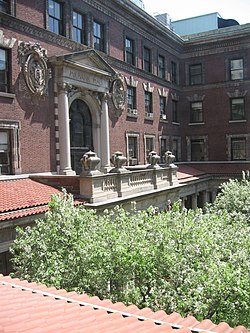
The relationship between Barnard College and Columbia University is governed by an intercorporate agreement that has been periodically updated and renewed since the two institutions first formally affiliated in 1900. [10] The agreement outlines their connections and independence, notably that Barnard’s administration, endowment, operating budget, hiring of faculty and staff, and student enrollment is fully independent of Columbia. The Barnard Bulletin in 1976 described the relationship as "intricate and ambiguous". [16] Barnard president Debora Spar said in 2012 that "the relationship is admittedly a complicated one, a unique one and one that may take a few sentences to explain to the outside community". [17] Outside sources often describe Barnard as part of Columbia; The New York Times in 2013, for example, called Barnard "an undergraduate women's college of Columbia University". [18] Barnard graduates receive Columbia University diplomas signed by both the Barnard and the Columbia presidents.
Coeducation
Radcliffe College and Vassar College are no longer women's colleges. Radcliffe merged completely into Harvard College in 1999 and no longer exists as a separate undergraduate institution. The component parts of its campus, the Radcliffe Quadrangle and Radcliffe Yard, retain the designation "Radcliffe" in perpetuity and serve or house both male and female students to this day. Vassar declined an offer to merge with Yale University and became independently coeducational in 1969, the same year that Yale did. [20]
Barnard College was founded in 1889 as a women's college affiliated with Columbia University. However, it is independently governed, while making available to its students the instruction and the facilities of Columbia University. Columbia College, the university's largest liberal-arts undergraduate school, began admitting women in 1983 after a decade of failed negotiations with Barnard for a merger along the lines of the one between Harvard College and Radcliffe and between Brown and Pembroke. Barnard has an independent faculty (subject to Columbia University tenure approval) and board of trustees. Columbia University issues its diplomas, however, and most of Barnard's classes and activities are open to all members of Columbia University, male or female, and vice versa, in a reciprocal arrangement dating from 1900. [10]
In 1969 Bryn Mawr and Haverford College (then all-male) developed a system of sharing residential colleges. When Haverford became coeducational in 1980, Bryn Mawr discussed the possibility of coeducation as well but decided against it. [21]
As with Bryn Mawr, Mount Holyoke College, Smith College, and Wellesley College decided against adopting coeducation. Mount Holyoke engaged in a lengthy debate under the presidency of David Truman over the issue of coeducation. On November 6, 1971, "after reviewing an exhaustive study on coeducation, the board of trustees decided unanimously that Mount Holyoke should remain a women's college, and a group of faculty was charged with recommending curricular changes that would support the decision." [22] Smith also made a similar decision in 1971. [23] Two years later, Wellesley also announced that it would not adopt coeducation. [24]