
Ceratophyllaceae is a cosmopolitan family of flowering plants including one living genus commonly found in ponds, marshes, and quiet streams in tropical and in temperate regions. It is the only extant family in the order Ceratophyllales. Species are commonly called coontails or hornworts, although hornwort is also used for unrelated plants of the division Anthocerotophyta.
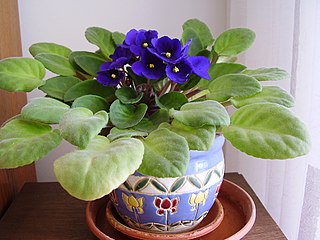
Gesneriaceae, the gesneriad family, is a family of flowering plants consisting of about 152 genera and ca. 3,540 species in the tropics and subtropics of the Old World and the New World, with a very small number extending to temperate areas. Many species have colorful and showy flowers and are cultivated as ornamental plants.

The Bixaceae are a family of dicotyledonous plants commonly called the achiote family. Under the Cronquist system, the family was traditionally placed in the order Violales. However, newer arrangements move it, with some other families previously in the Violales, into the Malvales.

Petrosaviaceae is a family of flowering plants belonging to a monotypic order, Petrosaviales. Petrosaviales are monocots, and are grouped within the lilioid monocots. Petrosaviales is a very small order composed of one family, two genera and four species accepted in 2016. Some species are photosynthetic (Japonolirion) and others are rare, leafless, chlorophyllous, mycoheterotrophic plants (Petrosavia). The family is found in low-light montane rainforests in Japan, China, Southeast Asia and Borneo. They are characterised by having bracteate racemes, pedicellate flowers, six persistent tepals, septal nectaries, three almost-distinct carpels, simultaneous microsporogenesis, monosulcate pollen, and follicular fruit.

Asphodelaceae is a family of flowering plants in the order Asparagales. Such a family has been recognized by most taxonomists, but the circumscription has varied widely. In its current circumscription in the APG IV system, it includes about 40 genera and 900 known species. The type genus is Asphodelus.

Asparagaceae, known as the asparagus family, is a family of flowering plants, placed in the order Asparagales of the monocots. The family name is based on the edible garden asparagus, Asparagus officinalis. This family includes both common garden plants as well as common houseplants. The garden plants include asparagus, yucca, bluebell, and hosta, and the houseplants include snake plant, corn cane, spider plant, and plumosus fern.

Calceolariaceae is a family of flowering plants in the order Lamiales that has been recently segregated from Scrophulariaceae. The family includes three genera, Calceolaria, Porodittia, and Jovellana, but analysis suggests that the monotypic Porodittia should be placed within Calceolaria. Recent molecular phylogenies that included Calceolaria have shown not only that this genus does not belong in Scrophulariaceae but also that it is the sister clade to the majority of the other families of the Lamiales. Morphological and chemical characters also support the separation of Calceolariaceae from Scrophulariaceae and other Lamiales. Some recent studies have supported a sister-group relationship between Calceolariaceae and Gesneriaceae. Given this close relationship, some authors opt to merge this family into Gesneriaceae as subfamily Calceolarioideae

Gesneria is a genus of flowering plants in the family Gesneriaceae. It contains 62 species which are native to islands of the Caribbean. The genus is classified in the tribe Gesnerieae along with the genera Bellonia, Pheidonocarpa, and Rhytidophyllum. Gesneria species are usually woody shrubs or subshrubs, and are unusual in the family in having alternately arranged leaves. A complete list of the accepted species and their synonyms can be found in the Smithsonian Institution's World Checklist of Gesneriaceae.

Sinningia is a genus of flowering plants in the family Gesneriaceae. It is named after Wilhelm Sinning (1792–1874), a gardener of the Botanische Gärten der Friedrich-Wilhelms-Universität Bonn. There are about 65 species of tuberous herbaceous perennials, all occurring in Central and South America, with the greatest concentration of species occurring in southern Brazil.

Peridiscaceae is a family of flowering plants in the order Saxifragales. Four genera comprise this family: Medusandra, Soyauxia, Peridiscus, and Whittonia., with a total of 12 known species. It has a disjunct distribution, with Peridiscus occurring in Venezuela and northern Brazil, Whittonia in Guyana, Medusandra in Cameroon, and Soyauxia in tropical West Africa. Whittonia is possibly extinct, being known from only one specimen collected below Kaieteur Falls in Guyana. In 2006, archeologists attempted to rediscover it, however, it proved unsuccessful.
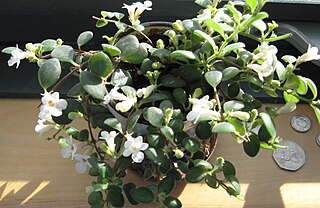
Codonanthe is a genus of mainly epiphytic plants in the family Gesneriaceae, endemic to the Atlantic Forest of Brazil. The botanical name comes from the Ancient Greek for 'bellflower'. They have white or pale pink flowers and somewhat fleshy leaves. In 2013, the genus was reduced in size when more than half of the species were transferred to Codonanthopsis. They can be grown as houseplants, particularly in hanging baskets. Artificial crosses with Nematanthus hybrids have produced the hybrid genus × Codonatanthus.
Sanango is a genus of flowering plants containing a single species, Sanango racemosum. It is a shrub or tree native to Ecuador and Peru.
Lenbrassia australiana, synonym Fieldia australiana, is a species of flowering plant in the family Gesneriaceae. It is the sole species in genus Lenbrassia. It is a small tree native to the tropical rainforests of north-eastern Queensland, Australia.
The Gesnerioideae are a subfamily of plants in the family Gesneriaceae: based on the type genus Gesneria. Although genera typically originate in the New World, some species have become widely distributed as ornamental plants.
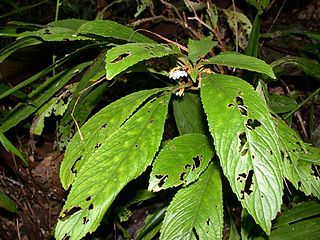
Rhynchotechum is a genus of plants in the family Gesneriaceae, subfamily Didymocarpoideae. Species distribution records are mostly from India, Sri Lanka, China through to southern Japan, Indo-China and Malesia through to New Guinea.
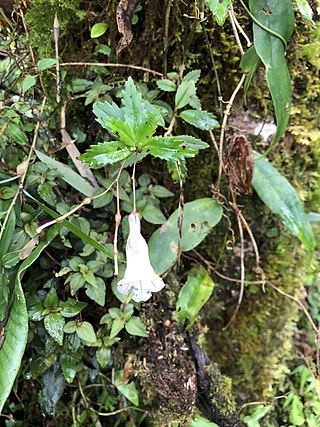
Lysionotus is a genus of flowering plants in the family Gesneriaceae. It occurs in the Himalayas, China, Japan, and Southeast Asia. The genus was described by David Don in 1822.
Tetraphyllum is a genus of flowering plants belonging to the family Gesneriaceae. As of April 2021, there was no consensus as to whether the correct scientific name for the genus is Tetraphyllum or Tetraphylloides, some sources using the former and some the latter.
Lesia is a genus of flowering plants in the family Gesneriaceae, subfamily Gesnerioideae.
Cobananthus is a genus of flowering plants in the family Gesneriaceae, with a single species Cobananthus calochlamys. It is a subshrub native to southern Mexico (Chiapas) and Guatemala. It is sometimes included in the genus Alloplectus, but molecular phylogenetic studies suggest that the two genera are not closely related, with Cobananthus more closely related to Alsobia.
Rufodorsia is a genus of epiphytic flowering plants in the family Gesneriaceae. The genus name refers to the reddish back of the upper lobes of the flower. It is native to montane cloud forest in Central America.

