Ovenbirds or furnariids are a large family of small suboscine passerine birds found from Mexico and Central to southern South America. They form the family Furnariidae. The ovenbird, which breeds in North America, is not a furnariid – rather it is a distantly related bird of the wood warbler family, Parulidae.
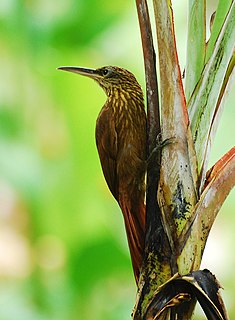
The woodcreepers (Dendrocolaptinae) comprise a subfamily of suboscine passerine birds endemic to the Neotropics. They have traditionally been considered a distinct family Dendrocolaptidae, but most authorities now place them as a subfamily of the ovenbirds (Furnariidae). They superficially resemble the Old World treecreepers, but they are unrelated and the similarities are due to convergent evolution. The subfamily contains around 57 species in 15 to 20 genera.

Automolus is a genus of bird in the family Furnariidae.

The tepui foliage-gleaner, also known as the white-throated foliage-gleaner, is a species of bird in the family Furnariidae. It is found in forest and woodland in the tepuis of Brazil, Guyana and Venezuela.

The typical spinetails, Cranioleuca, are a genus of birds in the family Furnariidae. It may include the straight-billed reedhaunter.

The line-cheeked spinetail is an arboreal species of bird in the family Furnariidae. It is a common species in the Andes in Ecuador and Peru. Its natural habitat is subtropical or tropical moist montane forests, woodland and scrub. It is distinguished from other species by its distribution, behaviour and white supercilium. There are two recognized subspecies, which are in reality a gradient in morphology and plumage from one extreme to the other.
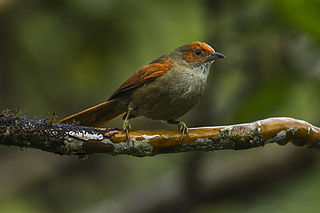
The red-faced spinetail is a species of bird in the family Furnariidae. It is found in Colombia, Costa Rica, Ecuador, and Panama. Its natural habitat is subtropical or tropical moist montane forest.

The stripe-crowned spinetail is a species of bird in the family Furnariidae. It is found in Argentina, Bolivia, Brazil, Paraguay, and Uruguay. Its natural habitats are subtropical or tropical dry forest and subtropical or tropical moist lowland forest. The species shows considerable plumage variation following Gloger's rule. It is known to hybridize with Cranioleuca obsoleta in Southern Rio Grande do Sul, Brazil.
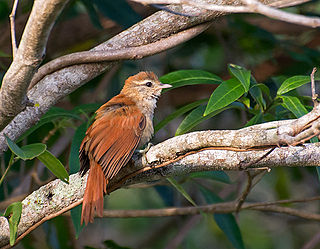
The rusty-backed spinetail is a Neotropical species of bird in the Furnariidae (ovenbird) family. The taxon from Panama is considered a separate species, the Coiba spinetail.

The red-shouldered spinetail is a species of bird in the ovenbird family Furnariidae. It is endemic to the Caatinga region of north-eastern Brazil. It is threatened by habitat loss.

The eastern woodhaunter, also known as the Amazonian woodhaunter, is a species of bird in the family Furnariidae. It was formerly treated as conspecific with the western woodhaunter and when lumped had the name "striped woodhaunter". It is found in the western part of the Amazon rainforest: west Brazil, southeast Colombia, east Ecuador, northeast Peru, south Venezuela and north Bolivia. Its natural habitats are subtropical or tropical moist lowland forests and subtropical or tropical moist montane forests.
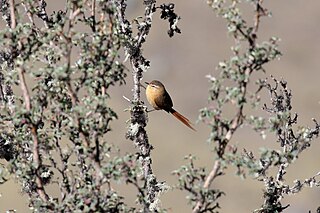
The tawny tit-spinetail is a species of bird in the family Furnariidae. It is found in Peru, Bolivia and far northwestern Argentina.

The curve-billed reedhaunter is a species of bird in the family Furnariidae. It is found marshy areas of north-eastern Argentina, south-eastern Brazil, and Uruguay. It occupies a similar ecological niche to some reed warblers.

The chestnut-winged foliage-gleaner is a species of bird in the family Furnariidae. It is found in Bolivia, Brazil, Colombia, Ecuador, Peru, and Venezuela. Its natural habitat is subtropical or tropical moist lowland forest.

The buff-fronted foliage-gleaner is a species of bird in the family Furnariidae, the ovenbirds. It is found in southeastern regions of South America in the cerrado and pantanal of Brazil and Paraguay as well as areas of southeast coastal Brazil; also extreme northeast Argentina. In western Andean and northwest South America, it is found in Venezuela, Colombia, Ecuador, Peru and Bolivia; and in the northwest, it is also found in Panama and Costa Rica.
The recurvebills are two species of Furnariid birds from the genus Syndactyla. They are restricted to humid forests in the South American countries of Bolivia, Peru and Brazil. Their common name refers to the peculiar bill-shape, which, at least in the case of the larger-billed Peruvian recurvebill, is an adaption for manipulating bamboo stems. Both species are overall rufescent brown. The SACC reclassified the recurvebills from the genus Simoxenops to Syndactyla based on studies from Dewberry (2011).

The great spinetail is a species of bird in the family Furnariidae. It is endemic to Peru where its natural habitat is Mediterranean-type shrubby vegetation. It is threatened by habitat loss.
Thripophaga is the genus of birds that popularly are known as softtails. They are members of the ovenbird family, Furnariidae. They are found in wooded and shrubby habitats, sometimes near water, in South America.

The striated earthcreeper is a species of bird in the family Furnariidae. It is monotypic within Geocerthia, but has traditionally been included in Upucerthia. The two genera are not particularly close. The striated earthcreeper is found in woodland and shrub in the Andean highlands of western Peru.
Poecilurus is an obsolete genus of birds formerly classified in the Furnariidae (ovenbird) family from South America. It contained three species: