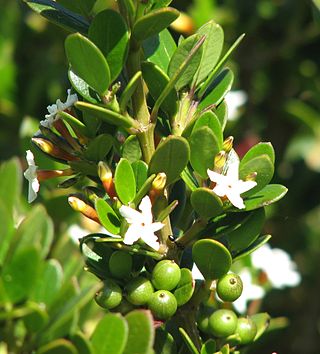
Alyxia is a genus of flowering plants in the family, Apocynaceae. It contains at present 106 species, but Alyxia stellata and A. tisserantii are very variable, might be cryptic species complexes, and are need of further study. It consists of shrubby, climbing or scrambling plants. This genus occurs in China, the Himalayas, Southeast Asia, Australia, New Caledonia and the Pacific Islands. There are 14 species in Australia, 21 in New Caledonia and 7 in the other Pacific Islands, including Hawaiʻi.

Antidesma is a genus of tropical plant in the family Phyllanthaceae formally described by Linnaeus in 1753. It is native to tropical Africa, S + E + SE Asia, Australia, and various oceanic islands. The greatest diversity occurs in Southeast Asia.

Phyllanthus is the largest genus in the plant family Phyllanthaceae. Estimates of the number of species in this genus vary widely, from 750 to 1200. Phyllanthus has a remarkable diversity of growth forms including annual and perennial herbs, shrubs, climbers, floating aquatics, and pachycaulous succulents. Some have flattened leaflike stems called cladodes. It has a wide variety of floral morphologies and chromosome numbers and has one of the widest range of pollen types of any seed plant genus.

Macaranga is a large genus of Old World tropical trees of the family Euphorbiaceae and the only genus in the subtribe Macaranginae. Native to Africa, Australasia, Asia and various islands of the Indian and Pacific Oceans, the genus comprises over 300 different species. It was first described as a genus in 1806, based on specimens collected on the Island of Mauritius.
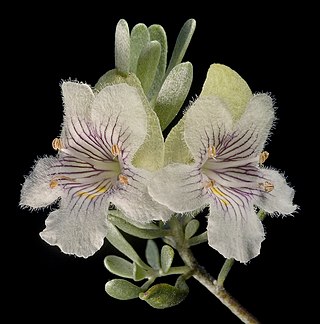
Prostanthera, commonly known as mintbush or mint bush, is a genus of about 100 species of flowering plants in the mint family Lamiaceae, and all are endemic to Australia. Plants are usually shrubs, rarely trees with leaves in opposite pairs. The flowers are arranged in panicles in the leaf axils or on the ends of branchlets. The sepals are joined at the base with two lobes. The petals are usually blue to purple or white, joined in a tube with two "lips", the lower lip with three lobes and the upper lip with two lobes or notched.

Claoxylon is a flowering plant genus in the spurge family, Euphorbiaceae, comprising dioecious subshrubs to small trees. It was first described as a genus in 1824. The genus is distributed in paleotropical areas: Madagascar through South and Southeast Asia, Malesia to Melanesia, Hawaiʻi, and Australia. Half of the species are in Malesia.

Bertya is a genus of plants in the family Euphorbiaceae first described as a genus in 1845. The entire genus is endemic to Australia.

Beyeria is a genus of shrubs and small trees in the family Euphorbiaceae known as turpentine bushes. It was first described as a genus in 1844. The entire genus is endemic to Australia.
Dissiliaria is a genus of plants under the family Picrodendraceae described as a genus in 1867.

Baccaurea is a genus of flowering plants belonging to the family Phyllanthaceae. The genus comprises 51 species, distributed from India to Indochina, southern China, Malesia, New Guinea, and the West Pacific. It is dioecious, with male and female flowers on separate plants. Many species contain edible fruits.

Breynia is a genus in the flowering plant family Phyllanthaceae, first described in 1776. It is native to Southeast Asia, China, Réunion, the Indian Subcontinent, Papuasia and Australia.

Glochidion is a genus of flowering plants, of the family Phyllanthaceae, known as cheese trees or buttonwood in Australia, and leafflower trees in the scientific literature. It comprises about 300 species, distributed from Madagascar to the Pacific Islands. Glochidion species are used as food plants by the larvae of some Lepidoptera species including Aenetus eximia and Endoclita damor. The Nicobarese people have attested to the medicinal properties found in G. calocarpum, saying that its bark and seed are most effective in curing abdominal disorders associated with amoebiasis.
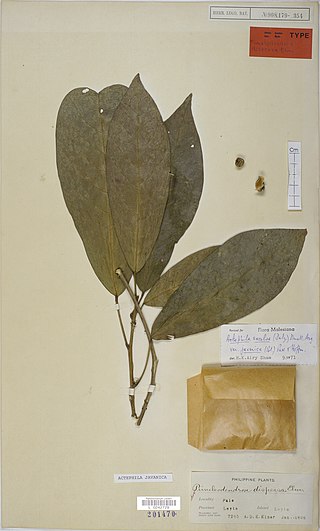
Actephila is a genus of about 36 species of flowering plants in the family Phyllanthaceae native to Southeast Asia, China, the Himalayas, Papuasia and northern Australia. Plants in the genus Actephila are monoecious trees or shrubs with entire leaves that are usually arranged alternately along the branches, flowers arranged singly or in clusters in leaf axils usually with 5 sepals and petals.
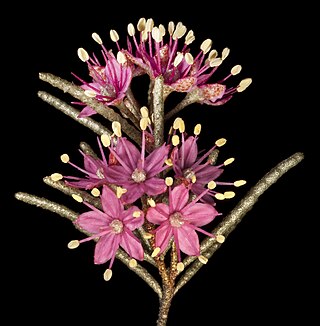
Phebalium is a genus of thirty species of shrubs or small trees in the family Rutaceae and is endemic to Australia. The leaves are arranged alternately, simple and often warty, the flowers arranged singly or in umbels on the ends of branchlets or in leaf axils, usually with five sepals, five petals and ten stamens. There are about thirty species and they are found in all Australian states but not in the Northern Territory.
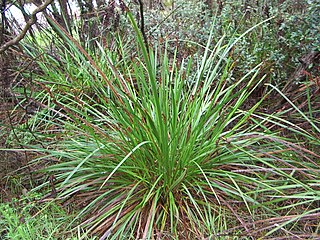
Lepidosperma is a genus of flowering plant of the family Cyperaceae. Most of the species are endemic to Australia, with others native to southern China, southeast Asia, New Guinea, New Caledonia and New Zealand.

