
Tradescantia is a genus of 85 species of herbaceous perennial wildflowers in the family Commelinaceae, native to the Americas from southern Canada to northern Argentina, including the West Indies. Members of the genus are known by many common names, including inchplant, wandering jew, spiderwort, dayflower and trad.

Pinus echinata, the shortleaf pine, is a species of pine native to the southeastern United States.

Tradescantia pallida is a species of spiderwort similar to T. fluminensis and T. zebrina. The cultivar T. pallida 'Purpurea' is commonly called purple secretia, purple-heart, or purple queen. It is native to the Gulf Coast region of eastern Mexico. Edward Palmer collected the type specimen near Ciudad Victoria, Tamaulipas in 1907.

Tradescantia zebrina, formerly known as Zebrina pendula, is a species of creeping plant in the Tradescantia genus. Common names include silver inch plant and wandering Jew. The latter name is controversial, and some now use the alternative wandering dude. The plant is popular in cultivation due to its fast growth and attractive foliage. It is used as a groundcover in warm winter climates, and as a houseplant elsewhere.

Tradescantia fluminensis is a species of spiderwort native to South America. It is one of several plants known by the common name wandering Jew, but now also commonly called wandering trad. It is also known as small-leaf spiderwort, river spiderwort, inch plant, speedy Henry, and wandering willie. The genus is named after the English naturalists and explorers John Tradescant the Elder and John Tradescant the Younger (1608–1662).

Phyllospadix scouleri, or Scouler's surfgrass, is a flowering marine plant in the family Zosteraceae. It is native to the coastline of western North America from the Alaskan panhandle to Baja California.

Cerastium glomeratum is a species of flowering plant in the family Caryophyllaceae known by the common names sticky mouse-ear chickweed and clammy chickweed. It is native to Europe, Macaronesia to Assam but is known on most continents as an introduced species. It grows in many types of habitat. The blooming period is February, March, April, and May.
Coreopsis nuecensis, the crown tickseed, is a North American plant species of Coreopsis in the family Asteraceae. It is native to Texas, Louisiana, and probably Tamaulipas. There are reports of isolated populations in Michigan and Florida, both probably escapes from cultivation.

Tradescantia virginiana, the Virginia spiderwort, is a species of flowering plant in the family Commelinaceae. It is the type species of Tradescantia native to the eastern United States. It is commonly grown in many gardens and also found growing wild along roadsides and railway lines.

Grayia spinosa is a species of the genus Grayia in the subfamily Chenopodioideae of the flowering plant family Amaranthaceae, which is known by the common names hop sage and spiny hop sage. It is widely distributed across the Western United States, where it grows in a number of desert and mountain habitats.

Senecio triangularis, known as arrowleaf ragwort, arrowleaf groundsel and arrowleaf butterweed, is a species of the genus Senecio and family Asteraceae.

Tradescantia ohiensis, commonly known as bluejacket or Ohio spiderwort, is an herbaceous plant species in the genus Tradescantia native to eastern and central North America. It is the most common and widely distributed species of Tradescantia in the United States, where it can be found from Maine in the northeast, west to Minnesota, and south to Texas and Florida. It also has a very small distribution in Canada in extreme southern Ontario near Windsor.

Tradescantia spathacea, the oyster plant, boatlily or Moses-in-the-cradle, is a herb in the Commelinaceae family first described in 1788. It is native to Belize, Guatemala, and southern Mexico but widely cultivated as an ornamental and naturalized in parts of Florida, Texas, Hawaii, and various oceanic islands.
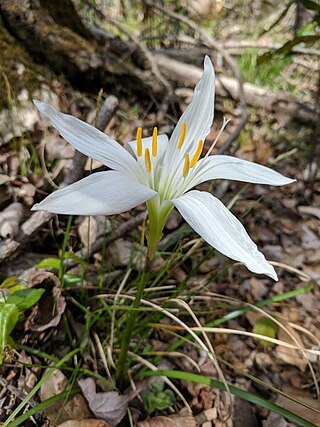
Zephyranthes atamasca, commonly known as the atamasco-lily or more generally a rain-lily, is native to the southeastern United States. It grows in swampy forests and coastal prairies, preferring acid boggy soils rich with leaf mold. Following the appearance of broad, grassy leaves in early winter, it blooms in March or April. It has several narrow, linear basal leaves about 0.5 in (13 mm) wide and 10–15 in (25–38 cm) long. Its native range extends from Florida north to Maryland and west to Mississippi. The species is also naturalized in Bermuda and in the Mariana Islands. Both its leaves and bulbs are poisonous.
Tradescantia buckleyi, commonly known as Buckley's spiderwort, is a species of flowering plant in the dayflower family, Commelinaceae. It is native to southern Texas in the United States as well as northern Tamaulipas in Mexico. The specific name honours Samuel Botsford Buckley (1809-1884), who collected the type specimen near Corpus Christi, Texas.
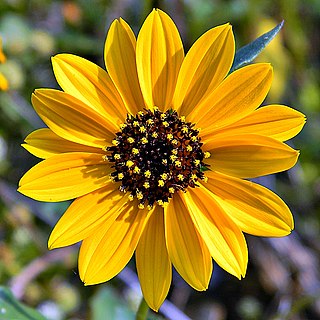
Helianthus debilis is a species of sunflower known by the common names cucumberleaf sunflower, beach sunflower, weak sunflower, and East Coast dune sunflower. It is native to the United States, where it can be found along the Atlantic and Gulf Coasts. It is known elsewhere as an introduced species, such as South Africa, Australia, Taiwan, Slovakia, and Cuba.

Tradescantia longipes, commonly known as the wild crocus, is a perennial herbaceous plant in the dayflower family. It is found only in the Ozark Mountains of southern Missouri and northern Arkansas in the Midwest United States. A spring blooming species, its flowers can be observed from April to May, typically in its preferred habitat of wooded slopes on rocky hillsides. While most other members of the genus in North America have stems reaching at least a few inches above the soil, the flowering shoots of Tradescantia longipes are borne essentially at ground level. This character is shared with some individuals of Tradescantia hirsuticaulis and Tradescantia virginiana, two closely related species, although both typically have obvious stems. Regardless, Tradescantia longipes can be distinguished from the former with its longer pedicels and bracts without fine hairs, and from the latter by the presence of at least some glandular hairs on the sepals. Furthermore, Tradescantia longipes is a tetraploid, meaning it has four sets of chromosomes, while Tradescantia hirsuticaulis is diploid with only two sets. Tradescantia virginiana occurs in both diploid and tetraploid forms, although it is consistently tetraploid where its range overlaps with Trandescantia longipes.

Crassula nudicaulis is a succulent plant native to South Africa, and Lesotho.

Smilax lasioneura, the Blue Ridge carrionflower, is a North American species of flowering plants in the greenbriar family. It is widespread across central Canada and the central United States, from Ontario, Manitoba and Saskatchewan south to Texas, Louisiana, and Florida.

Hypericum hookerianum, or Hooker's St. John's Wort, is a perennial shrub in the flowering plant family Hypericaceae native to eastern and southern Asia. The specific name hookerianum is named for William Jackson Hooker.


