
Hibiscus is a genus of flowering plants in the mallow family, Malvaceae. The genus is quite large, comprising several hundred species that are native to warm temperate, subtropical and tropical regions throughout the world. Member species are renowned for their large, showy flowers and those species are commonly known simply as "hibiscus", or less widely known as rose mallow. Other names include hardy hibiscus, rose of sharon, and tropical hibiscus.

Celtis is a genus of about 60–70 species of deciduous trees, commonly known as hackberries or nettle trees, widespread in warm temperate regions of the Northern Hemisphere. The genus is part of the extended hemp family (Cannabaceae).

Ilex opaca, the American holly, is a species of holly, native to the eastern and south-central United States, from coastal Massachusetts south to central Florida, and west to southeastern Missouri and eastern Texas.

Trema is a genus of about 15 species of evergreen trees closely related to the hackberries (Celtis), occurring in subtropical and tropical regions of southern Asia, northern Australasia, Africa, South and Central America, and parts of North America. They are generally small trees, reaching 10–20 m (33–66 ft) tall.

Dracaena reflexa is a tree native to Mozambique, Madagascar, Mauritius, and other nearby islands of the Indian Ocean. It is widely grown as an ornamental plant and houseplant, valued for its richly coloured, evergreen leaves, and thick, irregular stems.

Carissa spinarum, the conkerberry or bush plum, is a large shrub of the dogbane family (Apocynaceae), widely distributed in tropical regions of Africa, Southern Asia, Australia, and various islands of the Indian Ocean. It is most well known in Australia, where it is also called currant bush or, more ambiguously, native currant or even black currant. It is, however, neither closely related to plums (Prunus) nor to true currants (Ribes), which belong to entirely different lineages of eudicots. In India, it is also called wild karanda /wild karavanda, referring to the related karanda. Carissa spinarum is often discussed under its many obsolete synonyms.

Madhuca longifolia is an Indian tropical tree found largely in the central, southern, north Indian plains and forests, Nepal, Myanmar and Sri Lanka. It is commonly known as madhūka, madkam, mahuwa, Butter Tree, mahua, mahwa, mohulo, Iluppai or vippa chettu. It is a fast-growing tree that grows to approximately 20 meters in height, possesses evergreen or semi-evergreen foliage, and belongs to the family Sapotaceae. It is adaptable to arid environments, being a prominent tree in tropical mixed deciduous forests in India in the states of Odisha, Chhattisgarh, Jharkhand, Uttar Pradesh, Bihar, Maharashtra, Andhra Pradesh, Madhya Pradesh, Kerala, Gujarat, West Bengal and Tamil Nadu.

Correa alba, commonly known as white correa, is a species of shrub that is endemic to south-eastern Australia. It has egg-shaped to more or less circular leaves, erect white flowers arranged singly or in groups on short side branches, and green fruit.

Banksia neoanglica, commonly known as New England banksia is a shrub or small tree with leaves that are greenish on the upper surface, whitish with soft hairs on the lower side and spikes of flowers with styles that turn black as they open. It is similar to Banksia spinulosa and was formerly known as Banksia spinulosa var. neoanglica, but differs in that its leaves are wider and have margins that are not tightly turned under. It is found mainly along the eastern edge of the Great Dividing Range.

Crinum asiaticum, commonly known as poison bulb, giant crinum lily, grand crinum lily, or spider lily, is a plant species widely planted in many warmer regions as an ornamental. It is a bulb-forming perennial producing an umbel of large, showy flowers that are prized by gardeners. However, all parts of the plant are poisonous if ingested. Some reports indicate exposure to the sap may cause skin irritation.
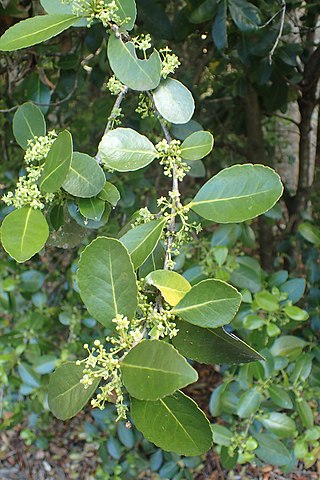
Elaeodendron australe, commonly known as red olive-berry, red-fruited olive plum, or blush boxwood, is a species of flowering plant in the family Celastraceae and is endemic to eastern Australia. It is a shrub or small tree with egg-shaped to oblong leaves with a wavy margin, yellowish green male and female flowers on separate plants and fleshy orange-red fruit.

Trema tomentosa var. viridis is a forest plant. In Australia it occurs from Twofold Bay in New South Wales to far northern Queensland, New Guinea and West Papua (Indonesia). It had been recorded near Mallacoota, but is now presumed extinct in the state of Victoria.

Trema orientale is a species of flowering tree in the hemp family, Cannabaceae. It is known by many common names, including charcoal-tree, Indian charcoal-tree, pigeon wood, Oriental trema, and in Hawaii, where it has become naturalized, gunpowder tree, or nalita. It has a near universal distribution in tropical and warm temperate parts of the Old World, with a range extending from South Africa, through the Middle East, the Indian subcontinent and southern China to Southeast Asia and Australia.

Olearia tomentosa, commonly known as the toothed daisy-bush, is a species of flowering plant in the family Asteraceae and is endemic to south-eastern continental Australia. It is a spreading shrub with egg-shaped leaves, the edges toothed or lobed, and blue or white and yellow, daisy-like inflorescences.
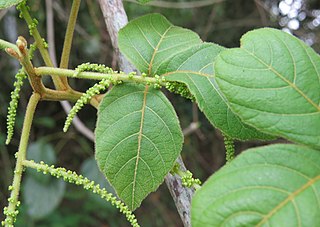
Allophylus cobbe, commonly known as titberry or Indian allophylus, is a pantropical, shrub in the family Sapindaceae with many uses in traditional medicine. It has a highly variable morphology throughout its range and may prove to be more than one species.

Clerodendrum floribundum, known as the lolly bush or smooth clerodendrum, is a shrub or tree found in Australia and New Guinea. The habitat is in or at the margins of coastal rainforests, up to 300 metres above sea level. In Western Australia it grows in drier areas; such as rocky sites, gorges, cliffs, floodplains and creek beds.

Persoonia juniperina, commonly known as prickly geebung, is a species of flowering plant in the family Proteaceae and is endemic to south-eastern Australia. It is a small erect to low-lying shrub with smooth bark, hairy new branches, linear leaves, yellow flowers borne singly or in groups of up to forty in leaf axils, and yellowish green to purplish fruit.

Ehretia saligna, commonly known as peach bush, native willow and peachwood is a species of shrubs or small trees, endemic to Northern Australia. The natural range extends from the Gascoyne, across the Northern Territory throughout northern Queensland and coastal; regions of Southern Queensland and New South Wales.
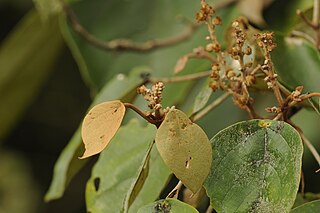
Mallotus tetracoccus, also known as the rusty kamala, is a species of flowering plant in the family Euphorbiaceae. It is a tree species found in parts of south Asia, typically occurring in the edges of tropical wet evergreen and semi-evergreen forests.

Casearia tomentosa, commonly known as the toothed leaf chilla, is a species of flowering plant in the family Salicaceae, native to the Indian Subcontinent and Myanmar. It is one of 1,000 species that can be found in the Salicaeceae family. Casearia tomentosa has various phytochemical and pharmacological properties that are used in the treatment of many illnesses. It is most notable used in the treatment of seafood poisoning, diabetes, ringworm, and snake bites. Other common names include Bhari, Maun, Churcha, Sonne bethe, and Kakoli based on the region where it is found.

