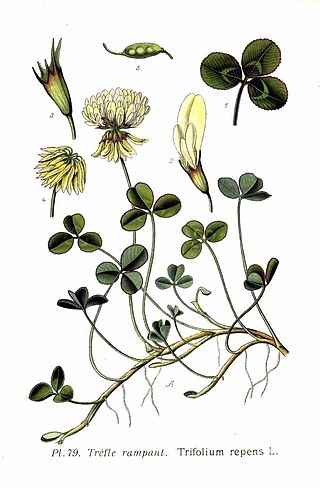
Clovers, also called trefoils, are plants of the genus Trifolium, consisting of about 300 species of flowering plants in the legume family Fabaceae originating in Europe. The genus has a cosmopolitan distribution with the highest diversity in the temperate Northern Hemisphere, but many species also occur in South America and Africa, including at high altitudes on mountains in the tropics.
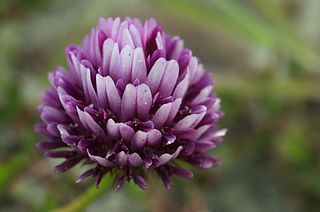
Trifolium wormskioldii is a species of clover native to the western half of North America. Its common names include cows clover, coast clover, sand clover, seaside clover, springbank clover, and Wormskjold's clover.

Trifolium amoenum, known by the common names showy Indian clover and two-fork clover, is endemic to California, and is an endangered annual herb that subsists in grassland areas of the San Francisco Bay Area and the northern California Coast Ranges.
Erythronium pluriflorum is a rare species of flowering plant in the lily family Liliaceae which is known by the common names manyflower fawn lily,golden fawn-lily, and Shuteye Peak fawn lily.

Melilotus indicus, sometimes incorrectly written Melilotus indica, is a yellow-flowered herb native to northern Africa, Europe and Asia, but naturalized throughout the rest of the world.

Trifolium cyathiferum is a species of clover known by the common names cup clover and bowl clover.

Trifolium trichocalyx is a species of clover known by the common name Monterey clover.
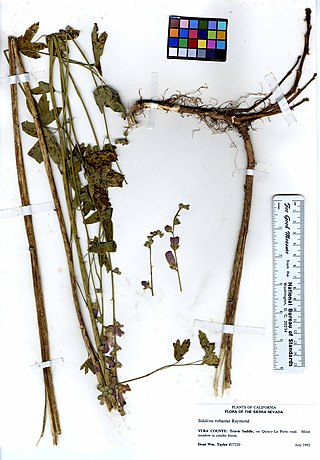
Sidalcea robusta is an uncommon species of flowering plant in the mallow family known by the common name Butte County checkerbloom.
Trifolium beckwithii is a species of clover known by the common name Beckwith's clover.
Trifolium bolanderi is a species of clover known by the common names Bolander's clover and parasol clover.

Trifolium depauperatum is a species of clover known by the common names cowbag clover, poverty clover, and balloon sack clover.

Trifolium eriocephalum is a species of clover known by the common name woollyhead clover or hairy head clover.

Trifolium gracilentum is a species of clover known by the common names pinpoint clover and slender clover. It is native to western North America including the west coast of the United States and northwestern Mexico, where it grows in many types of habitat, including disturbed areas. It is an annual herb growing prostrate to erect in form with mostly hairless or slightly hairy herbage. The leaves are made up of lance-shaped to oval leaflets. The inflorescence is an umbel of flowers that spread out or flex downward. The flowers have pink or purple corollas less than a centimeter long.
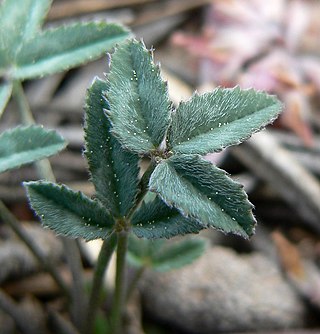
Trifolium gymnocarpon is a species of clover known by the common name hollyleaf clover.
Trifolium lemmonii is a species of clover known by the common name Lemmon's clover.

Trifolium longipes is a species of clover known by the common name longstalk clover. It is native to the western United States, where it occurs in many types of habitats such as meadows, valleys, lower mountains, and subalpine slopes. There are many subspecies and varieties which exist in different regions and differ slightly in appearance. In general, it is a perennial herb with leaves made up of 2 to 5 leaflets which vary in shape. The inflorescence is a head of flowers up to 3 centimeters wide with white to purplish or bicolored corollas.

Trifolium macrocephalum is a species of clover known by the common name largehead clover or bighead clover native to the Great Basin region of the western United States.

Trifolium microcephalum is a species of clover known by the common names smallhead clover and small-headed clover.
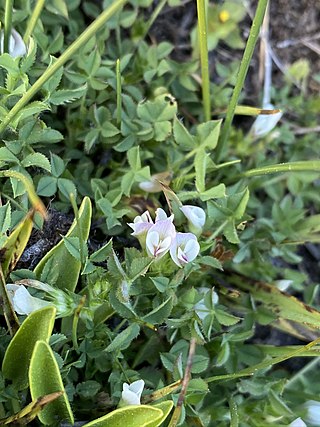
Trifolium monanthum is a species of clover known by the common name mountain carpet clover.

Trifolium variegatum is a species of clover known by the common name whitetip clover. It is native to western North America from southern Alaska and British Columbia to Baja California, where it occurs in many types of habitat.


