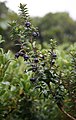
Psidium is a genus of trees and shrubs in the family Myrtaceae. It is native to warmer parts of the Western Hemisphere.

Baco blanc or Baco 22A is a French-American hybrid grape variety. It is a cross of Folle blanche and the Noah grape, created in 1898 by the grape breeder François Baco. Folle blanche is its Vitis vinifera parent. Noah, its other parent, is itself a cross of Vitis labrusca and Vitis riparia.

Trebbiano is an Italian wine grape, one of the most widely planted grape varieties in the world. It gives good yields, but tends to yield undistinguished wine. It can be fresh and fruity, but does not keep long. Also known as ugni blanc, it has many other names reflecting a family of local subtypes, particularly in Italy and France. Its high acidity makes it important in Cognac and Armagnac productions.

Schinus is a genus of flowering trees and tall shrubs in the sumac family, Anacardiaceae. Members of the genus are commonly known as pepper trees. The Peruvian pepper tree is the source of the spice known as pink peppercorn.
Armagnac is a distinctive kind of brandy produced in the Armagnac region in Gascony, southwest France. It is distilled from wine usually made from a blend of grapes including Baco 22A, Colombard, Folle blanche and Ugni blanc, traditionally using column stills rather than the pot stills used in the production of cognac, which is made predominantly from ugni blanc grapes. The resulting spirit is then aged in oak barrels before release. Production is overseen by the Institut national de l'origine et de la qualité (INAO) and the Bureau National Interprofessionel de l'Armagnac (BNIA).

Ugni molinae, commonly known as Chilean guava berry, or strawberry myrtle, is a shrub native to Chile and adjacent regions of southern Argentina. The local Spanish name is murta, and the Mapuche Native American name is "Uñi" or Uñiberry. It is in the same botanical family as the guava, in Myrtaceae.

Lomatia is a genus of 12 species of evergreen flowering plants in the protea family Proteaceae. Within the family, they have been placed, alone, in their own subtribe, Lomatiinae according to Johnson & Briggs 1975 classification of the family and subsequently in Flora of Australia (1995).
Ugni is a genus of plants in the myrtle family Myrtaceae, described as a genus in 1848. It is native to western Latin America from the Valdivian temperate rain forests of southern Chile and adjacent regions of southern Argentina, north to southern Mexico.

Plinia is a genus of flowering plants in the myrtle family, Myrtaceae described by Linnaeus in 1753. It is native to Central and South America as well as the West Indies.

The following outline is provided as an overview of and topical guide to South America.

Guyana, officially the Co-operative Republic of Guyana, is a country on the northern mainland of South America. Guyana is an indigenous word which means "Land of Many Waters". The capital city is Georgetown. Guyana is bordered by the Atlantic Ocean to the north, Brazil to the south and southwest, Venezuela to the west, and Suriname to the east. With a land area of 215,000 km2 (83,000 sq mi), Guyana is the third-smallest sovereign state by area in mainland South America after Uruguay and Suriname, and is the second-least populous sovereign state in South America after Suriname; it is also one of the least densely populated countries on Earth. It has a wide variety of natural habitats and very high biodiversity.
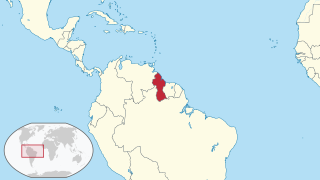
The following is an alphabetical list of topics related to the Co-operative Republic of Guyana.
The people of Guyana, or Guyanese, come from a wide array of backgrounds and cultures including aboriginal natives, also known as Amerindians, those of Indian and African origins, as well as a minority of Chinese and European descendant peoples. Demographics as of 2012 are Indian 39.8%, Afro-Guyanese 30.1%, mixed race 19.9%, Amerindian 10.5%, other 1.5%.

Rotheca myricoides is a species of flowering plant in the family Lamiaceae. It is native to Africa and widely cultivated elsewhere. In cultivation, it is frequently known by one of its synonyms, such as Clerodendrum myricoides.

The Embassy of the Co-operative Republic of Guyana to the United States of America is located at 2490 Tracy Place, NW, Washington, DC. The Permanent Mission of Guyana to the Organization of American States (OAS) is also located there. The Embassy of Guyana was established in 1966, and the Permanent Mission in 1991.

Lomatia myricoides, commonly known as the river lomatia, is a shrub native to New South Wales and Victoria in southeastern Australia.

Ugni candollei is a species of shrub, 80 cm in height, with white, 5-petal flowers, endemic to Chile. Its fruit is edible, and is used by natives to make a chicha. It is reported to be an oneirogen.

Mohamed Irfaan Ali is a Guyanese politician serving as the tenth and current president of Guyana since 2020. A member of the People's Progressive Party/Civic (PPP/C), he previously served as the minister of Housing and Water from 2009 to 2015. He is the first Muslim to hold office, and is the second Muslim head of state in the Americas after Noor Hassanali of Trinidad and Tobago.

Salix myricoides, the bayberry willow or blue-leaf willow, is a species of flowering plant in the family Salicaceae, native to the Great Lakes region of the Midwestern United States, and to eastern Canada. It is typically found on beaches and dunes of the Lakes, and occasionally along inland streams and in fens, if calcareous. For example, in Maine it is found only on the ice-scoured shore of the St. John River.