The Romualdo Formation is a geologic Konservat-Lagerstätte in northeastern Brazil's Araripe Basin where the states of Pernambuco, Piauí and Ceará come together. The geological formation, previously designated as the Romualdo Member of the Santana Formation, named after the village of Santana do Cariri, lies at the base of the Araripe Plateau. It was discovered by Johann Baptist von Spix in 1819. The strata were deposited during the Albian stage of the Early Cretaceous in a lacustrine rift basin with shallow marine incursions of the proto-Atlantic. At that time, the South Atlantic was opening up in a long narrow shallow sea.

The Ischigualasto Formation is a Late Triassic fossiliferous formation and Lagerstätte in the Ischigualasto-Villa Unión Basin of the southwestern La Rioja Province and northeastern San Juan Province in northwestern Argentina. The formation dates to the Carnian age and ranges between 231.7 and 225 Ma, based on ash bed dating.
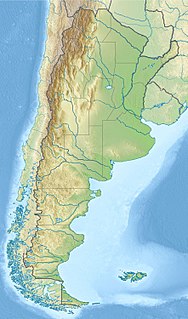
The Río Colorado Subgroup, formerly named as Río Colorado Formation, is a Late Cretaceous geologic subgroup of the Neuquén Basin in northern Patagonia, Argentina. It belongs to the Neuquén Group and contains the Anacleto and Bajo de la Carpa Formations. The subgroup overlies the Río Neuquén Subgroup and is overlain by the Allen Formation of the Malargüe Group, separated by an unconformity dated to 79 Ma. Dinosaur remains diagnostic to the genus level are among the fossils that have been recovered from the formation.

The Echkar Formation is a geological formation comprising sandstones and claystones in the Agadez Region of Niger, central Africa.
The Farak Formation is a geological formation in Niger, central Africa.

The Asencio Formation is a geological formation in the Paraná Basin of southwestern Uruguay whose strata date back to the Late Cretaceous (Campanian-Maastrichtian). Dinosaur remains are among the fossils that have been recovered from the formation.
The Río Limay Subgroup is a geological unit of the Neuquén Group in the Neuquén Basin of Neuquén, Mendoza and Río Negro Provinces, northern Patagonia, Argentina. The strata date back to the Late Cretaceous (Early Cenomanian to Early Turonian. The Río Limay Subgroup overlies the Lohan Cura Formation, separated by an unconformity dated to 98 Ma. Dinosaur remains are among the fossils that have been recovered from the formations it contains.
The Wadi Milk Formation is a geological formation in Sudan whose strata date back to the Late Cretaceous. Originally, the formation was thought to be Albian to Cenomanian, later research has provided dating to the Campanian to Maastrichtian. Dinosaur remains are among the fossils that have been recovered from the formation. It stretches from the lower Wadi Al-Malik across the Wadi Muqaddam into the Bayuda Desert.

The Chota Formation is an Early Campanian to Late Eocene geologic formation of the Cajamarca and western Amazonas Region in northern Peru. Dinosaur remains are among the fossils that have been recovered from the formation, although none have yet been referred to a specific genus. The formation was formerly named Bagua Formation.
The Chico Formation is a geologic formation of the Campanian Age during the Cretaceous Period, found in California and southern Oregon.
The Yacoraite Formation is a largely Mesozoic geologic formation. The deposits of this formation mainly date from the Maastrichtian of the Upper Cretaceous, but the Cretaceous–Paleogene boundary runs right through this formation near its top, and the uppermost parts are consequently from the Danian. It was probably deposited around the intertidal zone, as the sedimentary rocks of this formation alternate according to sea level changes between deposits of muddy beaches and of shallow ocean.
The Cardiel Formation is a Maastrichtian geologic formation of the Austral Basin in Santa Cruz Province, Argentina. The formation comprises sandstones and conglomerates with abundant tuff beds. The formation is overlain by the Slogget and San Julián Formations and overlies the Divisadero and Kachaike Formations. Dinosaur remains diagnostic to the genus level are among the fossils that have been recovered from the formation.
The Laguna Palacios Formation is a Maastrichtian geologic formation of the Chubut Group in the Golfo San Jorge Basin in Patagonia, Argentina. The formation partly overlies and partly is laterally equivalent to the Lago Colhué Huapí Formation and is overlain by the Salamanca Formation of the Río Chico Group. The formation comprises tuff reworked by fluvial activity and paleosols. The Laguna Palacios Formation has provided fossilized bee nests. Dinosaur remains diagnostic to the genus level are among the fossils that have been recovered from the formation.
The El Jume Formation is an Early Cretaceous geologic formation in Argentina. Indeterminate fossil dinosaur tracks have been reported from the formation. The formation, belonging to the El Gigante Group, overlies the Los Riscos Formation and is overlain by the El Toscal Formation. The sandstones and claystones of the formation were deposited in a fluvial environment. Part of the formation was assigned to a new formation, Balde de Leyes Formation in 2015.

The Baños del Flaco Formation is a Late Jurassic to Early Cretaceous (Tithonian to Berriasian geologic formation in central Chile. The formation comprises limestones and sandstones deposited in a shallow marine to fluvial environment. Fossil ornithopod tracks have been reported from the formation.

The Caiuá Formation is an Early Cretaceous geologic formation in Brazil and Paraguay. Fossil theropod tracks have been reported from the formation. The formation, the lowermost unit of the Bauru Group, was deposited in the Barremian and Aptian epochs of the Early Cretaceous, around 130 to 120 Ma. The formation is unconformably overlain by the Santo Anastácio Formation and the unconformity probably represents the start of the opening of the South Atlantic and the formation of the Santos Basin.

The Cazaderos Formation is an Albian geologic formation in southern Ecuador. Fossil theropod tracks of 9 centimetres (3.5 in) in size, have been reported from the formation at the Puyango River tracksite.
The La Cantera Formation is a Late Aptian, geologic formation in Argentina. Fossil theropod tracks have been reported from the formation. The formation, deposited under lacustrine conditions, also has provided fossil plants, insects, fish and gastropods.
The Los Rastros Formation is a Ladinian to Carnian fossiliferous formation of the Agua de la Peña Group in the Ischigualasto-Villa Unión Basin in northwestern Argentina. Fossil theropod tracks, as well as many insects, fossil fish of Myriolepis, bivalves and crustaceans and flora have been reported from the formation.

The Valle de Ángeles Group is a geologic group in Honduras. It preserves fossils dating back to the Late Albian to Early Turonian stages of the Cretaceous period.