
Verbena, also known as vervain or verveine, is a genus in the family Verbenaceae. It contains about 150 species of annual and perennial herbaceous or semi-woody flowering plants. The majority of the species are native to the Americas and Asia; however, Verbena officinalis, the common vervain or common verbena, is the type species and native to Europe.

Robinia neomexicana, the New Mexican, New Mexico, Southwest, desert, pink, or rose locust, is a shrub or small tree in the subfamily Faboideae of the family Fabaceae.

Heuchera is a genus of largely evergreen perennial plants in the family Saxifragaceae. All species are native to North America except for Heuchera sichotensis, native to the Russian Far East. Common names include alumroot and coral bells.
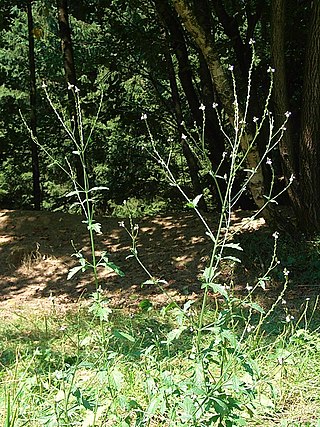
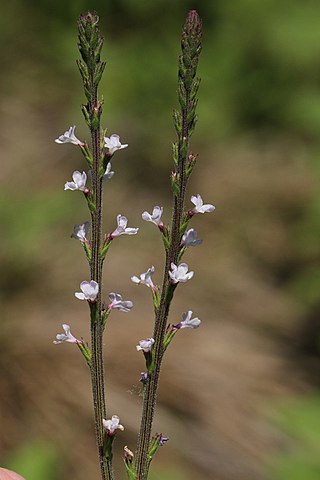
Verbena officinalis, the common vervain or common verbena, is a perennial herb native to Europe. It grows up to 70 cm high, with an upright habitus. The lobed leaves are toothed, and the delicate spikes hold clusters of two-lipped mauve flowers.

Verbena brasiliensis, the Brazilian verbena or Brazilian vervain, is a flowering plant species from the vervain family (Verbenaceae). It is native to parts of South America, namely Brazil, but has spread its range in recent times and has occasionally become an invasive weed. It is an annual plant with purple flowers, and it has been introduced outside of its native range as an ornamental plant, and is now largely considered an invasive weed in these regions.

Verbena bonariensis, the purpletop vervain, clustertop vervain, Argentinian vervain, tall verbena or pretty verbena, is a member of the verbena family cultivated as a flowering annual or herbaceous perennial plant. In USA horticulture, it is also known by the ambiguous names purpletop and South American vervain. For the misapplication "Brazilian verbena" see below.

Verbena urticifolia, known as nettle-leaved vervain or white vervain, is a herbaceous plant in the vervain family (Verbenaceae). It belongs to the "true" vervains of genus Verbena.

Verbena hastata, commonly known as American vervain, blue vervain, simpler's joy, or swamp verbena, is a perennial flowering plant in the vervain family Verbenaceae. It grows throughout the continental United States and in much of southern Canada.
Verbena californica is a rare species of verbena known by the common names California vervain and Red Hills vervain. This flower is endemic to Tuolumne County, California, where it is known from ten or eleven occurrences in the Red Hills, a section of the Sierra Nevada foothills near Chinese Camp. It grows in moist woodland habitat, often on serpentine soils. It is a federally listed threatened species of the United States.

Verbena bracteata is a species of verbena known by the common names bracted vervain, bigbract verbena, prostrate vervain, and carpet vervain. It is native to North America where it is widespread, occurring throughout the continent except for northern Canada and southern Mexico. It occurs in many types of habitat, especially disturbed areas. It typically blooms between the months of May and October. This annual or biennial herb produces several hairy, spreading stems up to 30 centimeters long forming a low mat on the ground. The hairy leaves are toothed or lobed. The inflorescence is a spike of flowers which is dense with long, pointed, leaflike bracts each up to 8 millimeters long. Each small tubular flower is about half a centimeter wide and white to pale purple in color.

Verbena gooddingii, commonly known as southwestern mock vervain, is a species of flowering plant in the verbena family. It is native to the southwestern United States and northern Mexico, where it occurs in sandy and rocky desert habitat.
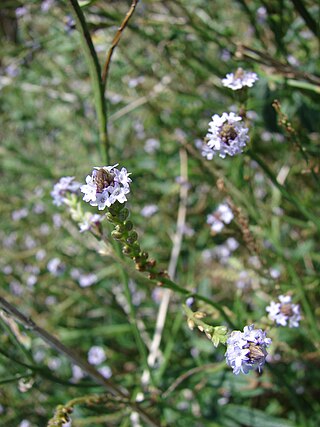
Verbena litoralis is a species of verbena known by the common names seashore vervain and Brazilian vervain, and in Hawaiian, ōwī. It is native to the Americas from Mexico south through Central and South America to Argentina and Chile. It is present throughout the world as an introduced species and in some areas a noxious weed. It is naturalized in the contiguous United States, Puerto Rico, Hawaii, Italy, Spain, South Africa, Mauritius, the Galápagos Islands, Australia, Easter Island, French Polynesia, Japan, New Zealand, and other places. It grows in many types of habitat, including disturbed and cultivated areas.

Verbena tenera, commonly known as South American mock vervain, is a species of flowering plant in the verbena family. It is native to Brazil, Argentina, and Uruguay, and it is present elsewhere as an introduced species and roadside weed. It is an annual or perennial herb producing one or more stems growing decumbent to erect in form and hairy to hairless in texture. The rough-haired leaves are divided deeply into lobes. The inflorescence is a dense, headlike spike of many flowers up to 1.5 centimeters wide. Each flower corolla is up to 1.4 centimeters wide and white to purple in color.

Verbena stricta, also known as hoary verbena or hoary vervain, is a small purple wildflower native to a large region of the central United States.
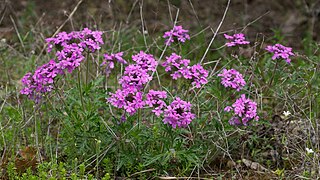
Verbena canadensis, commonly known as rose mock vervain, rose verbena, clump verbena or rose vervain is a perennial herbaceous flowering plant in the verbena family (Verbenaceae) with showy pink to purple flowers.. It is native to the eastern and south-central areas of the United States. This species is widely cultivated as an ornamental, and naturalized populations have been established outside its native range, such as in the northeastern U.S.
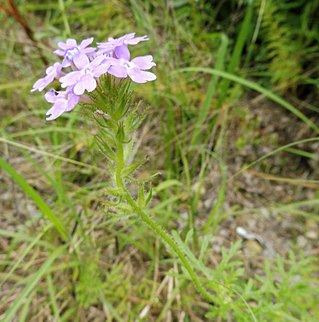
Verbena bipinnatifida, commonly called Dakota mock vervain, prairie verbena, and Moradilla, among others, is a species of flowering plant in the verbena family Verbenaceae.
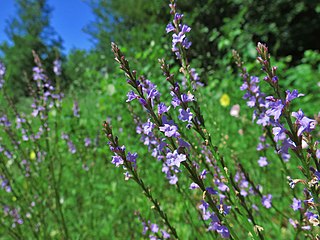
Verbena halei, commonly known as Texas vervain, Texas verbena, or slender verbena, is a flowering plant in the vervain family, Verbenaceae. It is native to much of the southern United States and Mexico. Scattered populations have been found along the east coast, and its range stretches south to Florida, west to Arizona, and throughout most of Mexico. It is a perennial shrub and grows in thickets and woodland borders. Flowers bloom March to June. It has been introduced to Australia, in Queensland, New South Wales, Victoria, and South Australia.
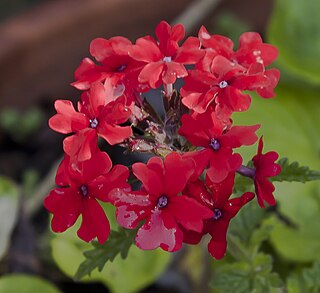
Verbena peruviana, the Peruvian mock vervain, is a species of flowering plant in the family Verbenaceae. It is native to Bolivia, southern Brazil, northern Argentina, Paraguay, and Uruguay, but not Peru, and has been introduced to scattered locations elsewhere, including the former Czechoslovakia, the US state of Illinois, and the Leeward Islands. Under the synonym Glandularia peruviana, its cultivar 'Balendpibi' has gained the Royal Horticultural Society's Award of Garden Merit.

Verbena aristigera, variously called the moss verbena, desert verbena, fine leafed verbena, wild verbena, tuber vervain, South American mock vervain, Mayne's curse and Mayne's pest, is a species of flowering plant in the family Verbenaceae. It is native to Bolivia, southern Brazil, northern Argentina, Paraguay and Uruguay. It has been widely introduced to the rest of the world's drier tropics and subtropics, including California, Guatemala, Honduras, Nicaragua, Venezuela, Greece, Nigeria, eastern and southern Africa, India, and all of Australia except Tasmania.

